Aluminium Corrosion: Why a Salt Spray Number Is a Ranking, Not a Life
Aluminium does not rust, and that comfortable fact has done more damage to specifications than almost any other. It corrodes by different mechanisms, in different places, and the test that everyone quotes is not a prediction of anything.
Short answer
Aluminium does not rust because rust is iron oxide and there is no iron in it. It corrodes instead through a set of mechanisms that look different and happen in different places: pitting in chloride, galvanic attack where it touches a more noble metal, crevice attack in a gap, filiform corrosion under a coating, and alkaline attack wherever the environment is above roughly pH 9. Its natural protection is a thin oxide layer, and that layer is amphoteric, so both acids and strong alkalis destroy it. On top of that, the salt spray test that appears in every datasheet — ASTM B117 or ISO 9227 — explicitly makes no prediction of service life. A salt spray result ranks two finishes against each other under one arbitrary condition; it does not tell you how many years a profile will last in a real environment, and treating it as a life figure is the most common corrosion mistake in procurement.
Aluminium does not rust, and that is not the same as not corroding
Rust is a specific product: hydrated iron oxide, formed when iron is oxidised in the presence of water. Aluminium contains no iron, so it cannot form rust. What aluminium does form is a thin, adherent oxide layer, a few nanometres thick, which grows almost instantly in air and then protects the metal beneath it by sealing it off.
That layer is the reason aluminium performs so well outdoors, and it is also the reason aluminium corrosion is under-estimated. Steel corrodes visibly and generally: the rust flakes, exposes fresh metal, and the damage is obvious. Aluminium corrodes locally and quietly. A pit can be a millimetre deep while the surface around it still looks bright, and the failure is discovered when the section is measured or when a fastener pulls out.
The other difference is repairability. Aluminium’s oxide layer is self-healing in air, so a scratch on a mill-finish profile usually recovers. That is a genuine advantage, and it is also why an anodised or coated surface behaves differently: the protective layer there is engineered, and once it is breached the underlying metal is on its own.
The protective layer has a pH window, and both acids and alkalis break it
Aluminium oxide is amphoteric, meaning it reacts with both acids and bases. The practical consequence is a stability window: the oxide layer is stable over a pH range of roughly 4 to 9, and outside that range it dissolves. This single fact explains most of the surprising corrosion failures on aluminium.
On the alkaline side, the offenders are common. Wet concrete and cement dust sit well above pH 9, which is why an aluminium profile cast into a concrete kerb without a separation layer corrodes. Many industrial and cleanroom cleaning agents are alkaline by design, because alkalinity is effective against organic soil, and a daily high-pH wipe will strip an anodic layer over months. On the acid side, the offenders are more specialised but no less real: some process chemicals, some food products, and some acidic cleaning agents used in food and beverage plants.
So the environment has to be specified as a chemistry, not as a description. Coastal is not a sufficient answer; the question is what else touches the profile, and at what pH.
| Environment or detail | Mechanism | Control |
|---|---|---|
| Chloride, marine or de-icing | Pitting, because chloride breaks down the oxide locally | Specify an anodic class or coating, and plan an inspection interval |
| Aluminium against stainless or steel | Galvanic couple, with the aluminium as the anode | Isolate the joint, or keep the aluminium area large |
| Wet concrete or cement dust | Alkaline attack above about pH 9 | A separation layer, or a coating that tolerates alkalinity |
| Alkaline cleaning agents | Progressive dissolution of the oxide layer | Put the cleaning chemistry in the specification |
| Open slots and lap joints | Crevice attack where the environment differs from the bulk | Seal or cover the gap, and avoid stagnant pockets |
| Coated surfaces in chloride | Filiform corrosion tracking under the coating from a defect | Good surface preparation, sealed edges, and no scribe damage |
The four corrosion modes that matter on a profile
Pitting is localised attack that produces small deep holes. Chloride is the usual trigger, because it can break down the oxide layer in one spot while leaving the rest intact. Pitting is dangerous because it concentrates metal loss: a profile can lose a small fraction of its mass and a large fraction of its section at the pit.
Galvanic corrosion happens where two dissimilar metals are in electrical contact in an electrolyte. The more anodic metal, which is usually the aluminium, corrodes faster than it would alone. This is covered in more detail below, because the area ratio makes it either a nuisance or a failure.
Crevice corrosion occurs in a narrow gap where the chemistry inside the gap differs from the bulk: oxygen is consumed and cannot be replenished, and the local pH shifts. An open T-slot, a lap joint between two profiles, and the gap under a gasket are all crevices. The control is to close the gap or to eliminate the stagnant pocket, which is the same advice that cleanroom design gives for contamination.
Filiform corrosion is the one that appears under a coating as fine threads of attack tracking away from a defect, usually a scratch or an unsealed cut edge. It is characteristic of coated aluminium in a humid chloride environment, and it is a preparation and edge-sealing problem rather than an alloy problem.
Galvanic corrosion and the area ratio that decides the rate
When aluminium is coupled to a more noble metal — stainless steel, carbon steel, copper, brass — in the presence of an electrolyte, the aluminium becomes the anode and gives up metal. The rate is governed by the ratio of the cathode area to the anode area, and the effect is counter-intuitive: a small aluminium part coupled to a large stainless part corrodes very fast, because all of the corrosion current is concentrated into a small area.
This is why the classic failure is a stainless fastener in an aluminium slot, or an aluminium bracket on a large steel frame, in a wet chloride environment. The stainless fastener looks like the safe choice because it will not rust, and it is the worst choice for the aluminium around it.
Four controls are available, and they are usually combined. Break the electrical contact with an isolating washer or a coated interface. Choose a fastener material that is closer to aluminium in the galvanic series. Keep the aluminium area large relative to the cathode. And where none of those is possible, accept the couple and set an inspection interval, because the corrosion will happen and it should be found before it matters.
Salt spray: what ASTM B117 and ISO 9227 actually tell you
Neutral salt spray testing is a chamber test in which a sample is exposed to a continuous fog of salt solution at a controlled temperature and concentration, and the result is reported as the time to a defined degree of corrosion. ASTM B117 is the American practice and ISO 9227 is the international standard, which also defines accelerated variants using acetic acid or copper-accelerated acetic acid for different coating systems.
The critical point is what the standards say about themselves. Both make no prediction of service corrosion behaviour: the test is a comparative, quality-control tool, not a service-life model. There is no valid conversion from salt spray hours to years in a real environment, because the chamber holds one constant condition while a real exposure varies in wet and dry periods, temperature, pollutant and salt deposition rate. A coating that lasts 1,000 hours in the chamber and one that lasts 2,000 hours can rank in the opposite order in a real coastal site.
So a salt spray figure belongs in a specification as a ranking and an acceptance criterion, not as a life. It is useful for confirming that a batch of anodising or coating is consistent with the approved sample. It is not useful for answering the question a buyer usually asks, which is how long the frame will last, and a supplier who offers it as an answer is either misunderstanding the test or hoping the buyer will.
The cut end, the drilled hole and the crevice
Three details concentrate almost all of the avoidable corrosion on a fabricated aluminium part, and all three are drawing decisions.
The cut end is bare metal. An anodised profile has a protective layer on its faces, but sawing or machining exposes the core, and the anodic layer stops at the edge. In a chloride environment, a cut end is where attack starts, and it is also where water enters a hollow section. Sealing cut ends is part of the finish specification.
The drilled hole is the same problem with an added one: a hole creates a crevice under the head of the fastener, and if the fastener is a dissimilar metal, a galvanic cell as well. Through-drilling rather than blind-drilling helps, because a blind hole holds water. Sealing the fastener, or using an isolating washer, addresses the couple.
The crevice is any gap that holds stagnant water. An upward-facing slot, a lap joint, a gasket line and a poorly sealed end cap are all crevices. The control is to close them, drain them, or orient them so they do not hold water, which is the same principle that governs an outdoor structure.
What to send with a corrosion enquiry
State the exposure: coastal or inland, chloride or not, de-icing salt or not, and the wet and dry pattern if it is unusual. State the chemistry that touches the profile, including cleaning agents and concrete, and its pH. State what the aluminium is fixed to, and with what. State the design life and the inspection interval the owner is willing to accept. State whether a salt spray result is required as an acceptance criterion, and if so against which standard and sample.
Given those, the finish and the fastener strategy follow, and the specification can be written around the mechanisms that will actually act on the part rather than around a number from a chamber.
RFQ checklist — corrosion-critical profiles
- Exposure — coastal, industrial, inland or de-icing salt, with the wet and dry pattern.
- Chemistry — cleaning agents, process chemicals, concrete contact, and their pH.
- Dissimilar metals — what the profile is fixed to and with, and whether isolation is required.
- Finish — anodic thickness with sealing, or a coating system, plus sealed cut ends.
- Design life and inspection — the target life and the interval the owner will accept for inspection.
- Test requirement — whether a salt spray result is needed, to which standard, and against which approved sample.
- Geometry — whether slots face up, whether joints are lap or butt, and whether holes can be through-drilled.
- Drainage and cleaning — how the part drains, and how it will be cleaned in service.
Ask one question before quoting: what else touches the aluminium, and at what pH. Galvanic couples and alkaline contact cause more premature failures than the outdoor atmosphere does.
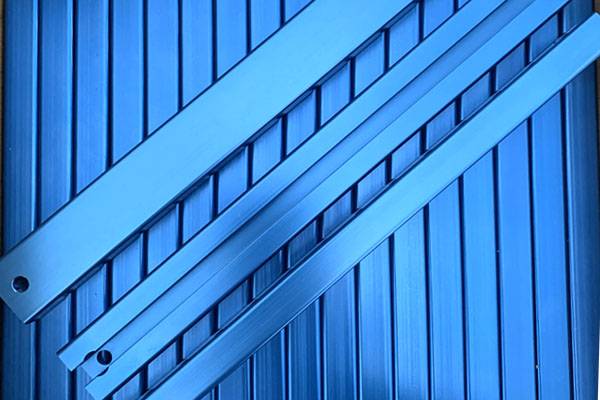
Four ways an aluminium part corrodes early
Related on this site
- Choosing a finish by failure mode— matching an anodic class or coating to the mechanism that will attack it
- Solar mounting: uplift, corrosion and a 25-year life— a 25-year outdoor case with the same galvanic problem
- Anodised vs powder coated— the two finish routes and where each one gives up
- Quality and inspection protocol— how a coating or anodic film is accepted against a sample
Terms used in this article
- Pitting
- Localised corrosion producing small deep holes, typically initiated where chloride breaks down the protective oxide layer.
- Galvanic corrosion
- Accelerated attack on the more anodic of two dissimilar metals in electrical contact in an electrolyte.
- Area ratio
- The ratio of cathodic to anodic area, which controls how fast a galvanic couple consumes the anode.
- Crevice corrosion
- Localised attack inside a narrow gap where the chemistry differs from the bulk, such as an open slot or a lap joint.
- Filiform corrosion
- Thread-like attack tracking under a coating from a defect, characteristic of coated aluminium in humid chloride.
- Amphoteric
- Reacting with both acids and bases; aluminium oxide is stable only over roughly pH 4 to 9.
Questions buyers ask
Does aluminium rust?
No, because rust is iron oxide and aluminium contains no iron. It corrodes through other mechanisms instead: pitting in chloride, galvanic attack against more noble metals, crevice attack in gaps, and alkaline attack above roughly pH 9.
Does 1,000 hours of salt spray mean a long life outdoors?
No. ASTM B117 and ISO 9227 explicitly make no prediction of service corrosion behaviour. The chamber holds one constant condition while a real site varies in wet and dry periods, temperature and salt deposition, so the result ranks finishes rather than forecasting years.
Why did my anodised frame stain and pit near the coast?
Chloride breaks down the oxide layer locally, and an anodic film delays pitting rather than preventing it. Cut ends and drilled holes have no film at all and are the usual starting points. Specify a thicker sealed class, seal the cut edges, and set an inspection interval.
Can I use stainless steel fasteners in an aluminium frame?
In a dry indoor environment, usually yes. In a wet or chloride environment, stainless is more noble than aluminium and drives galvanic attack on the frame, which is made worse when the aluminium area is small relative to the fastener. Use isolating washers or a fastener closer to aluminium.
Is aluminium safe in contact with concrete?
Not directly and not when wet. Wet concrete is strongly alkaline and attacks the oxide layer, so a separation layer or a suitable coating is needed. The same applies to cement dust and to alkaline cleaning agents.
Send the exposure and the chemistry
Tell us where the part goes, what it touches and what cleans it, and we will specify the finish and the fastener strategy for the mechanisms that will actually act.
Request a quoteRelated reading
Twelve more engineering notes from this blog, picked for this article — plus every category below.
 Engineering DesignAluminum vs Steel Machine Frames: Choose by Deflection, Not by Strength
 Engineering DesignMetric vs Imperial T-Slot Profiles: How to Test Compatibility Before You Order
 Quality and InspectionAnodising vs Powder Coating: Thickness, Colour, Salt Spray
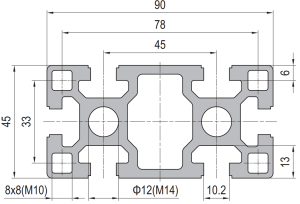 Materials and EngineeringAluminium Extrusion Section Design: What Each Feature on the Drawing Costs You
 ApplicationsAluminium Profiles Across Industries: What Actually Changes From One Sector to the Next
 Engineering Design4080 vs 4545 Aluminium Profile: Which for Your Frame
 Materials and EngineeringRecycled Aluminium Profiles: A Number You Have to Be Able to Evidence
 ApplicationsAluminium Profiles in Solar Mounting: Wind Uplift, Corrosion and a 25-Year Life
 ApplicationsESD-Safe Aluminum Profile Workbenches: Why Anodising Alone Fails the Audit
 ApplicationsAluminium Greenhouse Profiles: A Snow Load Problem With a Condensation Problem
 Engineering DesignT-Slot Aluminium: The Slot Mouth Is the Interface Standard, Not the Series Name
 ApplicationsAluminium Profile Applications
