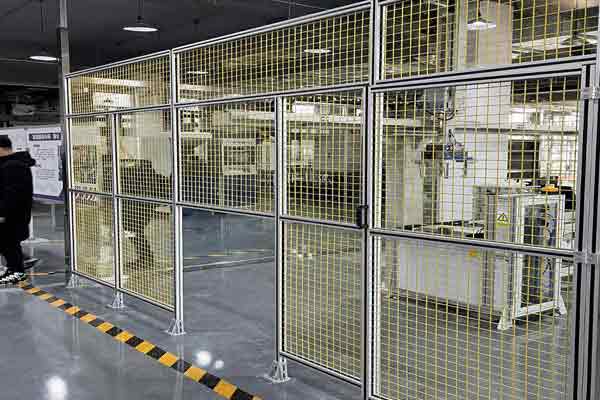
Aluminium Profile Sliding Door 40 Series 8 mm Slot for Machine Enclosures
Sliding door leaves framed in 40 series aluminium profile for machine enclosures. Top hung or bottom rolling, captive bottom guide, brush or EPDM seal, supplied as a cut list with the rail and stops.
| Material | Aluminium |
|---|---|
| Alloy Grade | 6063-T5 |
| Temper | T5 |
| Section Size | 40 x 40 mm leaf frame, 40 x 40 rail minimum, deeper rail above 1.2 m span |
| Slot | 8 mm slot, M6 T-nut fixing, four faces |
| Length | Cut to the door drawing; leaf and rail supplied as one cut list |
| Tolerance | Cut length +/-0.5 mm; rail straightness to EN 755-9; guide position set on assembly |
| Surface | Mill finish / clear anodised / black anodised |
| MOQ | No fixed minimum; priced per door set |
| Lead Time | 2 to 3 weeks for mill finish, plus about a week for anodising |
| Loading Port | Shanghai / Ningbo |
| Supply Ability | Leaf frame, rail, guides and stops cut and kitted from one drawing |
| Payment Terms | T/T 30% deposit + 70% before shipment | L/C at sight |
| Trade Terms | FOB | CIF | EXW |
| Certifications | Material declaration, RoHS and REACH on request; guard assessment is the machine builder's scope |
01How wide does the leaf have to be for a given opening?
A 40 series aluminium profile sliding door is not sized from the opening, it is sized from the opening plus the overlap. The leaf has to travel past the frame on both sides, or it leaves a gap that no seal will close.
| Configuration | Leaf width | Net opening | Overlap per side |
|---|---|---|---|
| Single leaf, opening 1000 mm | about 1120 mm | about 1000 mm | about 60 mm |
| Two leaves bi-parting, opening 2000 mm | 2 x about 1060 mm | about 2000 mm | about 60 mm each |
| Single leaf with a full perimeter seal | opening + 2 x 80 mm | the opening | about 80 mm, to give the seal somewhere to land |
| Leaf running inside the frame line | opening + 2 x leaf thickness + clearance | the opening | n/a, the leaf sits in a pocket |
The fourth row is the one that catches people out. A leaf that runs inside the frame line, in a pocket, needs the frame to be deep enough to accept it, and the pocket has to be clear of anything else in the slot. It is the neatest arrangement and the one that needs the most planning, because the pocket cannot be added later.
On a two-leaf bi-parting door the net opening is not the sum of the leaf widths. Each leaf has to overlap the frame at its own end and the two leaves have to overlap each other at the centre, so a 2000 mm opening needs leaves of about 1060 mm, not 1000 mm.
02Why does a top hung rail sag, and when does it matter?
Because a top hung door puts the entire leaf weight into a rail that is spanning, not sitting on a support. That is a bending problem, and bending deflection goes with the cube of the span — which is why a rail that looks fine at 1 m is unacceptable at 2 m.
Take a worked example with the assumptions stated, because the arithmetic is the useful part. For a central point load, the deflection of a simply supported rail is delta = P x L^3 / (48 x E x I), with E for aluminium at about 70 000 N/mm2. Assume a 40 x 40 four slot section at I of about 8 cm4 — an assumed value, check it against the section data sheet, because the conclusion does not change much if it is 10 instead of 8.
- Load P (assumed)
- 300 N, a 30 kg leaf treated as one central load
- Span L
- 2000 mm
- E, aluminium
- 70 000 N/mm2
- I (assumed, 40 x 40 four slot)
- 80 000 mm4
- Deflection
- 300 x 2000^3 / (48 x 70 000 x 80 000) = about 8.9 mm
- Same load, depth doubled
- I up about 8 times, deflection about 1.1 mm
Nine millimetres of rail deflection on a 2 m opening is not a cosmetic issue. The leaf rides down into the sag, the rollers load unevenly, and the leaf binds at one end of the travel — usually the end where it needs to open fully. The fix is not a thicker wall in the same depth, it is a deeper section: doubling the depth raises I by roughly eight times for the same mass, which is the whole reason 45 x 90 and 60 x 60 sections exist in this range.
A practical rule that comes out of the cube relationship: keep a 40 x 40 top rail under about 1.2 m of unsupported span. Above that, step up to a deeper section, or put a mid support in — a single extra bracket at mid span cuts the deflection by roughly eight times, which is cheaper than a new section.
03Top hung or bottom rolling?
Both are used on machine enclosures and they fail differently. The choice usually comes down to floor condition and to whether the door may be lifted off.
Top hung
- Floor stays clear, so nothing to trip on and nothing to clean around
- Swings out at the bottom if the guide fails, which is the safety concern
- Rail carries the full leaf weight, so span is the limiting factor
- Needs a bottom guide at both ends of the travel
- The usual choice on a machine enclosure with a good floor
Bottom rolling
- Weight goes straight into the floor, so span is not a structural problem
- Floor must be flat, and swarf or a cable will stop the door
- Needs a top guide to keep the leaf upright
- Easier to make a wide, heavy leaf work
- The usual choice for a large or heavy enclosure door
The safety point deserves its own sentence: a top hung leaf that can be lifted off its track is a guard that can be removed without a tool. On a machine guard that is usually unacceptable, and the bottom guide is the part that prevents it. A guide that runs in the slot and is retained by a bolt, rather than a simple roller, is what makes the door non-removable.
04How much seal can a hand-operated door afford?
There is a direct trade between sealing and effort, and it is worth doing the arithmetic before specifying a full perimeter seal on a door that somebody has to slide by hand.
| Seal | Friction | Sealing performance | Use when |
|---|---|---|---|
| Brush strip | Low, and almost independent of gap | Moderate, good against swarf and draught | The default on machine enclosures |
| EPDM bulb, light compression | Moderate | Good against dust and coolant spray | Where coolant or fine dust must be kept in |
| EPDM bulb, heavy compression | High, and rises steeply as the gap closes | Very good | Where the door is clamped shut, not slid freely |
| No seal, overlap only | Very low | Poor | Guarding only, no process containment |
| Labyrinth overlap, no elastomer | Low | Moderate, and no wear part | Hot or dirty environments where elastomer degrades |
The number that matters is not the friction force in new condition, it is the force at the end of the travel where the leaf enters the last 100 mm and the seal starts to compress. That is where a door that slid easily becomes a door that needs two hands. If the seal is mandatory, reduce the compressed length — seal the perimeter of the opening rather than the whole travel, so the leaf only compresses a seal where it is actually closed.
05Where does the interlock go on a sliding door?
Sliding doors are actually easier for interlocks than hinged doors, because the motion is linear and the target approaches the switch along a predictable line. The mistakes are about partial opening and about reach.
- Body on the frame, target on the leaf. Same principle as a hinged door, and for the same reason: the cable stays still.
- Align the switch to the direction of travel, so the target enters the switch head axially rather than sliding across it. A tongue switch approached sideways wears its head and goes out of tolerance.
- Assume the leaf will stop part way. A sliding leaf can be left 50 mm open, and a switch that reads “closed” at 50 mm open is not guarding anything. Use a coded or RFID switch, or a tongue long enough that partial opening still breaks the circuit.
- Check the switch at both ends of the travel, not just closed. Some switch bodies foul the leaf at full open.
- Do not use the end stop as the switch target. The stop is a structural part and it moves when the door is slammed.
As with hinged doors: we supply the profile, the track and the frame. The interlock and the guard assessment are the machine builder’s scope, against the machinery safety standard that applies to that machine.
06What usually goes wrong on the first build?
| Symptom | Cause | Fix |
|---|---|---|
| Leaf binds at one end of the travel | Rail sag, or the rail is not parallel to the bottom guide | Deeper rail, a mid support, or shim the rail to parallel |
| Leaf rides up and comes off | Bottom guide too short, or the guide is a roller rather than a captive block | Captive guide block spanning at least the leaf depth |
| Seal drags and the door needs two hands | Seal compressed along the whole travel instead of only at the closed position | Seal the opening, not the track |
| Interlock reads closed when the door is part open | Tongue too short, or a non-coded switch on a leaf that can stop anywhere | Coded switch, or a longer tongue |
| Leaf rattles when the machine runs | No catch, so the leaf moves in its clearance | A latch or a magnetic catch at the closed position |
| Panel cracks at the corners after a few months | Panel fixed rigidly all round, so it takes the frame deflection | Clearance in the panel groove, and fix on one edge only |
The last one is not a door problem but it shows up on doors first. A panel held rigidly in a frame that deflects will crack at the corner, and the deflection that matters is the rail sag from section 02. Fixing the panel on one edge and leaving clearance on the others is what stops it.
07What to check before ordering
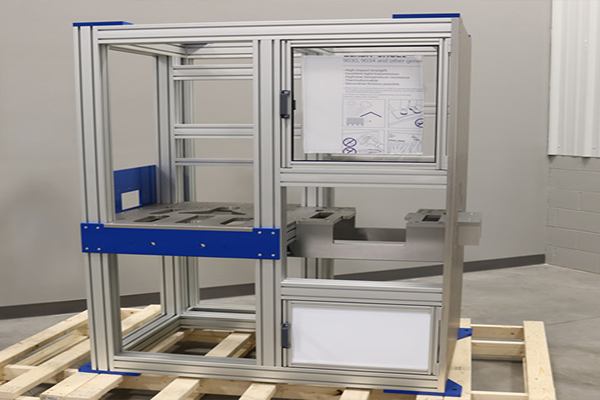
Sliding door checklist
- Opening size, and whether the leaf runs outside the frame or in a pocket
- Leaf width including overlap on both sides
- Top hung or bottom rolling, and the floor condition if bottom rolling
- Unsupported rail span, and the section depth that span needs
- Bottom guide type, and whether the leaf must be non-removable
- Seal type, and whether it compresses along the travel or only at the closed position
- Latch or catch at the closed position
- Interlock type, target position, and how partial opening is detected
- Panel material, thickness, and how it is fixed for clearance
08Questions from enclosure designers
Related sections and categories
Browse Door and Window Elements, Panel Installation Elements, 40 Series Aluminium Profiles, or see the 40 x 40 mm four slot section for the leaf frame and the 40 x 80 mm six slot section when the rail span needs more depth.
How wide should a sliding leaf be for a 1000 mm opening?
About 1120 mm, so it overlaps 60 mm on each side. With a full perimeter seal, allow 80 mm per side. A leaf that is exactly the opening width will always leave a gap.
Why does my top hung sliding door sag?
Rail deflection goes with the cube of the span. A 40 x 40 rail over 2 m carrying a 30 kg leaf deflects by roughly 9 mm on the assumptions in this page. Keep 40 x 40 under about 1.2 m of unsupported span, or add a mid support.
Can a sliding door be lifted off its track?
A top hung leaf can, unless a captive bottom guide is fitted. On a machine guard that is a safety issue, so the guide has to be a retained block rather than a simple roller.
How much seal can I use on a hand-operated door?
A brush strip adds very little friction. A compressed EPDM bulb adds a lot, especially in the last 100 mm of travel. Seal the opening rather than the whole track so the leaf only compresses a seal where it is closed.
Where should the safety switch be mounted?
Body on the frame, target on the leaf, approached axially along the direction of travel. Use a coded switch or a long tongue, because a sliding leaf can be left part open and a short tongue will still read closed.
Can the door frame be supplied as a kit?
Yes. Send the opening size and the track arrangement and the leaf, the rail, the guides and the stops come as one cut list rather than as separate parts to reconcile.
What to send for a sliding door quote
- Opening size and a sketch of the frame it sits in
- Single leaf or bi-parting, and the direction of travel
- Leaf outside the frame, or running in a pocket
- Top hung or bottom rolling, with the floor condition if bottom rolling
- Panel material and thickness, so the leaf weight can be estimated
- Seal requirement and the process being contained
- Interlock type, if already chosen
- Finish, and whether the rail is seen
- Quantity of doors, and whether the leaves are wanted as a kit with the frame
Send the opening and the frame sketch, not just the leaf. The rail span is set by the frame, and the rail span is what decides whether the leaf will slide or bind.
Send the opening and the frame sketch
Tell us the opening, the leaf direction and whether the leaf runs outside the frame or in a pocket. We will size the rail from the span and quote the door as a kit.
Request a quotationRelated Products
 ESD Aluminium Profile Workbench 40 x 40 mm Anti-Static Assembly Frame
ESD workbench built on a 40 x 40 mm aluminium profile frame, supplied mill…
 Aluminium Profile Stair Stringer 45 x 90 mm for Access Platforms
45 x 90 mm six slot heavy aluminium profile at about 4.85 kg/m, cut…
 Aluminium Profile CNC Router Gantry 90 x 180 mm Twelve Slot Beam
90 x 180 mm twelve slot aluminium profile at about 9.50 kg/m for a…
 Aluminium Profile Truck Body Frame 50 x 100 mm for Dry Freight Boxes
50 x 100 mm six slot aluminium profile at about 5.40 kg/m for dry…
 Solar Mounting Aluminium Rail 45 x 45 mm for PV Array Frames
45 x 45 mm four slot aluminium profile at about 2.55 kg/m, used as…
 Aluminium Profile for Sale: 45 x 60 mm Cut to Length, No Minimum Run
45 x 60 mm aluminium profile in 6063-T5, sold by the length or by…
 120 x 120 mm Aluminium Profile for Automotive Line Tooling
120 x 120 mm twelve-slot aluminium extrusion in 6063-T5 for welding jigs, assembly fixtures…
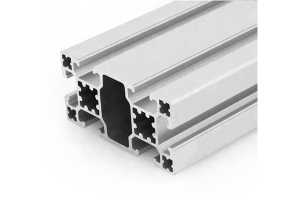 40 x 80 mm Aluminium Profile with 80 x 120 mm Beams: A Gantry Combination
Gantry pairing: 40 x 80 mm six-slot columns at 3.60 kg/m with an 80…
