FOB vs CIF vs DAP vs DDP for Aluminium Profiles
In 2026 a mill-finish 2020 T-slot runs about US$1.80–2.60 per metre FOB Shanghai or Ningbo at a few hundred metres. FOB is cheapest on the invoice and most expensive in surprises; DDP is the opposite. The difference is who owns the risk between the factory gate and your door.
Short answer
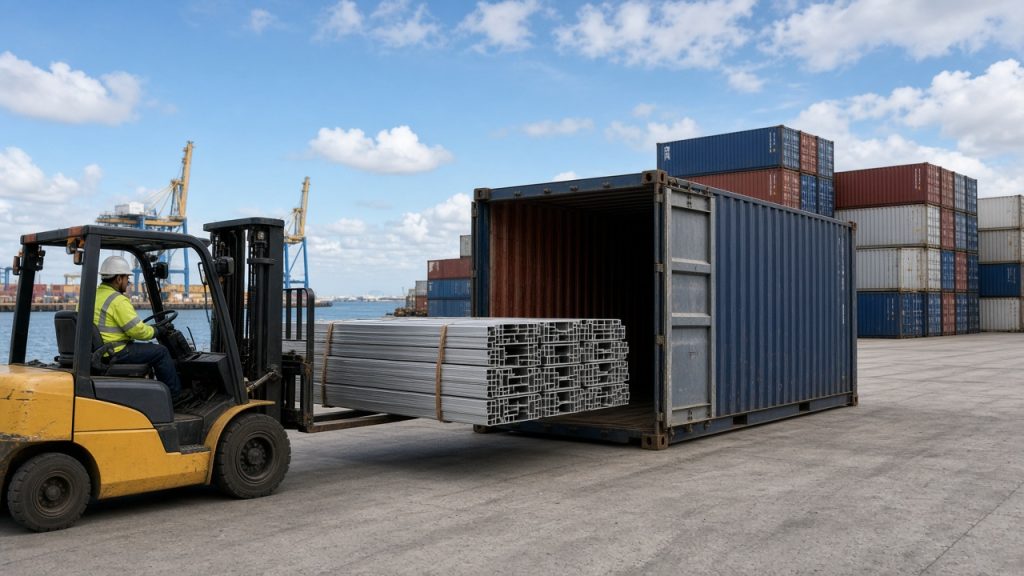
Under FOB the mill delivers the container onto the vessel at Shanghai or Ningbo; you buy ocean freight, insurance, destination fees, import clearance and duty. CIF adds seller-paid freight and minimum insurance to your port, but risk still passes at origin and you still clear customs. DAP delivers to your named place with import clearance and duty still yours. DDP includes duty and delivery, so the invoice is highest and the surprises are fewest. For the same 20 ft of 2020 profile in 2026, the goods line is identical; the spread between FOB and DDP is almost entirely logistics margin, insurance and duty handling. Payment stays T/T 30% deposit + 70% before shipment, or L/C at sight. Compare quotes only after every line is normalised to the same Incoterm and destination.
How much is 100 m of 2020 profile FOB China
At 2026 FOB Shanghai or Ningbo, 100 m of mill-finish 2020 6063-T5 sits in the US$180–260 band for the metal and extrusion alone, before packing and documentation, provided the run is off an existing die.
Scale changes the number because billet changeover and die heat-up are fixed. At 500 m the same section typically lands nearer US$1.65–2.30/m FOB. At about 1 tonne (~1,800–2,000 m of 2020 at ~0.50–0.55 kg/m) the FOB band commonly compresses toward US$1.50–2.10/m. At 2 tonnes the step at 2,000 m and then 5,000 m on the price ladder matters more than the Incoterm label on the invoice.
Those bands assume mill finish, standard EN 755 tolerances, cut to stock lengths, and an existing die. Anodising, powder coating, CNC holes and a new die sit on separate lines. The MOQ is 150 m off an existing die and 500 m with a new die; below that you are in sample or surcharge territory, not the production FOB band.
| Quantity | Approx. weight | 2026 FOB band (USD) | Notes |
|---|---|---|---|
| 100 m of 2020 | ~50–55 kg | US$180–260 goods | Below preferred lot; existing die only |
| 500 m of 2020 | ~250–275 kg | US$825–1,150 goods | Hits new-die MOQ and first price step |
| 1 tonne of 2020 | 1,000 kg | US$2,800–3,800 goods | ~1,800–2,000 m depending on wall |
| 2 tonnes of 2020 | 2,000 kg | US$5,200–7,200 goods | Near the 2,000 m / 5,000 m break points |
| Price steps | — | 500 / 2,000 / 5,000 / 10,000 m | Same ladder for other sections |
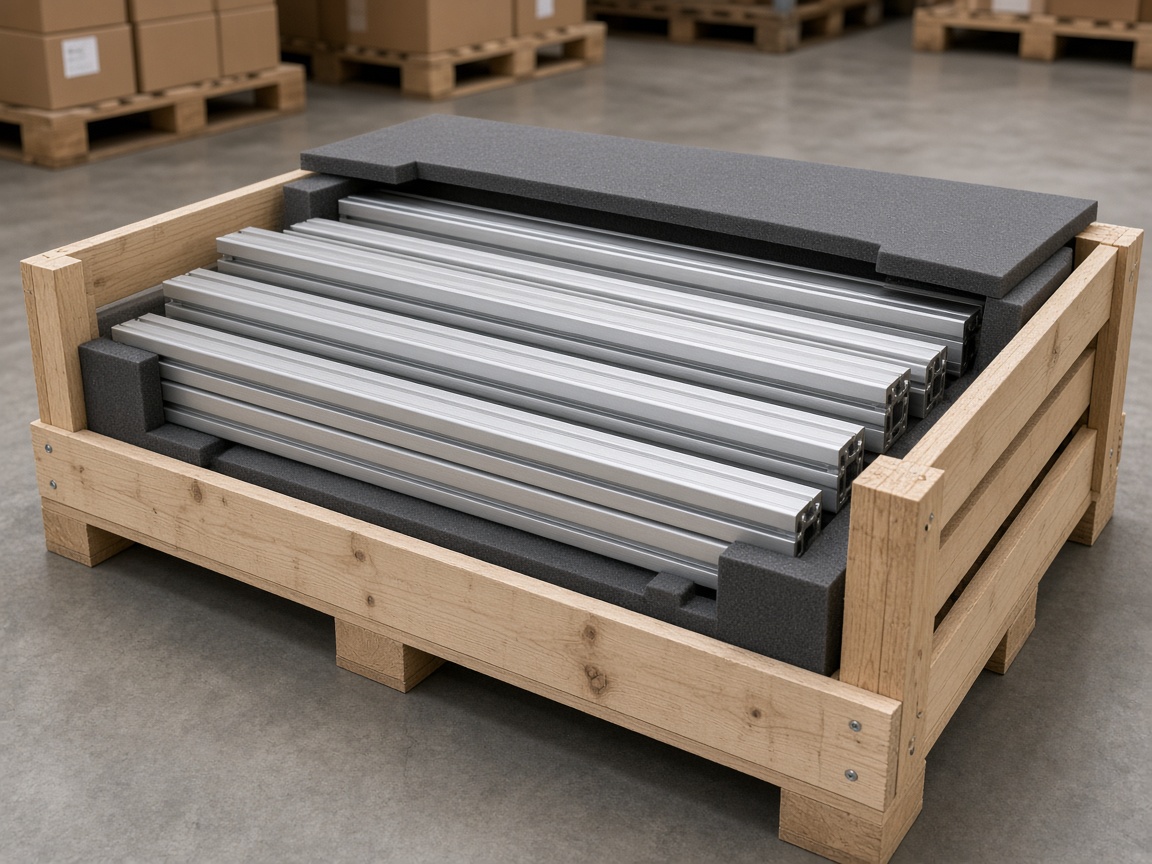
FOB China means the number above is not your landed cost. Ocean freight for a partial container of light T-slot, marine insurance, destination THC, broker fees and duty sit outside the FOB line. Ask for the FOB goods price and the packing weight separately so your forwarder can price the rest.
What is the fastest way to specify a workbench in T-slot
The fastest comparable quote for a T-slot workbench is a cut list plus hardware bill, finish, Incoterm and destination — not a photograph of a bench and a request for “FOB price”.
Send the series (20 / 30 / 40 / 45), every length with quantity, the connector and caster part numbers or equivalents, the top material if we supply it, and whether the profiles are mill, anodised or powder-coated. State FOB Shanghai, CIF named port, DAP named place or DDP named door in the same line as the destination country. That single block lets the mill price metal and fabrication, and lets freight be added under one Incoterm instead of rebuilt three times.
| Field | What to write | Why it changes the quote |
|---|---|---|
| Series and section | e.g. 4040 / 4080 frame, 2020 braces | kg/m and press class |
| Cut list | Length × qty for every bar | Scrap, saw time, packing length |
| Hardware | T-nuts, brackets, feet, casters | Bought-in lines and packing volume |
| Finish | Mill / clear anodise / RAL coat | Finishing MOQ and lead time |
| Incoterm + place | FOB Ningbo / CIF Hamburg / DAP Dallas / DDP door | Who pays freight, insurance, duty |
| Payment | T/T 30/70 or L/C at sight | Cash cycle, not the metal price |
Is it cheaper to order 100 m in one shipment or split it
For 100 m of light T-slot, one consolidated shipment is almost always cheaper landed than two or three splits, because origin docs, destination entry and minimum LCL charges repeat on every sailing.
One hundred metres of 2020 is roughly a fiftieth of a 20 ft payload by weight. Split into two lots and you pay two sets of bill-of-lading fees, two broker entries and two minimum freight tickets, while the goods value stays the same. The only case where a split wins is when the second lot would otherwise sit as dead inventory past a design freeze, or when air for a short first cut unlocks a production line that sea cannot meet.
| Option | Goods (FOB) | Logistics pattern | When it wins |
|---|---|---|---|
| One sea shipment | Full 100 m | One B/L, one entry, one LCL minimum | Default for cost |
| Two sea splits of 50 m | Same metal | Two minima, two entries | Rarely; design risk only |
| Air sample + sea balance | Sample surcharge + balance FOB | Air premium on a few bars | Fit check before the lot sails |
| Hold to 150 m MOQ | Extra 50 m at lower unit FOB | Still one sailing | When the extra length has a use |
| Mix sections in one container | Several dies, one freight | Shared origin and entry | When each die meets its own MOQ |
What Incoterms do you support: FOB, CIF, DAP, DDP
We support FOB, CIF, DAP and DDP from Shanghai or Ningbo; the right term is the one that matches who already controls freight and who is willing to carry duty risk.
FOB is the clean default for importers with their own forwarder: we clear export and load the vessel; you buy freight, insurance and everything after. CIF adds ocean freight and a minimum cargo policy to your named port; you still clear import and pay duty, and risk still transferred when the goods crossed the ship’s rail at origin. DAP brings the cargo to your named place with import clearance and duty still on you. DDP puts clearance, duty and door delivery on the seller, which raises the invoice and removes most destination surprises.
| Cost line | FOB | CIF | DAP | DDP |
|---|---|---|---|---|
| Origin truck + export clearance + loading | Seller | Seller | Seller | Seller |
| Ocean freight | Buyer | Seller | Seller | Seller |
| Marine insurance | Buyer | Seller (minimum) | Seller | Seller |
| Destination port / terminal fees | Buyer | Buyer | Seller | Seller |
| Import clearance | Buyer | Buyer | Buyer | Seller |
| Import duty + tax | Buyer | Buyer | Buyer | Seller |
| Inland delivery to door | Buyer | Buyer | Seller | Seller |
| Risk during ocean transit | Buyer | Buyer | Seller* | Seller |
*Under DAP the seller carries risk to the named place; under CIF the seller pays freight and insurance but risk already passed at origin — the claim sits with you on the seller’s policy. Always name the place: FOB Shanghai, CIF Rotterdam, DAP warehouse postcode, DDP door address.
Worked example — same 20 ft mixed T-slot lot, 2026 planning bands (USD). Goods FOB Shanghai US$12,000. Ocean to a US West Coast port about US$1,800–2,800. Insurance about US$80–180. Destination port and broker about US$500–900. Duty and tax depend on HS code and destination policy and are deliberately left as a buyer line under FOB/CIF/DAP. Illustrative totals before duty: FOB goods + your freight stack ~US$14,400–15,900; CIF invoice ~US$14,000–15,200 plus your destination fees; DAP door before duty often US$15,200–17,000; DDP door with duty inside commonly US$16,500–22,000+ depending on the duty line the seller has to fund. The goods never changed; only who priced which risk did.
What is the landed cost of profile by size
Landed cost for a given section is the FOB goods price plus the Incoterm stack for your destination; the table below is a 2026 FOB Shanghai/Ningbo reference per metre for mill-finish 6063 industrial T-slot at a few hundred metres, so you can add freight and duty once rather than once per size.
Use the FOB column as the goods seed. Add ocean, insurance and destination under your chosen term. Duty is destination-specific and must come from your broker’s HS reading, not from a blog table. Price steps at 500 m, 2,000 m, 5,000 m and 10,000 m move the FOB seed before freight is applied.
| Section | Circumscribed circle | Type | Reference price (USD) | Notes |
|---|---|---|---|---|
| 2020 | ~28 mm | Light T-slot | US$1.80–2.60/m FOB | Landed = FOB + freight/duty stack |
| 3030 | ~42 mm | Light T-slot | US$2.80–3.90/m FOB | Common workbench upright |
| 4040 | ~57 mm | Standard T-slot | US$4.20–5.80/m FOB | Highest volume industrial size |
| 4080 | ~89 mm | Rectangular T-slot | US$7.20–9.80/m FOB | Heavier frame rails |
| 4545 | ~64 mm | 45-series | US$5.40–7.40/m FOB | Metric-system frames |
| 4590 | ~101 mm | 45-series wide | US$9.50–12.80/m FOB | Watch press class / packing length |
| 5050 | ~71 mm | 50-series | US$7.00–9.50/m FOB | Heavier slot hardware |
| 8080 | ~113 mm | Heavy T-slot | US$12.50–17.00/m FOB | Freight share rises with kg/m |
| 9090 | ~127 mm | Heavy T-slot | US$16.00–22.00/m FOB | Often near full-container planning |
| 100100 | ~141 mm | Heavy structural | US$20.00–28.00/m FOB | Confirm press and packing |
| 16080 | ~179 mm | Wide structural | US$18.00–26.00/m FOB | Large circumscribed circle |
RFQ checklist — Incoterm quote
- Section and alloy — e.g. 4040 6063-T5, mill or anodised.
- Metres and cut list — total metres and finished lengths.
- Incoterm + named place — FOB Shanghai / CIF … / DAP … / DDP …
- Destination — country, port or door postcode.
- Payment — T/T 30/70 or L/C at sight.
- Existing die or new — 150 m vs 500 m MOQ.
Ask for the FOB goods line and the Incoterm adders as separate figures. That is the only way to compare a CIF quote with a FOB quote from another mill.
Four ways an Incoterm quote goes wrong
Related on this site
- how die cost amortises per meter— build the goods line before you add freight
- minimum order with a new die— 150 m existing die, 500 m new die
- die making adds 7–12 days— schedule before the sailing
- who owns the die— tooling title after you pay
Terms used in this article
- FOB
- Free On Board: seller loads at the named origin port; buyer takes freight, insurance and destination risk from that point.
- CIF
- Cost, Insurance and Freight: seller pays ocean freight and minimum insurance to the named port; buyer still clears import and bears transit risk from origin.
- DAP
- Delivered At Place: seller delivers to the named place; import clearance and duty remain with the buyer.
- DDP
- Delivered Duty Paid: seller delivers cleared, duty paid, to the named place.
- Landed cost
- Goods plus every cost required to receive sellable profile at the final place, including freight, insurance, clearance and duty.
- LCL
- Less than container load: shared container service with minimum charges that hurt small splits.
Questions buyers ask
What is included in the quoted price?
State the Incoterm in the quote. An FOB Shanghai figure covers profiles, export packing, inland China trucking to the port, export clearance and loading. It excludes ocean freight, insurance, destination fees, import clearance and duty. CIF adds freight and minimum insurance to the named port. DAP and DDP add further destination legs as defined above. Finishing and CNC are separate lines unless listed.
Do you charge for samples?
Cut samples from an existing die are usually charged at a short-run metre rate plus express freight, not at the production FOB band. A new-die sample still needs the die and the 500 m production MOQ logic behind it; a paid pilot length can be agreed before the bulk lot sails under the same Incoterm you will use for production.
How long is the quotation valid?
Goods lines are typically held 14–30 days in 2026 because billet tracks the metal market. Freight adders under CIF, DAP and DDP follow the carrier market and may be shorter. Ask for the validity on the goods line and the freight line separately when the Incoterm bundles them.
Can the price be fixed for a contract?
A call-off contract can fix the conversion and fabrication adder with a published billet index for the metal, and can lock an Incoterm and named place. Ocean freight under CIF/DAP/DDP is usually indexed or re-quoted per sailing. Payment remains T/T 30/70 or L/C at sight unless the contract states otherwise.
Send the Incoterm and the cut list
Tell us the section, metres, finish, and whether you want FOB Shanghai/Ningbo, CIF, DAP or DDP to a named place. We will separate the goods line from the freight stack so you can compare mills honestly.
Request a quoteRelated reading
Twelve more engineering notes from this blog, picked for this article — plus every category below.
 Materials and EngineeringAluminium Extrusion Section Design: What Each Feature on the Drawing Costs You
 Engineering DesignCustom Aluminium Extrusion: From Drawing to Production
 Materials and EngineeringRecycled Aluminium Profiles: A Number You Have to Be Able to Evidence
 Engineering DesignHow to Choose an Aluminium Extrusion Profile: The Three Decisions That Bind
 Sourcing and ProcurementAluminium Profile Quote: What Changes the Number by Quantity
 Sourcing and ProcurementAluminium Profile MOQ: 150 m Existing Die, 500 m New
 Engineering DesignWho Owns the Extrusion Die After Tooling Is Paid?
 Sourcing and ProcurementDistributor Terms: Territory, Margin and Price Protection
 Engineering DesignHeavy-Duty T-Slot Hinges and Sliding Door Buffers: Sizing Them with Numbers
 Engineering Design6063 vs 6061 vs 6082 and T5 vs T6: What Changes in Practice
 Engineering Design4040 T-Slot Aluminium Profile for Machine Frames: Choose It by Deflection
 ApplicationsWhere Modular Aluminium Framing Works: A Load-Tier Map Instead of an Industry List
