Nylon Levelling Feet and Swivel Ball Feet
A UK buyer running checkweigher and conveyor lines wrote with an annual requirement of about 40,000 levelling feet. Buyers searching this category often use the American spelling “nylon leveling feet”; from here the article stays with British “levelling”. The enquiry asked whether the bases are injection-moulded from 30% glass-filled PA66, whether we offer a vulcanised NBR pad to stop conveyors walking, whether the ball joint articulates 15–20° and whether the nylon flange is drilled for floor bolts, and it asked for M8 to M16 stems from 50 to 150 mm in zinc-plated steel and 304 stainless for food and pharmaceutical wash-down. The answers below come from the published catalogue for GP-FE-SBF-01, GP-FE-SFH-01, GP-FE-NPF-01 and, where a named stainless grade or a bonded pad is needed, GP-FE-MPF-01.
Short answer
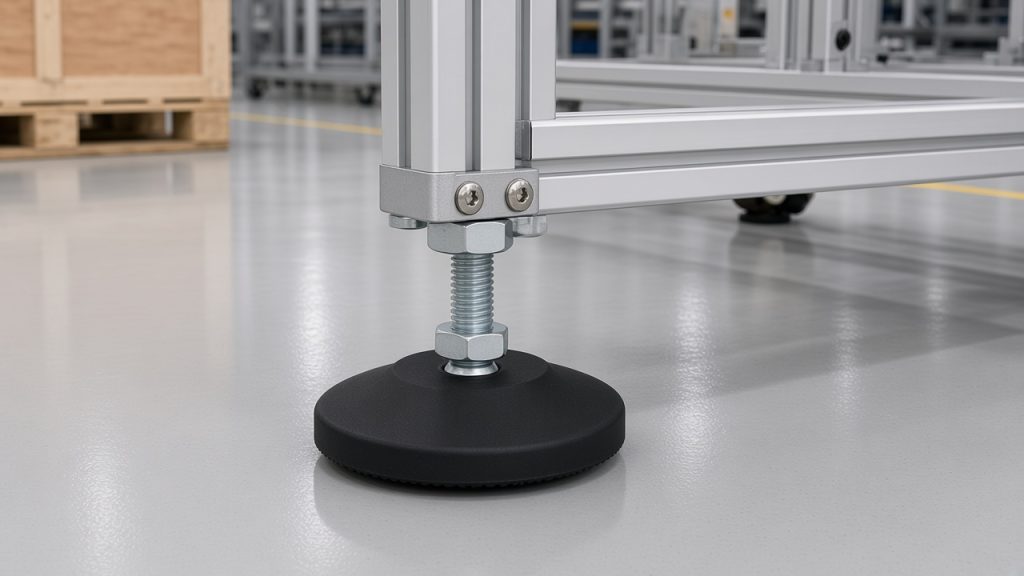
The listed nylon base is moulded PA6, not a published 30% glass-filled PA66 grade. A named filled-nylon tool is quoted from the drawing. We do not list a vulcanised NBR pad, a Shore hardness, or a walking-test figure; PA6 does not mark floors and damps vibration. If a conveyor must be stopped from migrating, the listed route is a holed, anchored pad — GP-FE-SFH-01 — not a stock rubber compound. A bonded elastomer is offered on request on GP-FE-MPF-01, but it is not named NBR. The published ball-and-socket tilt on SBF is 10–15° off vertical, not 15–20°. Holes in the moulded nylon SBF flange are not a stock variant; SFH uses a steel-with-nylon-insert or stainless drilled pad, 2 or 4 holes (Ø9, or Ø11 / Ø13 / Ø15) for M8–M14 anchors. NPF can take a drilled steel base plate. Standard SBF and NPF stems are M8 / M10 / M12 / M16 in 40, 50, 60 and 80 mm; 150 mm is custom on the drawing. SFH stems start at M10 and run to M20, with pads to 100 mm — Ø100 mm is not a listed SBF pad. Zinc-plated stems (8–12 µm, 48 h salt spray) are the standard; SBF carries a stainless option, while 304 and 316 are named on MPF. A 40,000-piece year is quoted per type: listed SBF configurations sit in the 2026 20,000+ band at $1.75; listed NPF configurations sit in the 10,000–49,999 band at $1.24.
Why a swivel ball-and-socket foot stops the stem from bending on a sloped floor
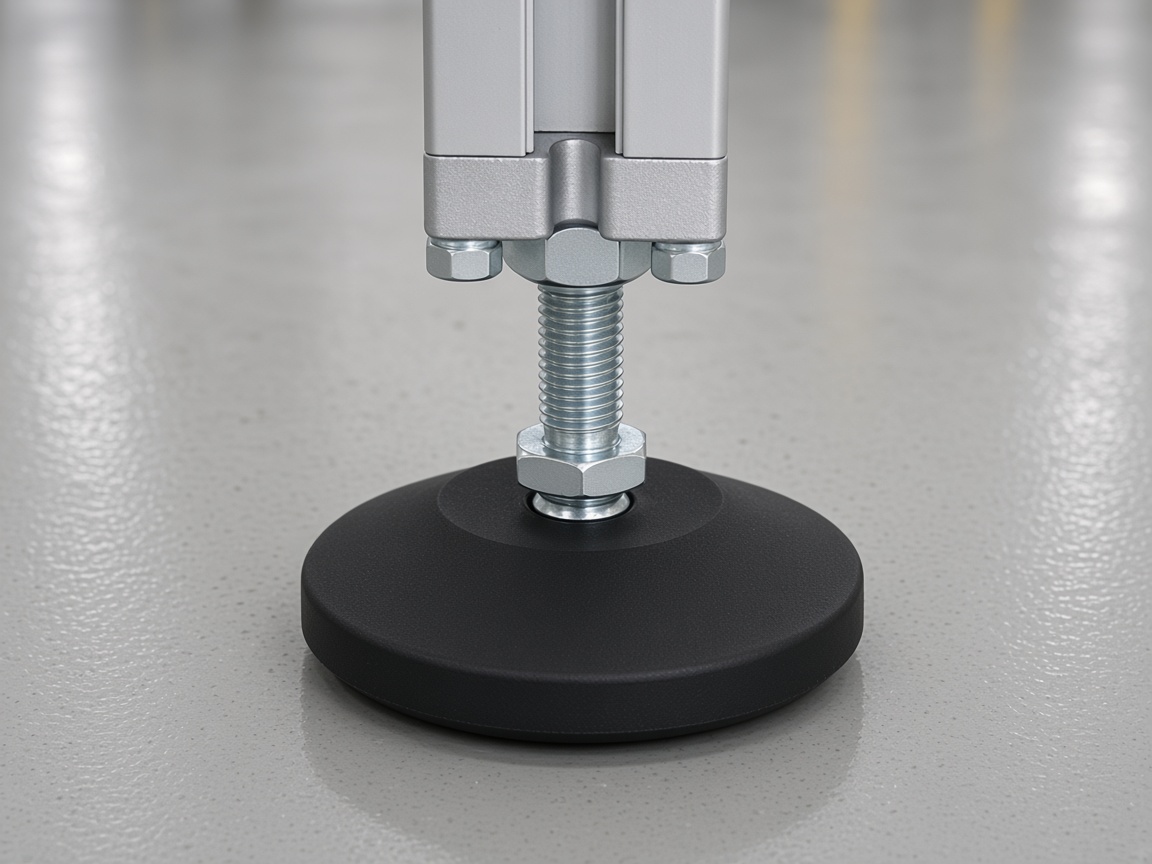
A swivel ball-and-socket foot keeps the pad flat and the stem straight when the leg is off vertical, provided the angle stays within the published 10–15°. Two things happen when a rigid levelling foot meets an angled leg — a floor with a fall, a frame that is not square, or a leg cut slightly long on one side. The pad bears on one edge, and the stem bends. Edge contact concentrates the load, lets a smooth floor start to slide, and, over time, puts a permanent set into the thread so the foot loses its adjustment range. The ball joint absorbs the angle instead: the pad stays fully in contact, the stem stays straight, and the load is spread over the whole pad face.
That published tilt is 10–15° off vertical on GP-FE-SBF-01. Buyers sometimes ask for 15–20°, which is not listed. Beyond it the socket reaches its limit and the pad starts to edge-load again — then the leg needs shortening, not more adjustment.
Read the load as static compression per foot, not per frame. A four-leg frame does not divide its weight by four: on an uneven floor one leg often carries little or nothing, so three feet should share the total load. A frame that is pushed, or that sees vibration, is normally quoted at about half the static figure. The factory compression test at 1.5× rated load is an inspection, not a selection formula. Fit the locking nut against the profile end; without it, vibration walks the stem out of adjustment within weeks.
PA6 nylon versus steel and stainless — not a listed 30% glass-filled PA66
The nylon we mould as standard is PA6, not a listed 30% glass-filled PA66, and the comparison that matters is that published PA6 against steel or stainless. On SBF the default base is PA6: it does not mark epoxy, vinyl or painted floors, it damps vibration, and it is electrically insulating. A steel base with a nylon insert is used where the pad has to resist a side load, because the steel shell takes the shear. A stainless base is specified for wash-down, outdoor use, and food or pharma frames where a bare steel pad would corrode.
GP-FE-NPF-01 moulds both the pivot joint and the base in PA6. It absorbs a useful fraction of the vibration between frame and floor, will not corrode, and will not scuff a new epoxy floor. It is rated to 90 °C continuous. Because it insulates, bonding of the frame has to be provided separately. Under a sustained high load the polymer creeps, so the working load should sit below the rating and the level should be re-checked after a few weeks in service. A frame that is pushed sideways, or one carrying a very heavy static load, belongs on steel or stainless.
We do not publish a 30% glass-filled PA66 grade. If the enquiry names a filled-nylon resin, we quote a tool from the drawing; until then the listed material remains PA6. The same rule applies to a rubber pad: no listed NBR compound, Shore hardness, or walking-test number. Damping is the published PA6 behaviour; stopping a frame from walking is a restraint problem, and the listed restraint is a holed, anchored pad.
The published stem, pad and load table — and where 150 mm sits
Standard SBF stems are M8, M10, M12 and M16 in 40, 50, 60 and 80 mm; a 150 mm stem is custom on the drawing, and a Ø100 mm pad is not listed on SBF. Typical published pairings on GP-FE-SBF-01 are below. UNC threads are available on request. Overall height is 55–140 mm. Custom stem length, thread and pad diameter are quoted from the drawing — we do not publish a 50–150 mm price grid.
| Stem | Pad Ø | Static load / foot | Typical frame |
|---|---|---|---|
| M8 × 40 mm | 40 mm | 400 kg | Light benches and instrument stands |
| M10 × 50 mm | 50 mm | 600 kg | Workbenches and light machine frames |
| M12 × 60 mm | 60 mm | 1,000 kg | Machine frames and assembly stations |
| M16 × 80 mm | 80 mm | 2,000 kg | Heavy machinery and gantry bases |
50, 60 and 80 mm are standard lengths on SBF and NPF, as is 40 mm. A 100 or 150 mm stem is machined to the drawing. SBF and NPF pads stop at 80 mm; a Ø100 mm pad is listed on SFH and MPF, not on SBF.
| Family | Code | Base | Stem threads | Standard stem | Pads | Static load / foot |
|---|---|---|---|---|---|---|
| Swivel ball foot | GP-FE-SBF-01 | PA6 nylon, steel with nylon insert, or stainless | M8 / M10 / M12 / M16 | 40 / 50 / 60 / 80 mm | 40 / 50 / 60 / 80 mm | 400 / 600 / 1,000 / 2,000 kg |
| Nylon pivot foot | GP-FE-NPF-01 | Moulded PA6 joint and base | M8 / M10 / M12 / M16 | 40–80 mm | 40 / 50 / 60 / 80 mm | 400 / 600 / 1,000 / 1,600 kg |
| Swivel foot with holes | GP-FE-SFH-01 | Steel with nylon insert, or stainless | M10 / M12 / M16 / M20 (no listed M8) | 50–100 mm | 50 / 60 / 80 / 100 mm | 600 / 1,000 / 2,000 / 3,500 kg |
| Metal pivot foot | GP-FE-MPF-01 | Zinc-plated steel, or stainless 304 / 316 | M12 / M16 / M20 / M24 | 60–120 mm | 60 / 80 / 100 / 130 mm | 1,500 / 2,500 / 3,500 / 5,000 kg |
NPF tops out at 1,600 kg on the 80 mm pad, not SBF’s 2,000 kg. SFH has no published M8 stem. MPF starts at M12, names 304 and 316, is rated well beyond 200 °C, and offers a bonded elastomer on request.
Plain nylon pads versus a holed pad that can be bolted down
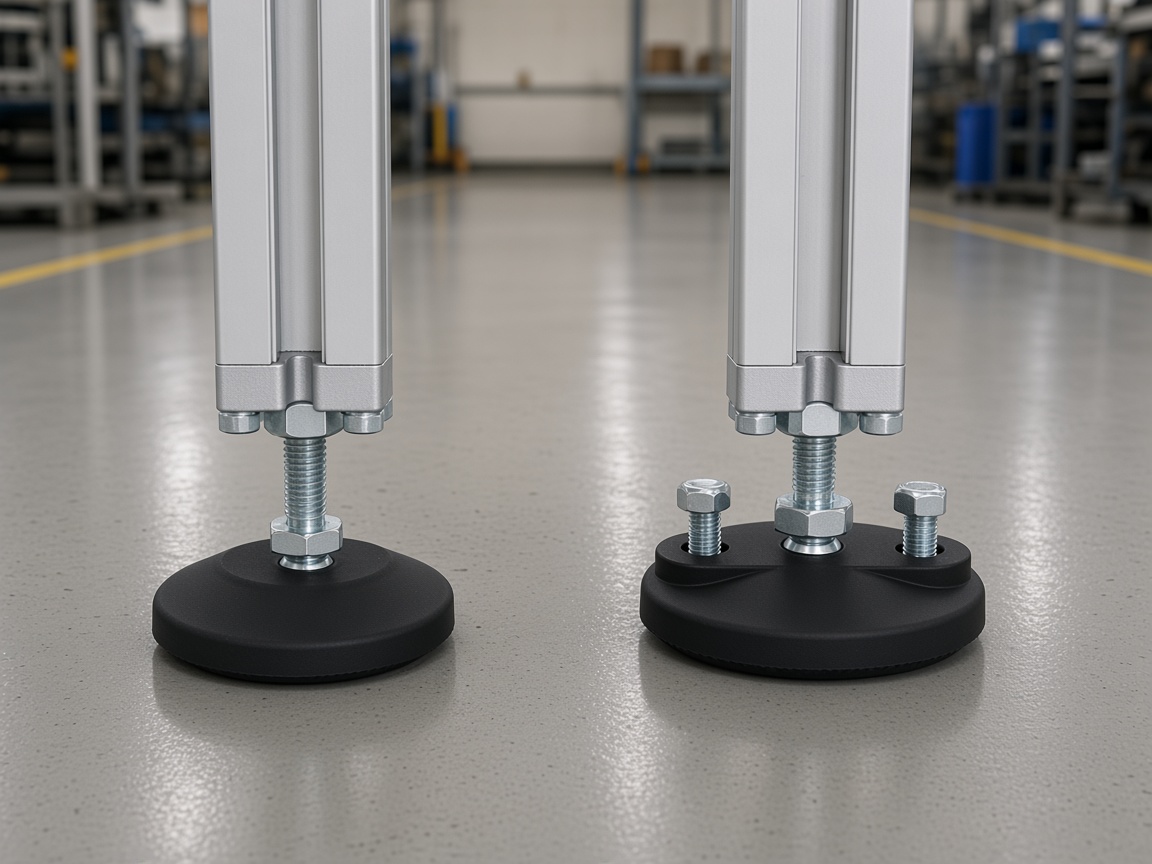
Floor bolting is done with a drilled steel or stainless pad, not with a stock hole pattern in the moulded nylon SBF flange. SBF is the plain, self-aligning foot: the pad stays flat, and the frame is held by weight and friction. On a vibrating checkweigher or conveyor, friction is not a restraint. The listed holed foot is GP-FE-SFH-01. The base is steel with a nylon insert, or stainless steel. The pad is drilled with 2 or 4 holes — 2 × Ø9, or 4 × Ø11 / Ø13 / Ø15 mm — for M8 to M14 anchors. Level the frame first, then bolt the pad down, so the same foot takes out floor unevenness and anchors the frame against migration, sliding and tipping. Slotted holes are available where the frame has to be moved for maintenance.
NPF can be supplied with a drilled steel base plate and, where the frame must stay isolated, an insulating bush so the anchor does not bridge the insulation. That is an NPF variant, not a hole pattern in the SBF nylon flange. Anchor type follows the floor build-up. On a plain-hole pad, level first and tighten second; only a slotted hole lets you adjust after the bolts are in.
Zinc-plated stems and stainless for food and pharmaceutical wash-down
Zinc-plated stems at 8–12 µm, with a 48 h salt-spray check, are the listed standard; stainless is the wash-down option, and we do not publish an FDA, EHEDG or 3-A certificate. On SBF the stem is published as zinc-plated steel, with a stainless option for wash-down. Food and pharmaceutical wash-down equipment is a listed SBF application, so a stainless stem with a stainless or nylon base is a listed combination. The SBF page does not name the grade as 304 or 316. Those numbers are published on GP-FE-MPF-01: zinc-plated steel is standard, 304 for wash-down and outdoor use, and 316 where chlorides or aggressive cleaners are present. If a nylon-base foot must carry a named 304 stem, state the grade on the drawing.
NPF’s published stem is zinc-plated steel with a moulded PA6 base — sound on a finished floor, not by itself a wash-down stainless specification. For wash-down, the usual listed path is an SBF or SFH foot with the stainless option, or MPF in 304 or 316 if the load, heat or side load wants a metal joint. MPF also offers a bonded elastomer base on request; it is not named NBR. Salt-spray checks are 48 h on zinc-plated SBF stems and SFH pads, and 96 h on MPF zinc-plated bases. None of those tests is a food-contact or hygienic-design certificate.
How a 40,000-piece year is quoted, and what the purchase order must state
A 40,000-piece annual quantity is quoted per type in the matching 2026 US dollar band, not as one price for a mixed M8–M16 / zinc / 304 / holed / plain basket. Forty thousand pieces of one listed SBF configuration sit in the 20,000+ band at $1.75; the same quantity of one listed NPF configuration sits in the 10,000–49,999 band at $1.24. Mix types, or mix standard lengths with a 150 mm custom stem, and each line is priced in its own band or from the drawing.
| Type | MOQ | 2026 USD / pc | Lead time |
|---|---|---|---|
| GP-FE-SBF-01 | 200 | 200–999 $6.80; 1,000–4,999 $4.20; 5,000–19,999 $2.60; 20,000+ $1.75 | 15–25 days after deposit |
| GP-FE-NPF-01 | 500 | 500–1,999 $3.20; 2,000–9,999 $2.05; 10,000–49,999 $1.24; 50,000+ $0.82 | 15–25 days after deposit |
| GP-FE-SFH-01 | 200 | 200–999 $9.40; 1,000–4,999 $5.90; 5,000–19,999 $3.60; 20,000+ $2.40 | 15–25 days after deposit |
| GP-FE-MPF-01 | 100 | 100–499 $26.00; 500–1,999 $17.50; 2,000–9,999 $11.20; 10,000+ $7.60 | 20–30 days after deposit |
Payment is T/T 30% deposit and 70% before shipment, or L/C at sight, on FOB, CIF or EXW terms, loading Shanghai or Ningbo. Samples and OEM or ODM marking are available; locking nuts and SFH anchor bolts can be kit-packed on request. The purchase order should state, for each line: base material; holed or plain; stem thread and length; zinc-plated or stainless, naming 304 or 316 if the grade must be controlled; pad diameter; load per foot or frame weight and leg count; and the quantity of that type.
Send this and the first quote is usable
- Quantity by type — plain nylon SBF, NPF, holed SFH, or metal/stainless MPF — not a single 40,000-piece mixed total.
- Base material, and whether a named filled-nylon resin or a named elastomer pad is required (to drawing once the grade is stated).
- Stem thread (M8–M16 on SBF and NPF; SFH starts at M10) and length (standard 40 / 50 / 60 / 80 mm, or a custom length such as 150 mm).
- Zinc-plated or stainless, and whether 304 or 316 must be named; pad diameter; holed or plain; floor build-up if anchoring; load per foot or frame weight and leg count; and whether the installation is static or sees vibration. Drawings: DWG, DXF, STEP, IGES or PDF.
Related on this site
- Swivel ball foot GP-FE-SBF-01 — PA6, steel or stainless pad, M8–M16, 10–15° tilt
- Swivel foot with holes GP-FE-SFH-01 — the holed, anchorable foot, M10–M20
- Nylon pivot foot GP-FE-NPF-01 — moulded PA6 joint and base, 90 °C continuous
- Metal pivot foot GP-FE-MPF-01 — named 304 / 316, bonded elastomer on request
- How do you mount levelling castors on 40- and 80-series legs? — when the frame also has to roll
- Building with T-slot aluminium — frames and workbenches
Terms used
- PA6
- The listed nylon for SBF and NPF bases. Not a published 30% glass-filled PA66 grade.
- Swivel ball foot (SBF)
- GP-FE-SBF-01. A ball-and-socket joint between stem and pad, published tilt 10–15° off vertical.
- Swivel foot with holes (SFH)
- GP-FE-SFH-01. A steel-with-nylon-insert or stainless drilled pad, not a stock holed nylon SBF flange.
- NBR pad
- The buyer’s term for a vulcanised nitrile pad. Not a listed compound. MPF offers a bonded elastomer on request, grade unnamed.
- Three-foot rule
- Size a four-leg frame as if three feet share the load, because an uneven floor unloads one foot.
- 1.5× static test
- A factory compression inspection, not a selection formula.
Questions buyers ask
Are the bases injection-moulded from 30% glass-filled PA66?
No. The listed nylon is moulded PA6. A named filled-nylon tool is quoted from the drawing once the grade is stated.
Do you offer a vulcanised NBR non-slip pad to stop conveyors walking?
Not as a listed compound. PA6 damps vibration and does not mark floors; we do not publish a Shore hardness or a walking-test number. Restraint against migration is a holed, anchored SFH pad. A bonded elastomer on GP-FE-MPF-01 is available on request and is not named NBR.
Does the ball-and-socket stem articulate 15–20°?
No. The published tilt on GP-FE-SBF-01 is 10–15° off vertical, not 15–20°. Beyond that angle the pad starts to edge-load again.
Do you offer holes in the nylon flange for floor bolting?
Not as a stock variant of the moulded nylon SBF flange. The holed foot is GP-FE-SFH-01: steel with a nylon insert, or stainless, with 2 or 4 holes (Ø9, or Ø11 / Ø13 / Ø15) for M8–M14 anchors. NPF can take a drilled steel base plate. SFH has no listed M8 stem.
Can you quote M8 to M16 stems from 50 to 150 mm in zinc-plated steel and 304 stainless?
M8 to M16 are standard on SBF and NPF. 40, 50, 60 and 80 mm are standard lengths; 150 mm is custom on the drawing, and there is no 50–150 mm price grid. Zinc-plated stems are the listed standard. SBF carries a stainless option; 304 and 316 are named on GP-FE-MPF-01.
Do the feet carry FDA, EHEDG or 3-A certification for food and pharma wash-down?
No. Wash-down in food and pharma is a listed SBF application, and a stainless stem with a stainless or nylon base is listed. We do not publish FDA, EHEDG or 3-A certificates for these feet.
What does 40,000 levelling feet a year cost?
We do not publish a lump-sum price for a mixed 40,000-piece basket. In the 2026 list, listed SBF configurations at 20,000+ are $1.75 (MOQ 200), listed NPF in the 10,000–49,999 band is $1.24 (MOQ 500), and listed SFH at 20,000+ is $2.40. Custom stems and named grades are to drawing.
Also searched as: nylon leveling feet, glass-filled PA66 levelling feet, vulcanised NBR anti-vibration pads, 15–20 degree swivel ball feet, holed nylon flange levelling feet, M8 M10 M12 M16 stems 50–150 mm, 304 stainless conveyor feet, checkweigher levelling feet
Send quantity by type, the base, and the stem
Give us the quantity of each type, the base, holed or plain, the stem thread and length, zinc-plated or stainless (name 304 or 316 if the grade matters), the pad diameter, and the load per foot or the frame weight and leg count. We will price listed configurations in the 2026 bands, and quote custom stems or named grades from drawings.
Request a levelling-foot quoteRelated reading
Twelve more engineering notes from this blog, picked for this article — plus every category below.
 Engineering DesignAnchor Connectors for AGV Chassis Frames
 ApplicationsLean Pipe vs T-Slot Profile: Two Interface Philosophies, Not Two Generations
 Materials and EngineeringAluminium Corrosion: Why a Salt Spray Number Is a Ranking, Not a Life
 Engineering DesignAluminium Profile Sizes: The Four Slot Dimensions That Decide Compatibility
 Engineering DesignHow to Choose the Right Aluminium Profile Size for Industrial Frames
 ApplicationsAluminium Workstations: From Fixed Benches to Reconfigurable Cells
- Engineering Design3030 vs 4040 Aluminium Profile: Which for Your Frame
 Engineering DesignAluminium Profile Basics: What the Series Numbers and Slot Codes Mean
 Sourcing and ProcurementFOB vs CIF vs DAP vs DDP: Aluminium Profile Landed Cost
 Sourcing and ProcurementAuditing an Aluminium Profile Supplier: Factory, Trader, or Something in Between
 Sourcing and ProcurementImporting Aluminum Profiles from China: Nine Failures That Quietly Raise Your Landed Cost
 Sourcing and ProcurementPayment Terms for Aluminium Profile Orders (T/T, L/C and the Risk)