Aluminium Conveyor Frames: Why Belt Tracking Is a Geometry Problem
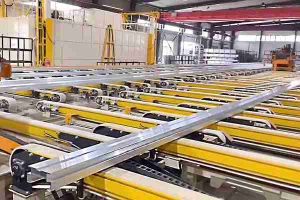
When a conveyor belt walks off centre, the belt gets blamed and the frame gets ignored. In most cases the belt is doing exactly what the geometry is telling it to do, and the geometry was set when the frame was built.
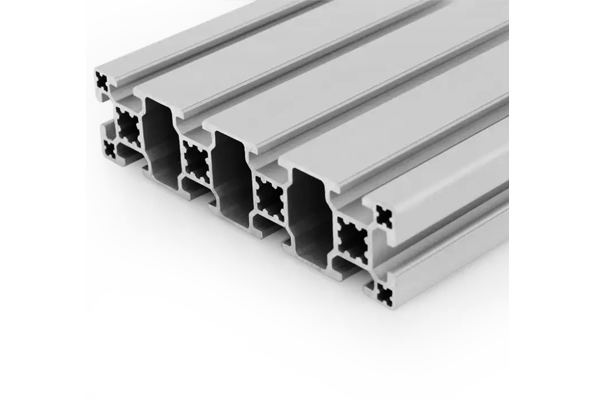
Short answer
A belt tracks toward the end of a roller it reaches first, so it drifts whenever the rollers are not parallel to each other and square to the belt’s direction of travel. On an aluminium conveyor that condition is set by three frame properties: the parallelism of the two side frames, the level across the width, and the deflection of the span between legs. A frame that is square and level when empty can lose all three under load, which is why mistracking often appears only once the conveyor is running.
Why the belt gets blamed
Belt tracking is a maintenance problem in most people’s minds: adjust the rollers, tension the belt, and if it persists, replace the belt. Those steps work often enough to reinforce the belief, and they work because they compensate for a geometry error rather than correcting it.
The mechanical rule is simple. A belt moves toward the end of a roller that it contacts first. If two rollers are not parallel, one end of the belt reaches its roller slightly before the other, and the belt steers. Every tracking adjustment is a way of introducing a deliberate, opposite misalignment to cancel an unintended one.
That is why adjusted conveyors drift again. The compensation is set for one load, one temperature and one belt tension. Change any of them — or let the frame deflect a little more under a heavier load — and the cancellation no longer balances.
The diagnostic that settles it
Empty the conveyor and watch it. If it tracks true when empty and drifts when loaded, the cause is deflection in the frame, not the belt. That single observation separates a frame problem from a belt problem in about a minute.
Three geometric conditions, all set during build
An aluminium conveyor frame has to satisfy three conditions that are independent of each other, and all three are established before the belt is ever fitted.
The first is parallelism between the two side frames. If the frames converge or diverge along the length, the rollers mounted across them cannot be parallel, and no amount of adjustment makes the belt run true over the whole length — only at the point where it was adjusted.
The second is level across the width. A frame that is twisted, with one side higher than the other, puts the belt on a slight slope, and gravity does the rest. Twist is the condition most often missed because it is invisible in a plan view and because a frame can be perfectly level at both ends and still be twisted in the middle.
The third is the span between legs. Under load the frame sags, and sag changes the relative position of the rollers along the length. A conveyor that is true when empty and drifts when loaded is telling you the span is too long or the section too light for the load.
| Condition | What goes wrong | What the belt does | Where it is set |
|---|---|---|---|
| Parallelism | Side frames converge or diverge | Drifts consistently, worse at one end | Side frame set-out and bracing |
| Level across width | Frame is twisted along its length | Drifts to the low side | Leg levelling and cross members |
| Span deflection | Frame sags between legs | True empty, drifts loaded | Leg spacing and section choice |
| Roller squareness | Roller not square to travel | Drifts at one roller | Machining of the mounting faces |
Accumulated tolerance: the long-conveyor problem
A short conveyor is easy to build true. A long one is built from sections, and every joint contributes a small error. Individually those errors are inside tolerance; added together along twenty metres they are not.
The mechanism is straightforward. Each frame joint has a positional tolerance, and each is assembled to the previous one rather than to a common datum. A tenth of a millimetre at each of fifty joints is five millimetres of drift at the far end, and five millimetres is more than enough to make a belt wander visibly.
The fix is a datum. Build the conveyor to a measured line rather than joint to joint, so that each section is corrected against a reference instead of inheriting the error of the one before it. On a long run that single change is usually worth more than any upgrade to the section.
RULE 1
Build to a line, not joint to joint. A common datum stops errors accumulating.
RULE 2
Level across the width, not just at the ends. Twist hides in the middle.
RULE 3
Check under load, not empty. Deflection is a loaded condition.
RULE 4
Re-check after any modification. Adding a module moves the datum.
Measuring it without a laboratory
Three measurements settle whether a conveyor frame is true, and none of them needs specialist equipment beyond a line and a level.
Parallelism is checked with a taut line or a laser along each side frame, measuring the offset at intervals. The frame’s width should be constant along its whole length; where it is not, the frames are not parallel. Level across the width is checked with a spirit level or a straightedge and level at several points along the length, not just at the ends, which is where twist shows up.
Deflection is measured by recording the frame’s position empty and then loaded at the mid-span. If the mid-span drops enough to change the roller geometry, the span or the section needs attention. The threshold depends on what the conveyor handles and what the process tolerates, so the useful step is to state the limit on the drawing rather than to look up a number.
- Frame width at intervals along the length
- Cross level at several points, not just the ends
- Mid-span position, empty and loaded
- Roller squareness to the direction of travel
- Before the belt is fitted
- Again under full product load
- After any frame modification
- On a service interval for long runs
What to send with a conveyor frame enquiry
A conveyor frame enquiry usually arrives with a length, a width and a belt type. The items that decide whether it will track are the ones about load, support and how the frame will be built.
RFQ checklist — conveyor framing
- Length, and whether it is built in sections — sections introduce joints, and joints accumulate error.
- Product load, distributed and peak — deflection under load is what changes the geometry.
- Leg spacing — the span, not the total length, governs deflection.
- Belt type and width — it sets the roller and the frame width requirement.
- Environment — washdown, dust, temperature; it changes the finish and the fastener material.
- Parallelism and level tolerance — state the target, so it can be built and checked against it.
- Whether adjustability is required — many frames need provision for tracking adjustment by design.
- Floor condition and anchoring — an unlevel floor twists a frame that was built true.
State whether the conveyor will ever be extended. Modular frames are chosen for that reason, and provision for it is much cheaper at the design stage.
Four ways a conveyor frame loses tracking
Related on this site
- PG40 80 x 40 six-slot heavy profile— a deeper beam for longer conveyor spans
- PG45 90 x 45 six-slot heavy profile— heavier option for loaded runs
- 40 series aluminium profiles— the series most conveyor frames use
- Modular framing: a load-tier map— where conveyor framing sits by load
Terms used in this article
- Tracking
- The tendency of a belt to stay centred on its rollers.
- Mistracking
- Drift of the belt away from centre, usually toward the end of a roller it reaches first.
- Twist
- A condition where one side of a frame is higher than the other along its length, invisible in plan view.
- Datum
- A reference line or surface that all parts of an assembly are measured against.
- Accumulated tolerance
- The sum of small individual errors across many joints or parts.
- Mid-span
- The point halfway between supports, where deflection is greatest.
Questions buyers ask
My belt drifts only when loaded. Is it the belt?
Almost certainly not. True when empty and drifting when loaded means the frame is deflecting under load and changing the roller geometry. Look at leg spacing and section depth rather than at the belt.
How parallel do the side frames need to be?
It depends on the belt and the process. Rather than looking up a number, state a parallelism target on the drawing and build and inspect against it. That makes the requirement checkable instead of assumed.
Can I build a long conveyor in sections?
Yes, and modular framing is well suited to it, but build each section to a common datum rather than to the previous section. Otherwise small joint errors accumulate into a visible drift.
Why does the drift come back after adjustment?
Because adjustment cancels a geometry error rather than removing it. When the load, temperature or belt tension changes, the compensation no longer balances and the drift returns.
Does the floor matter?
Yes. An unlevel or uneven floor twists a frame that was built true, and anchoring to a poor floor locks the twist in. Check and level the base condition before the frame is fixed.
Send the length, the load and the leg spacing
Give us the run length, the product load and the span, and we will check deflection and specify the frame geometry the belt needs.
Request a quoteRelated reading
Twelve more engineering notes from this blog, picked for this article — plus every category below.
 ApplicationsCleanroom and Medical Framing: There Is No Medical-Grade Aluminium Extrusion
 ApplicationsHow to Choose the Right 4040 T-Slot Aluminium Profile for Industrial Applications
 Engineering Design6061-T5 vs 6063-T5: What the Temper Label Really Decides
 Engineering Design30 Series T-Slot Profiles: The Middle That Has to Justify Itself
 Engineering DesignAluminium vs Steel, Extruded vs Cast: What Actually Changes
- Engineering DesignStandard vs Custom Aluminium Extrusion: The Break-Even Calculation
 Engineering DesignESD Anti-Static Workbench Grounding: The Four Joints That Break the Path
 Engineering DesignT-Slot Cross-Brand Compatibility: Bosch, Item and Generic
- Quality and InspectionGlobal Sourcing Excellence: Multi-Category OEM and ODM Manufacturing and Supply Chain Integration
 Quality and InspectionAluminium Extrusion Claims: What the Contract Must Say
 Quality and InspectionT-Slot Aluminium Profiles for Industrial Frames and Automation: A Specification Playbook
 Materials and EngineeringAluminium Corrosion: Why a Salt Spray Number Is a Ranking, Not a Life
