Aluminium Extrusion Price per kg in 2026
Extrusion is quoted per kg because the input is billed per tonne of billet, but buyers budget per metre. The conversion is the weight per metre: in 2026, silver-anodised 6063-T5 T-slot commonly lands near USD 2.80–3.60/kg FOB China, so a 4040 at ~1.55 kg/m is about USD 4.34–5.58/m before packing and freight.
Short answer
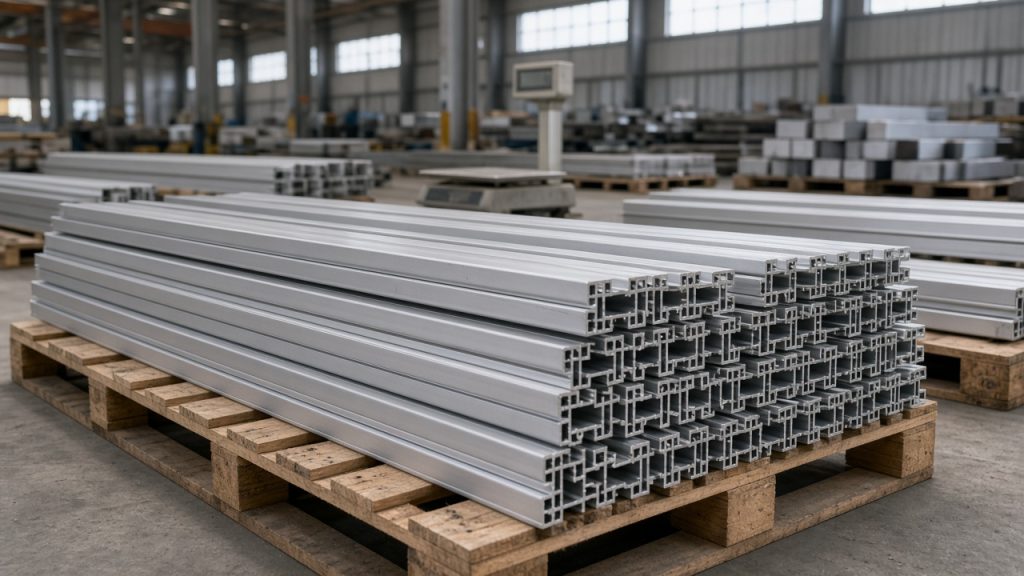
For standard 6063-T5 industrial T-slot from China in 2026, use USD 2.50–3.20/kg FOB for mill finish and USD 2.80–3.60/kg FOB for silver anodising as the working process bands. Multiply by the section’s kg/m to get USD/m. Alloy (6061-T6) and powder coating each add roughly USD 0.20–0.60/kg. Quantity steps at 500 m, 2 000 m, 5 000 m and 10 000 m dilute die and setup. Payment is T/T 30% deposit and 70% before shipment, or L/C at sight, on FOB/CIF/DAP/DDP from Shanghai or Ningbo.
What is the price per kg for extrusion in 2026 (by size)
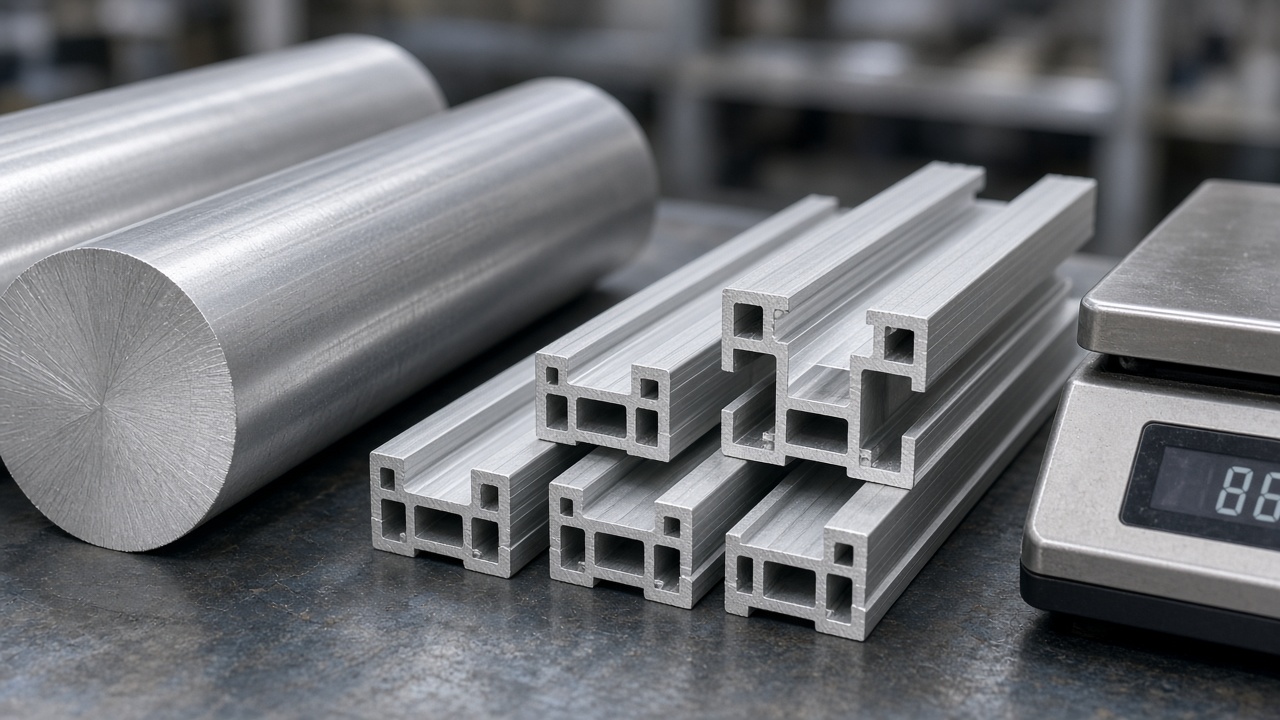
Reference 2026 FOB China kilogram bands for silver-anodised 6063-T5 T-slot off an existing die sit in a narrow range, with small sections carrying a modest conversion premium and large CCD sections sitting toward the floor of the band.
The table below folds the eleven sizes buyers ask about into one grid. “Reference price” is USD/kg FOB China for silver anodising at roughly 500–2 000 m; mill finish typically sits USD 0.30–0.40/kg lower. Circumscribed circle (CCD) is the press-size proxy that drives which press and die you need.
| Section | Circumscribed circle | Type | Reference price (USD) | Notes |
|---|---|---|---|---|
| 100×100 (100100) | 141 mm | 6063-T5 T-slot | USD 2.70–3.50/kg | ~10.50 kg/m; large CCD; FOB China 2026 anodised |
| 160×80 (16080) | 179 mm | 6063-T5 T-slot | USD 2.70–3.50/kg | ~9.80 kg/m; large CCD; press capacity drives die |
| 20×20 (2020) | 28 mm | 6063-T5 T-slot | USD 3.00–3.80/kg | ~0.50 kg/m; small-section conversion premium |
| 30×30 (3030) | 42 mm | 6063-T5 T-slot | USD 2.90–3.70/kg | ~1.00 kg/m; light frame staple |
| 40×40 (4040) | 57 mm | 6063-T5 T-slot | USD 2.80–3.60/kg | ~1.55 kg/m; machine-frame mid band |
| 40×80 (4080) | 89 mm | 6063-T5 T-slot | USD 2.80–3.60/kg | ~3.00 kg/m; rectangular strong-axis member |
| 45×45 (4545) | 64 mm | 6063-T5 T-slot | USD 2.80–3.60/kg | ~2.00 kg/m; 10 mm slot family common |
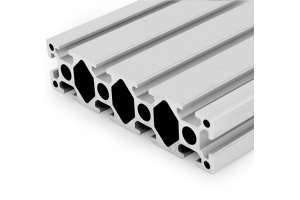
| 45×90 (4590) | 101 mm | 6063-T5 T-slot | USD 2.75–3.55/kg | ~4.10 kg/m; six-slot heavy rail |
| 50×50 (5050) | 71 mm | 6063-T5 T-slot | USD 2.80–3.60/kg | ~2.60 kg/m; mid-heavy square |
| 80×80 (8080) | 113 mm | 6063-T5 T-slot | USD 2.70–3.50/kg | ~6.00 kg/m; large frame / gantry |
| 90×90 (9090) | 127 mm | 6063-T5 T-slot | USD 2.70–3.50/kg | ~8.00 kg/m; heavy series; check press CCD |
Example conversion: 4040 at 1.55 kg/m × USD 3.20/kg = USD 4.96/m before packing. Ask for USD/kg and USD/m on the same sheet so the weight assumption is visible.
What the price is actually made of
Kilogram price is metal plus conversion plus finish, not a single catalogue number.
Start from the billet. In 2026 the China spot aluminium anchor has sat near roughly RMB 23 000–24 000 per tonne (about USD 3.20–3.40/kg of metal at an indicative RMB/USD near 7.15). Extrusion conversion for standard industrial sections typically adds about USD 0.20–0.50/kg. Silver anodising commonly adds about USD 0.30–0.60/kg; powder coating is similar or higher depending on colour and masking. Alloy and temper matter: 6061-T6 usually sits USD 0.20–0.40/kg above 6063-T5 for the same outline.
The useful check is the chain RMB/t → USD/kg → USD/m. Take metal plus conversion plus finish to get process USD/kg, then multiply by kg/m from the drawing or catalogue. If a quote shows only USD/m, reverse it with the stated mass so you can compare suppliers on the same kilogram base.
How quantity changes the unit price
Unit price falls when fixed costs are spread over more metres, not when the billet somehow gets cheaper.
MOQ is 150 m off an existing die and 500 m with a new die. Price steps at 500 m, 2 000 m, 5 000 m and 10 000 m are where die amortisation, press setup and packing labour dilute. A first 150 m lot carries more setup per metre than a 5 000 m programme of the same section. Mixing several sections in one container can fill freight without hitting each section’s best step, so say whether you need the lowest kg price on one SKU or a workable mix.
New-die programmes add tooling cash and usually 7–12 days of die making before the first press run. That tooling is a separate line on the quote; it should not be hidden inside an inflated USD/kg. Payment remains T/T 30% deposit and 70% before shipment, or L/C at sight, regardless of which quantity step you land on.
What to send us for a firm quote
A firm kilogram quote needs the section, finish, alloy, metres and Incoterm — not a request for “best price”.
RFQ checklist — price per kg
- Section / drawing — envelope, slot, wall, and kg/m if you have it.
- Alloy and temper — 6063-T5, 6061-T6 or other.
- Finish — mill, silver anodised (µm), powder colour, or bare for coating elsewhere.
- Metres and cuts — total metres, cut lengths, and whether existing or new die.
- Quantity step — target 500 / 2 000 / 5 000 / 10 000 m if known.
- Incoterm and port — FOB / CIF / DAP / DDP; Shanghai or Ningbo unless you name another.
- Payment — T/T 30/70 or L/C at sight.
Ask for USD/kg and USD/m on one sheet with die and freight as separate lines. That is the only way to compare two 2026 quotes without guessing the mass.
Three ways a kg quote misleads
Related on this site
- how die cost amortises per meter — building USD/m from kg/m and process price
- minimum order with a new die — 150 m existing vs 500 m new
- die making adds 7–12 days — where tooling sits in the schedule
- who owns the die — tooling cash vs ownership
Terms used in this article
- FOB
- Free On Board: seller delivers on board at the named port (Shanghai or Ningbo); buyer takes freight and risk thereafter.
- Process price per kg
- Metal plus extrusion conversion plus finish, before packing and ocean freight.
- Circumscribed circle (CCD)
- The smallest circle that encloses the section; it decides press capacity and die size.
- Die amortisation
- Spreading tooling cost over the metres ordered so unit price falls as quantity rises.
- 6063-T5
- The common architectural/industrial extrusion alloy and temper for T-slot frames.
Questions buyers ask
What is included in the quoted price?
A typical 2026 FOB kilogram quote covers billet, extrusion, the stated finish, and factory packing to the named Chinese port. It excludes ocean freight, destination duty, inland delivery and any new-die charge unless those lines are listed. CIF, DAP and DDP add freight and, for DDP, import clearance — ask which Incoterm the number uses.
Do you charge for samples?
Short cut samples off an existing die are usually charged at a sample rate plus courier; the metal cost is small compared with freight. New-die samples wait for tooling (typically 7–12 days of die making) and the die fee is separate. Say whether you need mill or anodised sample finish before we cut.
How long is the quotation valid?
Metal moves with the spot market, so a firm USD/kg band is commonly held for 7–14 days unless the quote states otherwise. Long programmes can fix a formula (metal index plus conversion) rather than a frozen number. Reconfirm if billet moves more than a few percent before you deposit.
Can the price be fixed for a contract?
Yes for a defined volume and window: either a firm USD/kg for a call-off period, or metal-index plus fixed conversion. State the metres, finish and Incoterm in the contract. Payment stays T/T 30% deposit and 70% before shipment, or L/C at sight, unless you negotiate a different structure for a rolling programme.
Send the section and finish for a 2026 USD/kg sheet
Give us the drawing or series, alloy, finish, metres and Incoterm. We return USD/kg and USD/m on one sheet with die and freight as separate lines.
Request a quoteRelated reading
Twelve more engineering notes from this blog, picked for this article — plus every category below.
 Sourcing and ProcurementAluminium Profile Price Breaks: How Volume Changes the Unit Price
 Engineering DesignHow to Choose an Aluminium Extrusion Profile: The Three Decisions That Bind
 Engineering DesignStandard vs Custom Aluminium Extrusion: The Break-Even Calculation
 Quality and InspectionAluminium Extrusion Claims: What the Contract Must Say
 Engineering DesignAluminium Extrusion Capacity: What a Factory Can Actually Deliver
 Engineering DesignAluminium Extrusion Die Cost (2026): Price by Section Size
 Quality and InspectionGood vs Bad Aluminium Profiles: What Your Receiving Dock Can and Cannot Check
 Sourcing and ProcurementDistributor Terms: Territory, Margin and Price Protection
 Engineering DesignAluminium Extrusion Tolerances: What to Write, and How to Inspect
 Engineering Design4040 T-Slot Aluminium Profile for Machine Frames: Choose It by Deflection
 ApplicationsAluminium Profiles for Automation Equipment Frames: Design From the Assembly Floor
 ApplicationsAluminium Partitions: The Three Performance Numbers Behind the Aesthetic
