Which Profile Size for Your Application: A Selection Guide
Pick the series by the governing constraint first: load, unsupported span, or slot/hardware — then lock one series across the frame. For a typical workbench at 1 m spans under ~50 kg, 3030 or 4040 is the practical band; 2020 is for light fixtures and short members, not primary bench rails.
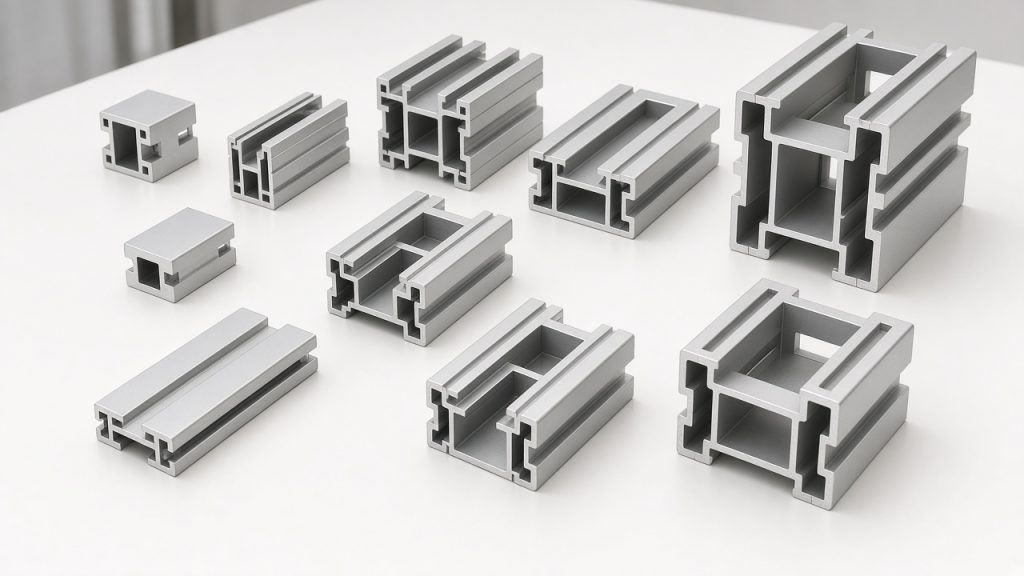
Short answer
Use 2020 only where members stay short (roughly under 500–700 mm) and loads are light — jigs, guards, sensor mounts. Step to 3030 for mid-weight benches and short machine frames. Make 4040 (or 4545 in a 45-series hardware set) the default for industrial workbenches, conveyor sides, robot-cell fences and automation bases. Go to 50/60 series or a rectangular 4080/4590 when spans grow past about 1.5 m under heavy distributed load or when deflection must stay near 1 mm. Keep one slot series for the whole frame so T-nuts and brackets interchange. Extrusion tolerances follow EN 755-9 (wall ±0.15 mm, straightness 1.5 mm/m, twist 2°); fabricated cut length ±0.5 mm, hole position ±0.2 mm, end square within 0.3 mm. Catalogue T-slot runs are usually 6063-T5. MOQ is 150 m off an existing die and 500 m with a new die; payment T/T 30/70 or L/C at sight on FOB, CIF, DAP or DDP from Shanghai or Ningbo.
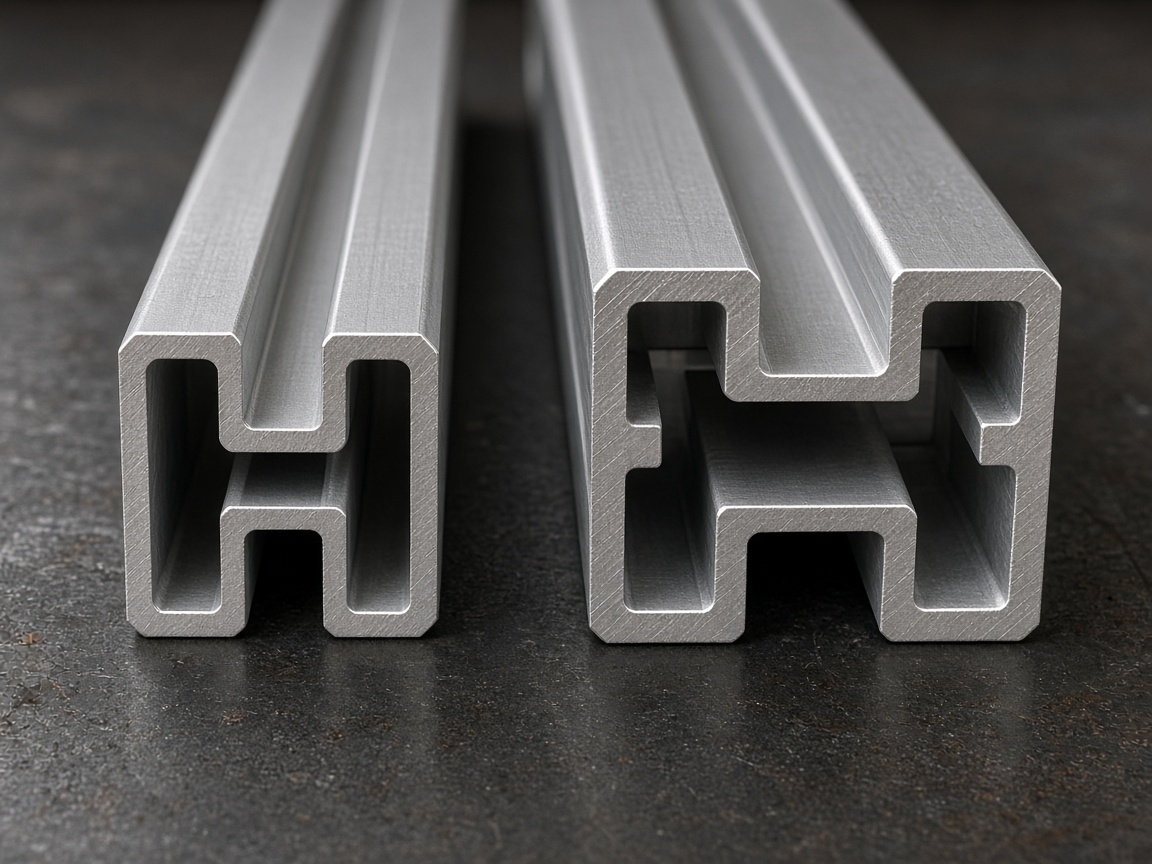
Should I use 2020 or a deeper section for a workbench
For a workbench, conveyor frame, machine frame or robot-cell fence, start with 3030 or 4040 — not 2020 — unless every primary rail is short and the top is self-stiffening.
2020’s second moment of area is typically around 0.7 cm⁴. Under the same mid-span load, deflection scales with 1/I and with L³, so a 1 m 2020 rail sags many times more than a 4040. That is why 2020 works for desktop fixtures and light guards, and fails as the primary perimeter of a loaded bench. A machine frame and a robot-cell fence see vibration and occasional impact; a conveyor frame sees continuous distributed load along the side rails. In all three cases a deeper section — 3030 for light duty, 4040 for industrial — cuts brace count and keeps the top flat.
Use 2020 inside a deeper frame as braces, panel ribs or light shelves. Do not mix slot series on the same faces if you want one T-nut family. If the bench must move on casters, treat dynamic load as higher than static nameplate weight and prefer 4040 uprights.
| Application | 2020 verdict | Better default | Why |
|---|---|---|---|
| Workbench top rails | Only if spans <~0.6 m and light top | 3030 / 4040 | Deflection, not yield, governs flatness |
| Machine frame | Rarely as primary | 4040 / 4080 | Vibration and mount stiffness |
| Robot cell fence | Panels only | 4040 posts | Impact and tall uprights |
| Conveyor frame | Light belt only, short bays | 4040 / 4080 | Continuous side-rail load |
| Jig / sensor mount | Yes | 2020 / 2040 | Short members, low mass |
| Guard / light enclosure | Often yes | 2020 / 3030 | Panel carries much of the stiffness |
Which series profile to use (by series)
Map series to a load band and a typical unsupported span, then pick the lightest series that still meets your deflection limit — not the largest that fits the budget.
Slot width travels with the series family: roughly 6 mm on 20-series, 8 mm on 30-series, 8 or 10 mm on 40-series, and 10 mm on most 45/50/60 industrial lines. Changing series mid-project means new nuts, brackets and often new panel fasteners. For OEM product development, lock the series early so the accessory bill of materials stays stable across revisions.
| Series | Slot | Typical use | Load band | Verdict |
|---|---|---|---|---|
| 20 series | ~6 mm | Jigs, small enclosures, short guards | Light / short span | Use when members stay short |
| 30 series | ~8 mm | Light workbenches, mid CNC, carts | Light–medium | First step up from 2020 |
| 40 series | ~8 / 10 mm | Industrial benches, automation, fences | Medium–heavy | Default industrial pick |
| 45 series | ~10 mm | Heavy frames matching EU 45 hardware | Medium–heavy | Choose when 45 hardware is the plant standard |
| 50 series | ~10 mm | Longer spans, heavier decks | Heavy | When 4040 deflection is marginal |
| 60 series | ~10 mm+ | Machine bases, long beams | Heavy / structural | Or use rectangular 4080/4590 first |
What is the right slot size for a workbench
For a workbench the right slot is the one that matches the T-nuts and brackets you will stock — usually 8 mm (30-series) or 8/10 mm (40-series) — not the widest mouth available.
A wider slot admits a larger nut and bolt, which helps clamp force on heavy tops, but it also changes the entire accessory set. If the plant already standardises on M6 or M8 T-nuts for 8 mm slots, stay on that series. If you need M8 in a 10 mm industrial slot for higher joint preload, move to a 40/45-series line and accept the heavier kg/m. Mixing 6 mm and 10 mm slots on one bench creates two fastener families and assembly errors.
| Slot (approx.) | Typical series | Common fasteners | Workbench fit |
|---|---|---|---|
| 6 mm | 20 | M4 / M5 | Light tops, short bays only |
| 8 mm | 30 / some 40 | M5 / M6 / M8 | Good general workbench slot |
| 8.2 mm | Some EU lines | System-specific | Only if matching that hardware set |
| 10 mm | 40 / 45 / 50 | M6 / M8 | Industrial benches and machine frames |
| Mixed slots | Avoid | Two BOMs | Reject unless forced by retrofit |
Which series should I pick for a workbench that has to be moved
For a movable workbench, pick 4040 (or 4545) uprights and perimeter rails rather than 2020/3030, because caster loads and racking during moves raise the effective demand well above static top weight.
A bench that is lifted or rolled sees concentrated loads at feet, side loads when turning, and occasional impacts into door frames. Light series that look adequate on a static calculation often twist at the base. Prefer square 4040 for equal stiffness in both axes, add lower stretchers, and use locking casters rated above the fully loaded mass. If the top mass is high and spans exceed 1.2 m, a 4080 long rail on the strong axis is cheaper than adding many braces in 3030.
| Move pattern | Series pick | Notes |
|---|---|---|
| Occasional roll in one room | 3030 min / 4040 preferred | Locking casters; lower stretcher |
| Daily relocation | 4040 / 4545 | Treat as dynamic; check foot plates |
| Forklift / pallet move | 4040+ with base frame | Fork pockets or skid rails |
| Height-adjustable + casters | 4040 uprights | Column buckling + caster offset |
| Light cart only | 3030 | Keep deck load modest |
Which profile for a workbench that gets rebuilt often
If the workbench is rebuilt often, stay on one catalogue series with drop-in or roll-in T-nuts and external brackets — typically 3030 or 4040 — and avoid welded or heavily CNC’d one-off joints.
Rebuild frequency rewards interchangeability: same slot, same nut, same bracket hole pattern. End-tapped hidden joints look cleaner but slow reconfiguration and wear tapped cores. Pre-load spare drop-in nuts in long rails so accessories can be added without tearing the frame down. For OEM product lines that ship as kits, 4040 with a published accessory list is easier to document than a mix of 20- and 40-series parts.
| Rebuild need | Profile approach | Hardware |
|---|---|---|
| Weekly reconfiguration | 4040 single series | Drop-in / roll-in nuts |
| Monthly layout change | 3030 or 4040 | External brackets |
| Kit / dealer rebuild | One series only | Documented BOM |
| Permanent factory line | 4040 / 4080 | May add end-taps |
| Show / demo units | 3030 light | Fast cosmetic rebuild |
What profile suits a workbench product
For a workbench sold as a product, standardise on one industrial series — usually 4040 or 4545 — so dies, accessories, manuals and spare parts stay on one track across SKUs.
Productised benches live or die on accessory continuity and predictable deflection under catalogue loads. A 4040 library die keeps MOQ at 150 m; a new custom aesthetic section jumps to 500 m plus die making (7–12 days). In 2026, mill-finish 4040 off an existing die commonly quotes in the mid single-digit USD per metre FOB China once quantity clears the floor — see how die cost amortises per meter. Spec EN 755-9 on the print, state 6063-T5 unless structural alloy is required, and publish a deflection limit (for example L/500 under rated top load) so dealers and end users share one acceptance number.
| Product type | Recommended series | Commercial note |
|---|---|---|
| Entry workbench SKU | 3030 | 150 m existing-die MOQ |
| Industrial workbench SKU | 4040 / 4545 | Default; one accessory set |
| Heavy / long-span SKU | 4080 / 4590 | Orient strong axis to span |
| Cleanroom / lab SKU | 4040 anodised | Finish MOQ may exceed extrusion MOQ |
| Private-label custom look | New die | 500 m + die; see minimum order with a new die |
RFQ checklist — profile selection
- Application — workbench, machine frame, fence, conveyor, product SKU.
- Span and load — unsupported length and distributed or point load in kg.
- Deflection limit — L/500, L/360 or a hard millimetre number.
- Slot / hardware family — 6 / 8 / 10 mm and whether existing nuts are reused.
- Movable or fixed — casters change the series pick.
- Alloy / finish — usually 6063-T5; anodise or powder if specified.
- Metres and die status — library (150 m) or new (500 m).
- Incoterm — FOB / CIF / DAP / DDP, Shanghai or Ningbo.
Send span, load and the deflection limit in one line. That triad picks the series faster than a catalogue browse.
Four selection mistakes
Related on this site
- how die cost amortises per meter— unit rate after tooling
- minimum order with a new die— 150 m vs 500 m floors
- die making adds 7–12 days— before first metal
- who owns the die— title after tooling is paid
Terms used in this article
- Series
- The modular size family (20, 30, 40, 45, 50, 60) that sets envelope and usually the slot width.
- Slot
- The T-groove opening that admits nuts and brackets; must match the hardware family.
- Unsupported span
- Clear length between supports; deflection grows with the cube of this length.
- Load band
- A practical range of static payload for which a series is the economic default.
- EN 755-9
- Extruded aluminium dimensional tolerance standard used here for wall, straightness and twist.
Questions buyers ask
What fastener torque should I use on 2020 joints
Treat published M5 T-nut torques from the hardware maker as the ceiling, typically in the low N·m range for 20-series drop-in nuts — enough to clamp, not enough to crush the slot lip. On 3030/4040 with M6/M8, follow the nut maker’s table; anodised slots need slightly higher torque for the same preload than mill finish. If the joint slips in service, increase friction area (larger bracket) before maxing torque.
Which profile size for a 1 m span under 20 kg
2020 can work if mid-span deflection of several millimetres is acceptable; 3030 is the comfortable pick for a flat feel. At 1 m and 20 kg mid-span, most catalogue 3030 sections stay near or under a few millimetres; confirm with the supplier’s I value and your L/500 or L/360 limit.
Which profile size for a 1 m span under 50 kg
Prefer 3030 for light benches and 4040 for industrial tops. Fifty kilograms mid-span on 1 m is where 2020 becomes a vibration and flatness problem for work surfaces.
Which profile size for a 1 m span under 100 kg
4040 is the default. Orient a 4080 with the 80 mm depth in the bending plane if you need roughly 1 mm-class deflection without adding a second rail.
Which profile size for a 1 m span under 150 kg
4040 with a second parallel rail, or a single 4080/4545 on the strong axis. Check L/500 explicitly; strength is rarely the limiter.
Which profile size for a 1 m span under 200 kg
4080 or 4590 strong-axis, or twin 4040 rails. A lone 3030 is the wrong answer at this load and span.
Which profile size for a 1 m span under 300 kg
Use 4080/4590 or 5050/8080 depending on hardware family, or a pair of 4040 rails with a stiff top plate. Ask for the I value on the print.
Which profile size for a 1 m span under 500 kg
Plan on 8080-class sections, multiple parallel rails, or a steel insert — aluminium T-slot still works, but as a system, not as one stick.
Which profile size for a 1 m span under 800 kg
Treat this as a structural frame: 8080/9090, twin heavy rails, or hybrid aluminium-steel. Do not stretch a 4040 single beam to this load at 1 m if deflection matters.
Which profile size for a 1.5 m span under 20 kg
3030 is usually enough; 4040 if the member is a primary bench rail or must stay visually flat. Span growth hurts more than the modest load suggests because deflection scales with L³.
Which profile size for a 1.5 m span under 50 kg
4040 default; 4080 if you need tighter deflection without intermediate posts.
Which profile size for a 1.5 m span under 100 kg
4080/4590 strong-axis or twin 4040. Add a mid post if the layout allows — often cheaper than jumping a full series.
Send span, load and the series you prefer
Include unsupported length, payload in kg, deflection limit (L/500 or mm), and whether the die is library or new. We will confirm the section against EN 755-9 and your hardware family before you commit metres.
Request a quoteRelated reading
Twelve more engineering notes from this blog, picked for this article — plus every category below.
 Engineering DesignRobot Cell Framing in Aluminium: Stiffness, Damping and the 2025 Safety Revision
 Engineering DesignAluminium Extrusion Tolerances: What to Write, and How to Inspect
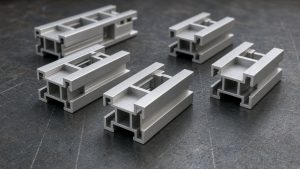 Engineering DesignMoment of Inertia and Section Modulus of T-Slot Profiles
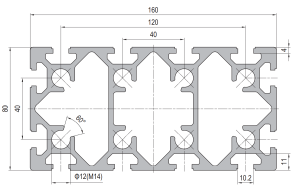 ApplicationsAluminium Greenhouse Profiles: A Snow Load Problem With a Condensation Problem
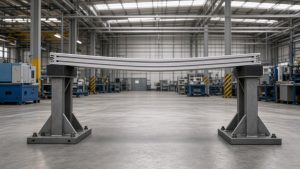 Engineering DesignAluminium Profile Max Span: Deflection Table by Section
 Materials and EngineeringRecycled Aluminium Profiles: A Number You Have to Be Able to Evidence
 Engineering DesignAluminium Profile Standard Sizes: How the Series Matrix Actually Works
- Engineering Design4040 T-Slot Aluminium Profile for Machine Frames: Choose It by Deflection
 ApplicationsCleanroom and Medical Framing: There Is No Medical-Grade Aluminium Extrusion
 Materials and EngineeringIndustrial Aluminum Profiles: Alloys, Tempers and How to Select Them
 ApplicationsESD-Safe Aluminum Profile Workbenches: Why Anodising Alone Fails the Audit
 Quality and InspectionAnodising vs Powder Coating: Thickness, Colour, Salt Spray
