8 mm slot series

30 Series Aluminium Profiles — 8 mm Slot (PG30)

The 30 series is the workhorse of modular aluminium framing: a 30 mm module with an 8 mm slot, running from 30×30 up to 60×120. It is the series most machine builders settle on because the slot is wide enough for a real M6 or M8 fixing yet the profile is light enough to handle. In European and Asian catalogues the same range is often listed as PG30.

8 mmslot width30×30 → 60×120section range6063-T6standard alloy and temper1 / 2 / 3 / 6 mstandard lengths

17 items

Products in this category

30 x 120 mm Aluminium Profile for Heavy Equipment Frames

30 x 120 mm Aluminium Profile for Heavy Equipment Frames

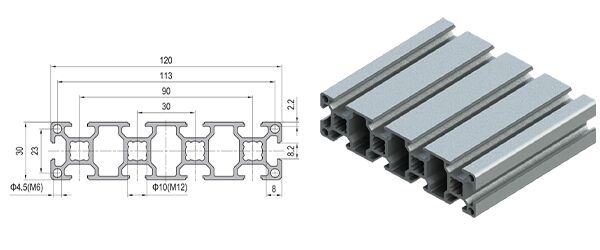
30 x 120 mm ten-slot aluminium extrusion in 6063-T5 for construction equipment guards, platform edges and attachment frames. 2.70 kg/m, with an axis ratio of about nine to one that has to be designed for.

MaterialAluminium
ToleranceEN 755-9, wall +/-0.15 mm; straightness 1.5 mm per metre; twist 2 degrees
FinishMill finish, or anodised AA15 to EN ISO 7599; clear or black
Minimum order150 m
Lead time20 to 28 days after deposit for mill finish, about one week longer for anodising
Full specification →
Joining Plate PG30 (3030)

Joining Plate PG30 (3030)

L-shaped joining plate that bolts into the 30 series T-slot to make a 90° corner joint on light frames, enclosures and guards, with no machining of the profile ends.

MaterialDie-cast aluminium ADC12 or machined 6063-T5
Tolerance±0.25 mm on bolt slot positions
FinishAnodised or powder coated
Minimum order500
Lead time15-25 days after deposit
Full specification →
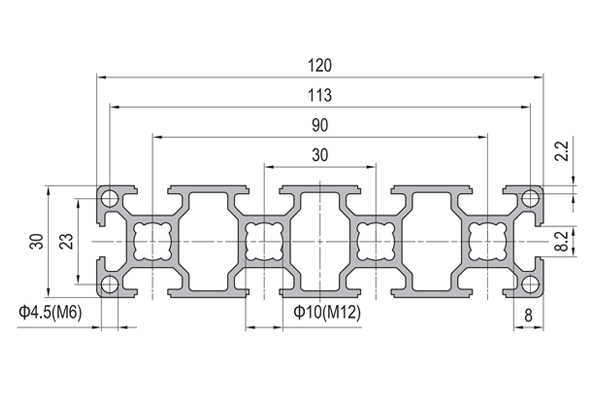
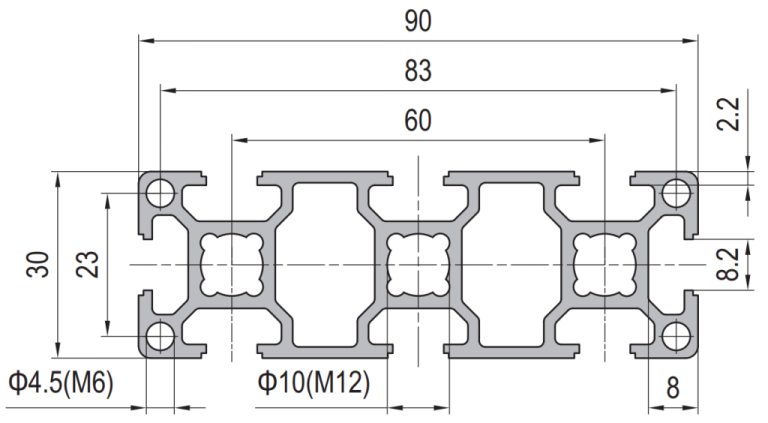
PG30 120 x 30 mm Ten Slot Aluminium Strut Profile Wide Multi Slot Rail

PG30 120 x 30 mm Ten Slot Aluminium Strut Profile Wide Multi Slot Rail

A 120 x 30 mm ten slot PG30 aluminium strut profile wide beam with 8.2 mm grooves on a 30 mm pitch. Four mounting positions per face for guard frames, accessory rails and service runs.

MaterialAluminium
ToleranceEN 755-9 / GB/T 6892, wall +/-0.15 mm
FinishMill finish / clear anodised / black anodised
Minimum order200 m
Lead timeTypically 20 to 30 days after deposit for mill finish
Full specification →
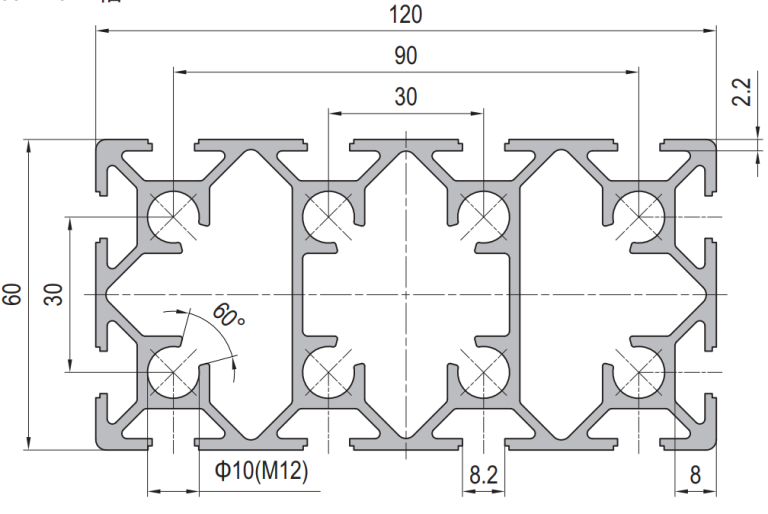
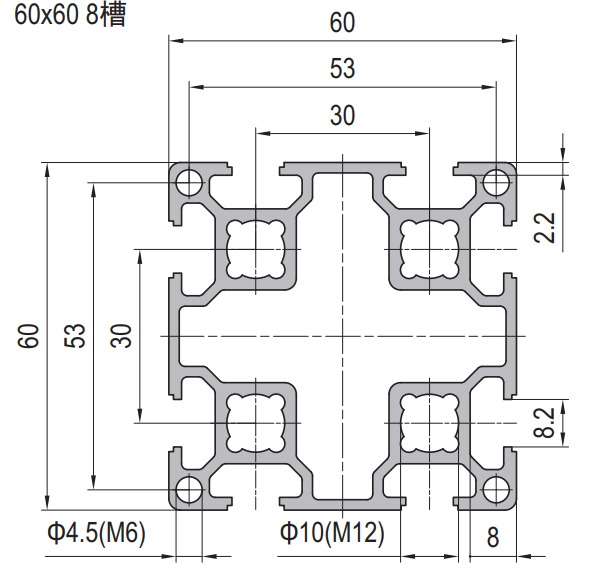
PG30 120 x 60 mm Twelve Slot Aluminium Strut Profile Heavy Frame Beam

PG30 120 x 60 mm Twelve Slot Aluminium Strut Profile Heavy Frame Beam

A 120 x 60 mm twelve slot PG30 aluminium strut profile at about 5.20 kg/m with 8.2 mm grooves on a 30 mm pitch and the outer pair 90 mm apart. Butt, corner, tee and offset joints on one member.

MaterialAluminium
ToleranceEN 755-9 / GB/T 6892, wall +/-0.15 mm
FinishMill finish / clear anodised / black anodised
Minimum order200 m
Lead timeTypically 20 to 30 days after deposit for mill finish
Full specification →
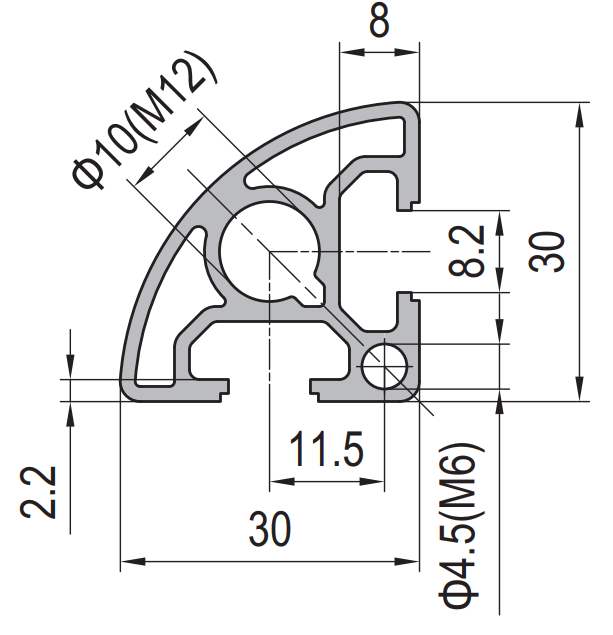
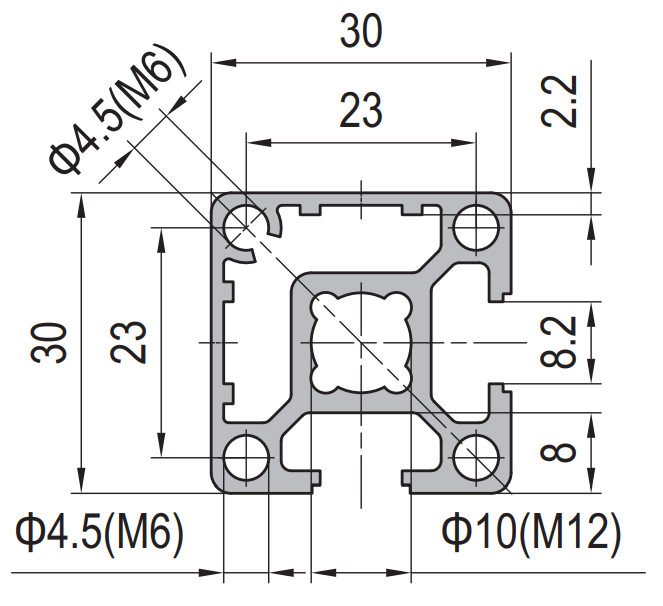
PG30 30×30 mm R90 Two Slot Aluminium Strut Profile Rounded Corner Rail

PG30 30×30 mm R90 Two Slot Aluminium Strut Profile Rounded Corner Rail

30 x 30 mm quarter round aluminium profile with one 8.2 mm T-slot on each flat face and a swept corner. Used for exposed frame edges where a sharp aluminium arris is not acceptable.

MaterialAluminium
ToleranceEN 755-9 / GB/T 6892, wall +/-0.15 mm
FinishMill finish / clear anodised / black anodised
Minimum orderMade to order; trial lengths available
Lead timeTypically 2 to 3 weeks for mill finish, about a week longer for anodising
Full specification →
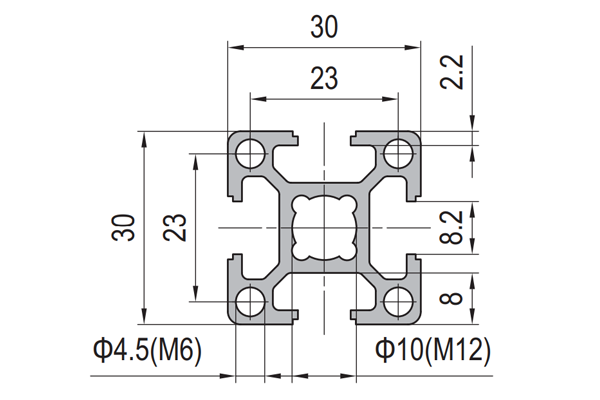
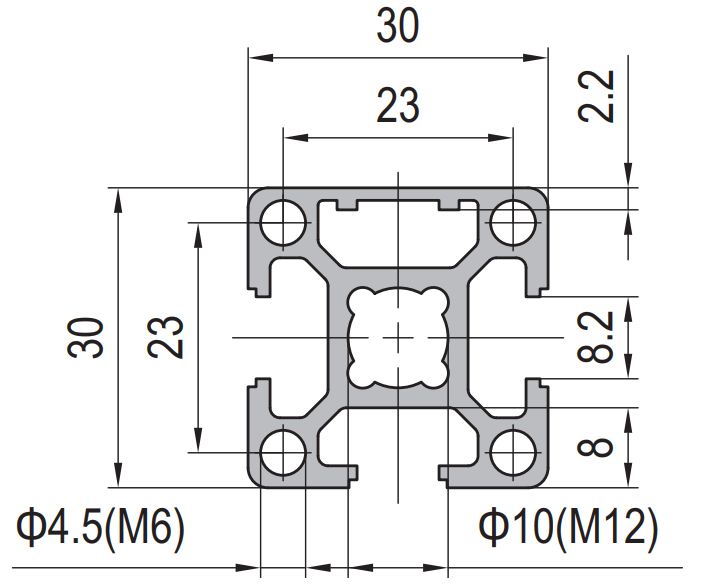
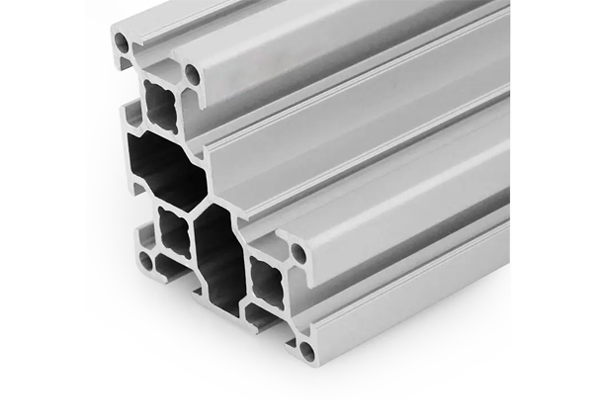
PG30 30×30 mm Three Slot Aluminium Strut Profile Light Frame Column

PG30 30×30 mm Three Slot Aluminium Strut Profile Light Frame Column

30 x 30 mm aluminium strut profile with three 8.2 mm T-slots and one closed face. The closed wall is tapped M8 to full depth, giving roughly eight threads of engagement for end joints and feet.

MaterialAluminium
ToleranceEN 755-9 / GB/T 6892, wall +/-0.15 mm
FinishMill finish / clear anodised / black anodised
Minimum orderMade to order; trial lengths available
Lead timeTypically 2 to 3 weeks for mill finish, about a week longer for anodising
Full specification →
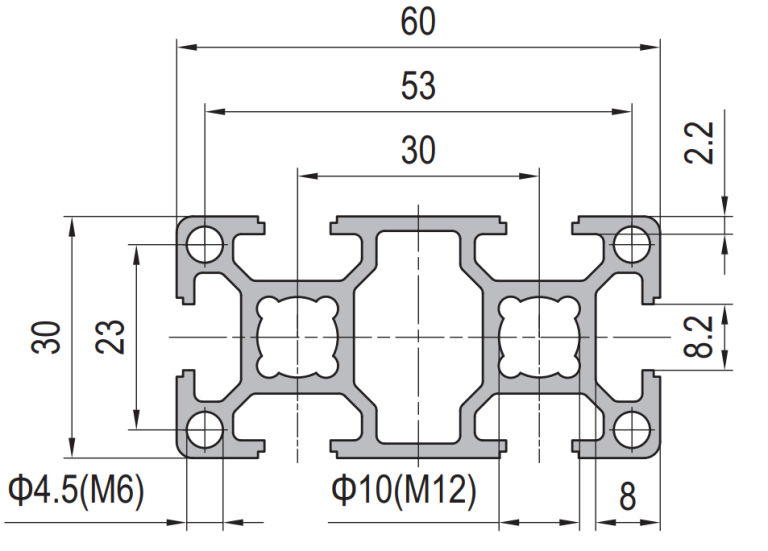
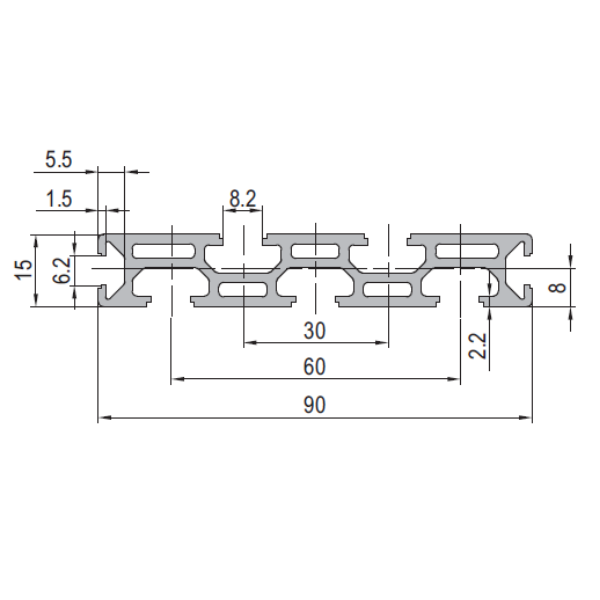
PG30 90 x 15 mm Seven Slot Aluminium Strut Profile Narrow Multi Slot Rail

PG30 90 x 15 mm Seven Slot Aluminium Strut Profile Narrow Multi Slot Rail

90 x 15 mm seven-slot aluminium strut profile with 8.2 mm grooves on a staggered 30 mm pitch. Dedicated cable and pneumatic routing rail for machine frames, using M8 fasteners.

MaterialAluminium
ToleranceEN 755-9 / GB/T 6892, wall +/-0.15 mm
FinishMill finish / clear anodised / black anodised
Minimum orderMade to order; small trial lengths available from stock offcuts
Lead timeTypically 2 to 3 weeks for mill finish, about a week longer for anodising
Full specification →
Strut Aluminium Profile 30×120 mm 3-Slot Wide Beam T-Slot Extrusion

Strut Aluminium Profile 30×120 mm 3-Slot Wide Beam T-Slot Extrusion

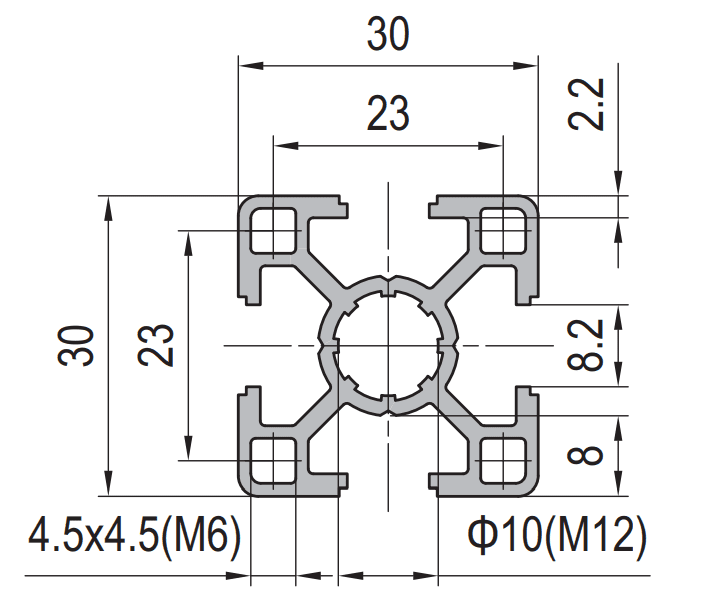
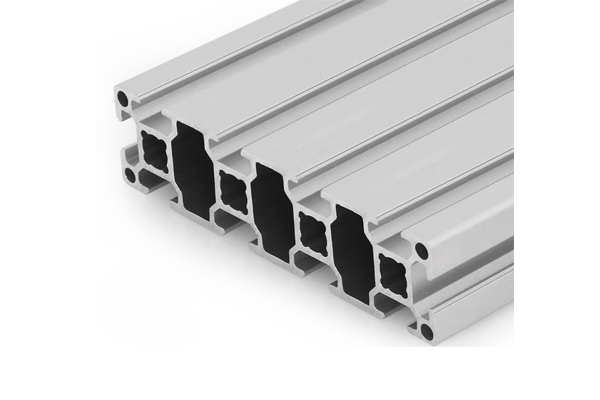
30 x 120 mm three-slot wide-beam T-slot strut aluminium profile in 6063-T5 with three M5 slots on a 30 mm pitch and a O 10 mm centre bore tapped M12. A flat cross member for bench top supports, shelf rails and wide mounting faces.

MaterialAluminium
ToleranceEN 755-9 / GB/T 6892, wall plus or minus 0.15 mm
FinishMill finish / clear anodised / black anodised
Minimum order300
Lead time22-35 days after deposit for mill finish
Full specification →
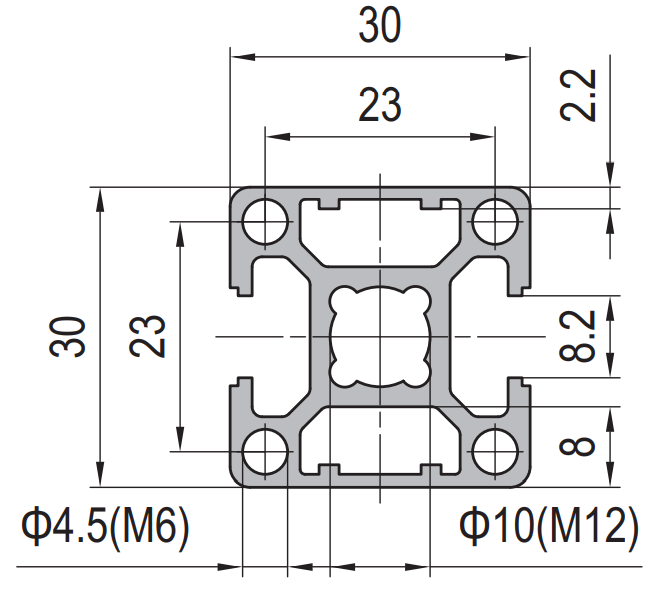
Strut Aluminium Profile 30×30 mm 4-Slot Light T-Slot Extrusion

Strut Aluminium Profile 30×30 mm 4-Slot Light T-Slot Extrusion

30 x 30 mm light-wall four-slot T-slot strut aluminium profile in 6063-T5 with M5 grooves on all four faces and a O 10 mm centre bore tapped M12. About 0.95 kg/m for portable, low-cost frames with internal cable routing.

MaterialAluminium
ToleranceEN 755-9 / GB/T 6892, wall plus or minus 0.12 mm
FinishMill finish / clear anodised / black anodised
Minimum order800
Lead time16-26 days after deposit for mill finish
Full specification →
T-Slot Nut 30 Series M6 Hammer Nut for 30×30 Aluminium Extrusion

T-Slot Nut 30 Series M6 Hammer Nut for 30×30 Aluminium Extrusion

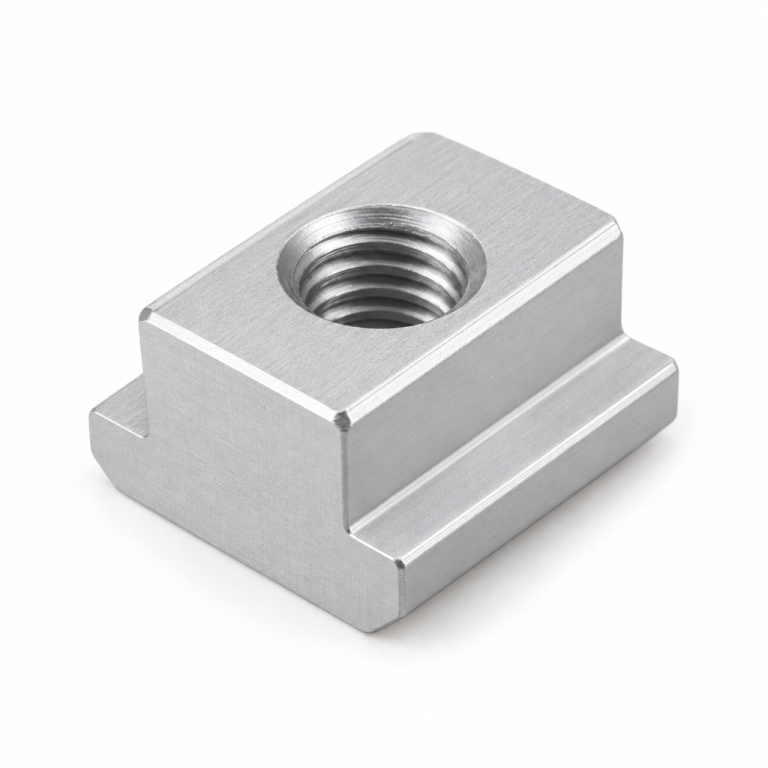
M6 hammer-head T-slot nut for the 8 mm groove of 30 x 30 mm aluminium extrusion, the standard fixing for 30 series framing. Carbon steel zinc plated or 304 stainless, 12 mm or 20 mm body, torque ceiling about 6 N m.

MaterialCarbon steel / 304 stainless steel
ToleranceThread to ISO 965-2 6H, head width -0.15 mm on the groove cavity
FinishZinc plated (clear trivalent) / passivated stainless
Minimum order10000
Lead time12-20 days after deposit for zinc plated, 18-26 days for 304
Full specification →

30 series aluminium profiles are slotted extrusions built on a 30 mm module with an 8 mm T-slot. The range covers 30×30, 30×60, 30×90, 30×120, 60×60, 60×90 and 60×120, in several wall variants. They accept M6 and M8 T-nuts, the full 8 mm connector family, and are the standard choice for machine frames, workbenches and guarding where spans stay under roughly 1,200 mm. Some suppliers list this range as PG30.

Below: how the sizes relate to each other, how to choose between them, and how the corners should be built.

What defines the 30 series

Three numbers define it. The module is 30 mm, so the standard square is 30×30 and every larger member is a multiple of that in at least one direction. The slot is 8 mm wide, which sets the fastener: an 8 mm slot takes M6 T-nuts as standard and M8 where the slot geometry allows. The series also fixes the bolt centres on connectors, which is why a 30 series bracket will not bolt onto a 40 series profile without an adaptor.

The 8 mm slot is the reason this series is so widely used. A 6 mm slot limits you to M5 and small brackets, which is fine for a sensor rail but not for a machine base. A 10 mm slot takes heavier fasteners but requires a heavier profile, and the weight and cost rise accordingly. 8 mm is the point where the fastening is genuinely structural while the frame is still light enough to move by hand.

The size family and what each size is for

All of these are 30 series and share the 8 mm slot. They differ in section area, which decides stiffness and weight.

SectionSlotsTypical roleNotes
30×304 (also 2 and 3 slot variants)Light frames, guard posts, panel edgesAvailable in standard, light and R90 corner variants
30×606Main uprights and horizontals of a bench or small machine frameThe most-used member in the series
30×908Longer spans, frame sides that also carry a panelUseful where two panels meet a single member
30×12010Beams over a wide opening, gantry rails at low loadNormally paired with 40 series at the joints
60×608Heavy uprights and compact machine basesSubstantially stiffer than 30×30 for the same length
60×90 / 60×12010–12Base frames, machine beds, large platformsOften the point where 40 series becomes the better economic choice
15×907Low-profile beams and step edgesKeeps the frame height down where headroom is limited

Choosing between the sizes

The decision is almost always about span, not about load. A 30×30 member is perfectly capable of carrying a 40 kg panel over 400 mm; over 1,500 mm the same member will sag visibly under its own weight plus a light load. Because deflection rises with the cube of the span, the practical rules are:

  • Under 600 mm — 30×30 is normally enough, and the frame stiffness comes from the joints and the bracing rather than the members.
  • 600–1,200 mm — use 30×60 as the default. It roughly doubles the section depth in one direction, which is the cheapest way to buy stiffness.
  • 1,200–2,000 mm — use 30×90 or 30×120, or add a mid-support. Adding a support is usually cheaper than a bigger profile.
  • Beyond 2,000 mm — move to 40 series or 45 series rather than trying to stiffen a 30 series beam.

Practical point: a frame is stiffened far more cheaply by a diagonal brace or a closed panel than by upgrading every member. A single 30×30 diagonal in a rectangular frame can raise the stiffness more than moving every member up one size, at a fraction of the cost and weight.

Building a 30 series corner

Corners are where 30 series frames succeed or fail, and there are four standard options. The choice is driven by whether the joint has to be invisible and whether it has to be re-openable.

MethodAppearanceRe-openableBest for
Anchor connectorFully hidden inside the slotYes, with a hex keyFrames where the outside faces must stay clean; see anchor connectors
Die-cast bracketVisible inside the cornerYesFast assembly, moderate loads; see die-cast brackets
Angle bracketVisible outside or insideYesRetrofitting a brace onto an existing frame; see angle profile brackets
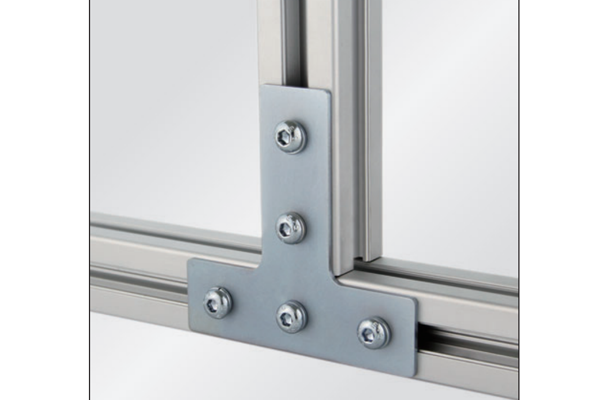
Joining plate plus bracketVisibleYesHigh-load corners where one connector would crush the slot lip; see joining plates

A single anchor connector in a 30 series corner is adequate for a bench. For a machine base that will see vibration, use two connectors, or a connector plus a plate, so the load is spread over more of the slot lip.

Cutting, tapping and machining

30 series profiles are supplied in 1 m, 2 m, 3 m and 6 m lengths and cut to a cut list on request. Because the module is small, squareness of the cut matters: a 0.5 mm error over a 600 mm member is a visible gap at the corner. We cut to ±0.3 mm with square ends and deburr every cut. Where a frame is supplied as a kit, each member is marked to the cut list.

End taps are the one machining operation worth doing at the factory. An anchor connector needs a tapped or counterbored hole in the end face of one member, and doing that on a bench drill without a jig is slow and easy to get wrong. See CNC machining for the drilling, tapping and milling we can add to the order.

Where 30 series is the right answer

Machine frames and enclosures

The standard choice where the machine footprint is under about 1.5 m and the frame has to be reconfigurable.

Workbenches and assembly stations

Bench tops, light rails, tool holders and ESD earthing all mount in the same 8 mm slot.

Conveyor guarding

Mesh and polycarbonate panels are retained by panel installation elements rather than drilled.

Laboratory and test rigs

Compact, hand-movable structures that are rebuilt between projects.

Specifying a 30 series order

Give us the section (for example 30×60), the slot width, the finish, the cut list and the quantity. If the frame has to be assembled without a drawing, a photograph of a similar frame plus the overall dimensions is usually enough for us to propose the members and the accessory list. Standard sections are quoted within one working day. Related ranges: 20 series, 40 series, connecting elements, fastening elements and profile accessories.
FAQ

Questions buyers ask about this range

What does PG30 mean?+

PG30 is a series designation used by some European and Asian suppliers for the 30 mm module range with an 8 mm slot. It is the same product as what we list as 30 series aluminium profiles; the PG number refers to the profile groove family, not to a different geometry.

Which 30 series section should I use for a machine frame?+

30x60 is the default for uprights and main horizontals. Use 30x30 for light posts and panel edges, and step up to 30x90 or 30x120 only when a span exceeds about 1,200 mm.

What size fastener fits the 30 series slot?+

An 8 mm slot takes M6 T-nuts as standard, and M8 where the slot geometry allows. Hammer nuts and T-nuts of both sizes are listed under fastening elements.

Can 30 series profiles be joined to 40 series profiles?+

Only with an adaptor, because the slot width and bolt centres differ. The usual solution is a flat adaptor plate drilled for both series, or a transition bracket.

How long a span can a 30 series profile carry?+

Practically, keep unsupported spans under about 1,200 mm for a 30x60 member with a light load. Beyond that, add a mid-support, a diagonal brace, or move to 40 series.

Do I need to tap the ends of the profiles?+

Only for anchor connectors, which need a tapped or counterbored end. If you use die-cast or angle brackets instead, no end machining is required.

What lengths do 30 series profiles come in?+

Standard lengths are 1 m, 2 m, 3 m and 6 m. Cut-to-length between roughly 100 mm and 6,000 mm is available, and cut members can be marked to a cut list for assembly.

Is 30 series suitable for an ESD workbench?+

Yes. Use satin anodised profiles and take the earth connection through dedicated earth studs or masked contact points, because the anodic layer itself is a poor conductor.

Related product categories

Strut Profiles20 Series Aluminium Profiles40 Series Aluminium Profiles45 Series Aluminium ProfilesConnecting ElementsAnchor ConnectorsFastening ElementsAll products

Need this range specified for your project?

Send the drawing, the section size or a sample and we will confirm the alloy, the tolerance, the finish and the commercial terms. Quotes for standard items normally go out within one working day.

Request a quotation