Aluminium Extrusion Section Design: What Each Feature on the Drawing Costs You
Extrusion is sold as near-unlimited shape freedom. It is closer to a menu: every hollow, every thin wall, every tightened tolerance and every visible face has a price, and most of it is paid per metre for the life of the part rather than once.
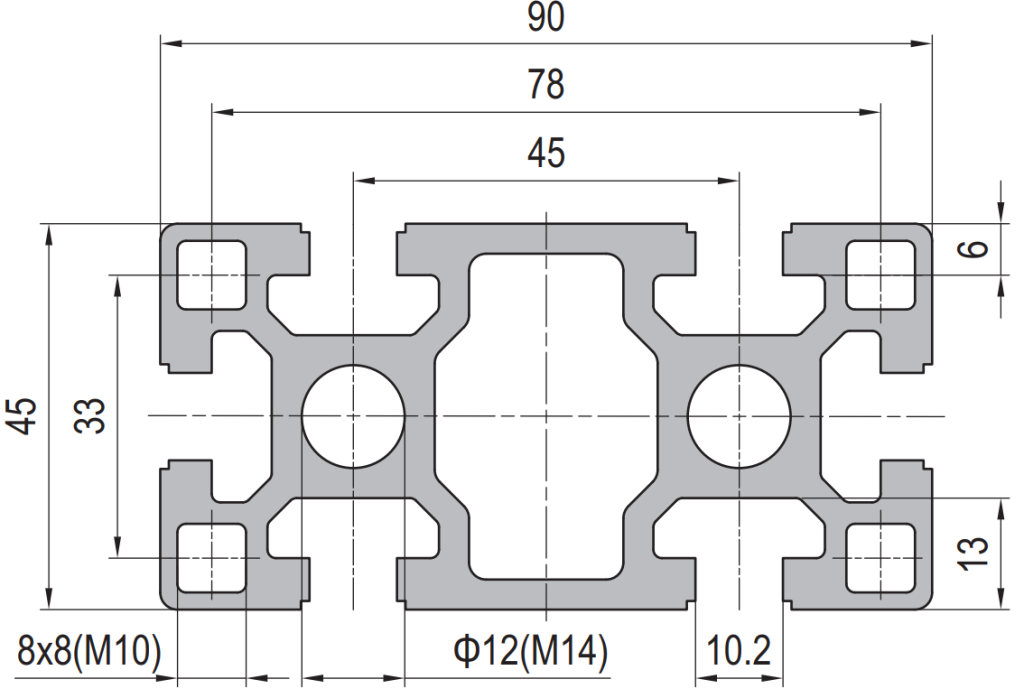
Short answer
The cost of an extruded section is set less by how much aluminium it contains than by how hard it is to extrude. Four features dominate: hollows and deep narrow slots, which are measured by tongue ratio and force a more complex die and a slower press; uneven or thin walls, which limit extrusion speed; tightened tolerances, which add trial runs, die corrections and inspection; and visible-face requirements, which slow the press and add handling. Relaxing any one of them usually costs less than the kilogramme saving it might give up.
Freedom is real, but it is priced per feature
The pitch for extrusion is that a die can produce almost any constant cross-section. That is true. The part of the pitch that is left out is that the die does not care how elegant the section is — it cares how fast metal can flow through it and how long the die lasts doing it.
Metal flow through a die is not uniform. Thin sections cool faster and resist flow; thick sections flow easily. Where the two sit next to each other in one section, the thin part throttles the whole extrusion, and the press has to slow down for the entire profile because of one feature on one corner.
That is the mechanism behind nearly every cost driver below. It is not that a feature adds metal; it is that it slows the press, wears the die, or adds a process step, and those costs are charged per metre rather than once.
The two numbers that predict most of it
Tongue ratio and circumscribing circle diameter. The first describes how hard the die’s job is; the second decides which press the job needs and what that press costs per hour.
Tongue ratio: the number that governs hollows and deep slots
A tongue is any part of the die that has to project into the metal flow to create a void — the core that forms a hollow, or the blade that forms a narrow slot. The tongue ratio compares the area of the void to the width of the gap that forms it. Roughly, it is the void area divided by the square of the gap width, and in practice the narrower and deeper the void, the higher the ratio.
A low ratio is easy: the die tongue is short and stiff, metal flows around it readily, and the die lasts. A high ratio means a long, thin tongue that deflects under pressure, wears quickly, and may break. Above a certain ratio the section stops being a straightforward solid-die extrusion and needs a different, more expensive die construction.
This is why two sections containing the same amount of aluminium can have very different tooling and per-metre costs. A section with three hollows is a much harder job than a solid section of the same weight, and it will be quoted accordingly.
| Feature | Effect on tooling | Effect on per-metre cost |
|---|---|---|
| Solid section | Simple die, long life | Lowest |
| Shallow open slots | Short tongues, low risk | Low, marginally above solid |
| Semi-hollow (deep narrow slot) | Longer tongue, higher ratio | Moderate increase |
| Fully hollow cavity | Porthole or bridge die required | Clear increase, slower press |
| Multiple hollows | Complex die, shorter life | High |
| Multiple hollows plus tight tolerance | Trial runs and die correction | Highest |
Wall thickness: uniformity matters more than the number
Buyers usually ask whether a wall can be thinner, to save weight and material. The more useful question is whether the walls can be made more uniform, because uniformity is what lets the press run fast.
In a section with a 2 mm wall next to a 6 mm boss, the 2 mm region is the bottleneck. It cools fast, resists flow, and may not fill at all at the speed the 6 mm region could tolerate. The press is set for the slowest feature, and the whole profile is produced at that rate.
There is also a floor. Below a certain wall thickness relative to the section’s overall size, the metal will not fill reliably, the section twists as it leaves the die, and scrap rises. A wall that saves 10% of material and raises scrap by 20% is not a saving.
The practical rule is to design for uniform wall thickness and to put material where the load needs it by changing the shape of the section rather than by thickening one part of it.
- Uniform wall thickness across the section
- Generous radii instead of sharp corners
- Shallow slots with low tongue ratio
- Standard tolerance class
- Symmetry where the function allows it
- Thin wall adjacent to a thick section
- Sharp internal corners
- Deep narrow slots and multiple hollows
- Tightened tolerance on non-functional dimensions
- Large circumscribing circle for the wall thickness
Tolerance, finish and alloy: the three that surprise buyers
Tolerance is the most commonly over-specified item on an extrusion drawing, because it is usually applied uniformly. A section with forty dimensions does not need forty tight tolerances; it needs the three that mate with something to be tight, and the rest can run at standard. Every tightened dimension adds die correction cycles, inspection time and scrap.
Finish works the same way. A visible face — called an A-surface in some shops — has to be free of die lines, pick-up and handling marks. That slows the press, restricts how the section can be handled and stacked, and adds inspection. Marking which faces actually matter is one of the cheapest things a buyer can do; leaving it unmarked means the supplier assumes the worst and prices for it.
Alloy is the third. 6063 extrudes readily and is the default. 6061 brings strength, machinability and generally better corrosion behaviour, but it is harder to extrude and runs slower, so the same section in 6061 costs more per metre before any of its benefits are considered. Choosing 6061 by habit for a section that will never see load is a real and avoidable cost.
CUT 1
Tolerance on non-functional dimensions. Tighten the three that mate; leave the rest standard.
CUT 2
Unmarked visible faces. Mark the faces that matter, or the supplier prices every face as visible.
CUT 3
6061 by default. Use 6063 unless strength, machining or corrosion actually requires 6061.
CUT 4
Wall thickness below the process floor. Material saved is lost to scrap and slow running.
What to send, and what to remove first
A section drawing can be improved for cost in about twenty minutes before it goes out, and the savings are permanent because they apply to every metre of every order. The exercise is to walk the drawing and justify each of the five drivers.
RFQ checklist — section design
Send the drawing with these decisions made:
- Which dimensions actually mate — tolerance them; leave the rest at the standard class.
- Which faces are visible — mark them on the drawing; unmarked means all.
- Which hollows are functional — every non-functional void is tongue ratio bought for nothing.
- Alloy justification — 6063 unless the application needs what 6061 provides.
- Circumscribing circle diameter — it decides the press size; ask what press the section needs.
- Annual volume and order pattern — small frequent orders cost more per metre than fewer large ones.
- Secondary operations — machining, cutting, punching; each is a separate line and some can be designed out.
- Willingness to relax — say where the design has slack. It is the most useful sentence in an enquiry.
Ask the supplier which single feature contributes most to the quote. There is usually one, and it is often not the one the designer would guess.
Four ways a section gets expensive by accident
Drawing review before release
- Count the tight tolerances; justify each one against a mating part.
- Mark visible faces explicitly, and confirm the rest are free at standard.
- Check wall uniformity; flag any thin section adjacent to a thick one.
- Confirm the alloy against a real load, machining or corrosion requirement.
- Ask which feature drives the quote, then decide whether it is worth it.
Related on this site
- 40 x 40 eight-slot strut profile— what eight slots does to tongue ratio and die cost
- Aluminium I-beam profile— a section where flange and web thickness diverge
- Strut profiles category— the standard section range, priced and stocked
- Standard vs custom extrusion: the break-even— when a custom die starts paying back
Terms used in this article
- Tongue ratio
- A measure of how slender the die’s projecting parts are relative to the void they form; higher means a harder, costlier extrusion.
- Circumscribing circle diameter
- The diameter of the smallest circle enclosing the section; decides which press size the job needs.
- Porthole die
- A two-part die construction used to form hollows; more complex than a solid die.
- A-surface
- A face with a specified visual quality, requiring slower running and more careful handling.
- Standard tolerance class
- The default dimensional tolerance a supplier achieves without extra die correction or inspection.
Questions buyers ask
Why is my section quoted higher than a heavier one?
Because cost tracks extrudability, not weight. A lighter section with deep slots or multiple hollows can cost more per metre than a heavier solid section that runs fast. Ask which feature drives the quote.
Can I just tighten every tolerance to be safe?
You can, and it will cost you on every metre. Tighten the dimensions that mate with something and leave the rest at standard. Over-tolerancing is one of the most common avoidable costs in an extrusion drawing.
Should I use 6061 or 6063?
6063 by default, because it extrudes readily and anodises well. Move to 6061 when strength, machinability or corrosion behaviour genuinely requires it, and expect a higher per-metre cost.
What is the single cheapest change to a section drawing?
Marking which faces are visible. It takes one note and it removes an assumption the supplier would otherwise price into handling, running speed and inspection.
Does a larger section always cost more?
More metal costs more, but the step changes come from press size. If the section crosses into a larger circumscribing circle, it needs a bigger press and the hourly rate jumps independently of weight.
Send the section, get the cost driver back
We will review a section drawing and tell you which single feature is setting the price, and what relaxing it would save per metre.
Request a quoteRelated reading
Twelve more engineering notes from this blog, picked for this article — plus every category below.
 Sourcing and ProcurementAluminium Extrusion Price per kg in 2026 (China FOB)
 Engineering DesignAluminium Extrusion Lead Time: New Die vs Existing Die
 Engineering DesignHow to Request a Quote for Custom Aluminium Extrusion (RFQ Checklist)
 ApplicationsAluminium Profiles in Solar Mounting: Wind Uplift, Corrosion and a 25-Year Life
 Engineering DesignMetric vs Imperial T-Slot Profiles: How to Test Compatibility Before You Order
 Engineering DesignT-Slot Aluminum Profile Connectors: What Each Type Is Actually Good At
 Engineering DesignCustom Aluminium Extrusion: From Drawing to Production
 Engineering DesignAluminium Profile Sizes: The Four Slot Dimensions That Decide Compatibility
 ApplicationsAluminium Profile Applications
 ApplicationsLean Pipe vs T-Slot Profile: Two Interface Philosophies, Not Two Generations
 Engineering DesignT-Slot Aluminium: The Slot Mouth Is the Interface Standard, Not the Series Name
 ApplicationsAluminium Profile Shelving: It Buckles and Tips Before It Bends
