Aluminium Profile Machine Guards: Size the Frame from the Energy, Not from the Mesh
Most guard frames are specified backwards: the mesh is chosen first because it is visible, and the posts are then spaced to suit it. The order should run from the hazard to the energy, from the energy to the post spacing, and only then to the infill.
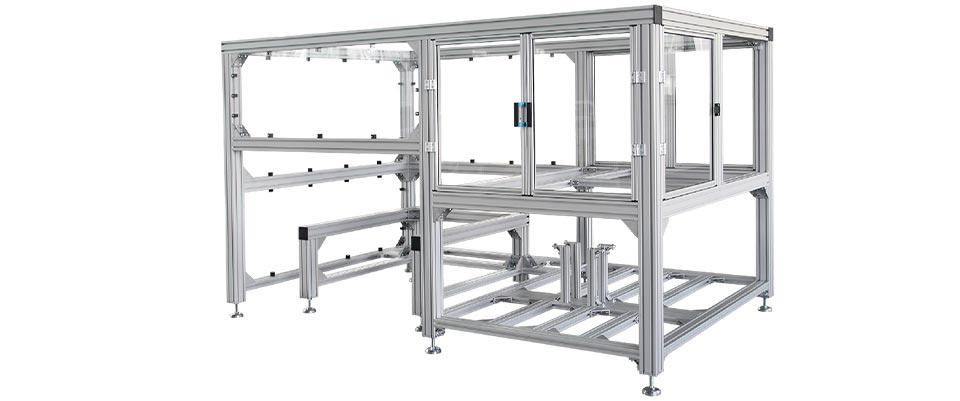
Short answer
A machine guard has to contain whatever the hazard can throw at it and keep people away from the hazard, and those are two different jobs. Size the frame by working out what can reach the guard, roughly how much energy it arrives with, and how far the posts can be spaced while the infill still contains it under that energy. Then choose the mesh or panel to suit the spacing you have just derived. Choosing the infill first fixes post spacing for a reason that has nothing to do with the hazard.
Why the usual sequence produces an under-built frame
The mesh is the most visible part of a guard, so it is the part that gets specified first. Standard panel widths exist, posts are placed to suit them, and the resulting frame is coherent, buildable and possibly wrong.
The reason it can be wrong is that the panel width sets the post spacing, and the post spacing sets how much energy each bay has to absorb. If the hazard can deliver more energy than a bay that wide can take, the guard will deform or open even though every individual part was correctly chosen.
Running the sequence the other way costs about half an hour and removes the risk. Start from what can hit the guard, derive the spacing, and then select an infill that fits that spacing and meets the containment requirement.
STEP 1
Identify the hazard. ejected parts, tooling, fluid, or access by a person.
STEP 2
Estimate the energy. What arrives at the guard, how fast, and how often.
STEP 3
Derive post spacing. A wider bay must absorb more; spacing follows from energy.
STEP 4
Select infill. Choose mesh or sheet to suit the spacing, not the other way round.
Three hazard types, three different frames
“Machine guard” covers a wide range, and the three common categories want different frames. Lumping them together is why a guard can be simultaneously over-built in one respect and under-built in another.
| Hazard type | What the guard must do | What governs the frame | Typical infill |
|---|---|---|---|
| Access prevention | Keep people out of a danger zone | Height, rigidity, no climbable features | Welded mesh, standard aperture |
| Ejected fragments | Contain parts or tooling that break free | Impact energy, post spacing, fixing strength | Heavier mesh or perforated or solid sheet |
| Fluid or swarf | Contain spray and chips, allow cleaning | Coverage, sealed joints, cleanability | Solid sheet or fine mesh with a backing |
An access-prevention guard is mostly a rigidity and geometry problem. It has to be tall enough, stiff enough not to be pushed into the hazard, and detailed so that it cannot be climbed or defeated. Energy barely enters the calculation.
An ejected-fragment guard is an energy problem. The frame and its fixings have to absorb an impact without opening a gap, and the infill has to resist penetration and tear-out at its edges. This is where spacing matters most, and where choosing mesh first does real damage.
From energy to post spacing
The physics is straightforward. An object arriving at the guard has kinetic energy, and that energy has to be absorbed by the infill and the frame deflecting elastically or plastically. The wider the bay, the more the infill deflects under a given impact, and the more load is delivered to the posts and their fixings.
Halving the post spacing roughly quarters the deflection of the infill under the same central impact, which is why spacing is a far more powerful variable than the infill grade. Going from a heavy mesh to a heavier one buys much less than closing up the spacing.
The absolute values in a real project have to come from the machine’s risk assessment and the applicable safety standard for that machine and jurisdiction. What belongs on the drawing is the derived outcome: a stated post spacing, a stated infill specification and a stated fixing, each traceable to the hazard it addresses.
Where the numbers come from
Do not take impact energy figures from an article, including this one. They come from the machine’s risk assessment and the standard that applies to it. What this article gives you is the sequence and the variables, so that when the number arrives it lands in the right place.
- Deflection falls with the cube of span for a plate-like infill
- Halving spacing is more effective than upgrading infill grade
- Fixing load at the post drops as bays get shorter
- Cost is a few extra posts, not a heavier section
- A heavier post does not stiffen the infill
- It adds weight and cost without reducing deflection
- It matters only for post buckling and fixing pull-out
- Upgrade the section last, if at all
The detail that fails: the fixing, not the frame
When a guard is tested or when an incident happens, the failure is rarely the section in bending. It is the base fixing pulling out, the mesh tearing away from its frame at the edge, or the door hardware letting a panel swing open.
Base fixings fail because the guard is tall and the impact arrives high, so the base sees an overturning moment that a light anchor was never sized for. Mesh tear-out fails because the load at the edge of the panel is concentrated on a few wires or a light retaining strip, and it is far higher than the load in the middle of the panel.
Doors fail because they carry all of the above plus a latch and often an interlock, and because they are the part that gets used repeatedly. A guard with a well-sized frame and an under-specified door is a guard with a hole in it.
Four weaknesses found in guard frames
What to send with a guard enquiry
A guard enquiry that arrives as a drawing with mesh on it and nothing else cannot be checked. The same enquiry with the hazard stated can be reviewed in one pass, and the review frequently changes the spacing rather than the section.
RFQ checklist — machine guard framing
- Hazard type — access prevention, ejected fragments, fluid or swarf, or a combination.
- What can reach the guard — part or tooling, its mass and its speed if known.
- Required height and the danger zone geometry — including whether climbing or reach-over must be prevented.
- Post spacing you have derived — or state that you want it derived from the hazard.
- Infill preference and aperture — mesh, perforated or solid, with the aperture limit.
- Door and interlock scope — who supplies the door, the latch and the interlock.
- Base fixing conditions — floor type and whether anchors are in scope.
- Applicable standard and risk assessment reference — state it; it governs the numbers.
If the risk assessment is not finished, say so and ask for a frame sized provisionally with the spacing stated as provisional. A provisional spacing is reviewable; a silent one is not.
Checks before installation
- Confirm post spacing on the drawing matches the spacing derived from the hazard.
- Check base fixings against overturning, not against the guard’s weight.
- Confirm the mesh retaining detail is rated for edge load, not mid-panel load.
- Verify door hardware and interlock are in scope and specified with the frame.
- Re-confirm the guard against the risk assessment after any machine modification.
Related on this site
- Aluminium profile machine guard frame— the guard framing section and its fixing detail
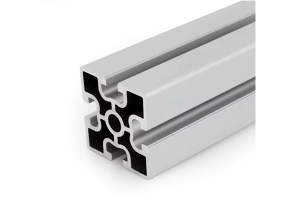
- PG40 40 x 40 four-slot heavy profile— the usual post section for guard framing
- 40 series aluminium profiles— sections and slot geometry for guard posts
- Machine guards to ISO 14120— the standard-side view of the same problem
Terms used in this article
- Danger zone
- The space around a machine in which a person is exposed to a hazard.
- Aperture
- The opening size in a mesh or perforated infill; drives the reach-distance requirement.
- Overturning moment
- The rotational force at the base of a tall guard when an impact arrives high up.
- Tear-out
- Failure where the infill pulls away from its retaining frame at the edge.
- Interlock
- A device that stops the machine when a guard door is opened.
Questions buyers ask
Can I reuse one guard design across several machines?
Only if the hazard is the same. The frame geometry can be reused, but the spacing and the infill follow the hazard, so a design validated for an access guard is not automatically valid where parts can be ejected.
Should I use a heavier section or closer posts?
Closer posts, almost always. Infill deflection and edge load fall sharply as spacing reduces, while a heavier post does nothing for either. Upgrade the section only for buckling or fixing pull-out.
What mesh aperture should I use?
Aperture is driven by how close the guard can be to the hazard and what must not pass through it. It is a reach-distance and containment decision, and it should be stated from the risk assessment rather than picked from a catalogue.
Why did the mesh tear out while the frame was undamaged?
Because edge load is much higher than mid-panel load and the retaining detail was not rated for it. The frame being intact is consistent with the infill failing; it means the fixings and retention were the weak elements.
Do I need to involve the frame supplier in the risk assessment?
The risk assessment is the machine builder’s responsibility. But sending its outcome with the enquiry lets the supplier check the spacing and the fixings, which is where a review usually finds something.
State the hazard, get the spacing checked
Send the hazard type and the machine layout and we will check whether your post spacing and base fixings follow from it, before the frame is built.
Request a quoteRelated reading
Twelve more engineering notes from this blog, picked for this article — plus every category below.
 Engineering DesignAluminium Extrusion Capacity: What a Factory Can Actually Deliver
 Quality and InspectionAluminium Extrusion Claims: What the Contract Must Say
 Engineering DesignHeavy-Duty T-Slot Hinges and Sliding Door Buffers: Sizing Them with Numbers
 Materials and EngineeringIndustrial Aluminium Extrusion: Five Advantages and the Conditions Attached to Each
 Sourcing and ProcurementAluminium Profile Price Breaks: How Volume Changes the Unit Price
 Quality and InspectionGood vs Bad Aluminium Profiles: What Your Receiving Dock Can and Cannot Check
 Engineering DesignWhich Profile Size for Your Application: A Selection Guide
 Sourcing and ProcurementAluminium Profile Shipping: Packing, Container Loading and ISPM 15
 ApplicationsHow to Fix Panels, Guards and Accessories to Aluminium Profiles
 Engineering Design4040 T-Slot Aluminium Profile for Machine Frames: Choose It by Deflection
 Engineering DesignSlot Dimensions Explained: 6 mm, 8 mm and 10 mm T-Slots
 ApplicationsHow Strong Is an Aluminium Profile? It Depends on How You Fix It
