Aluminium Profile Applications
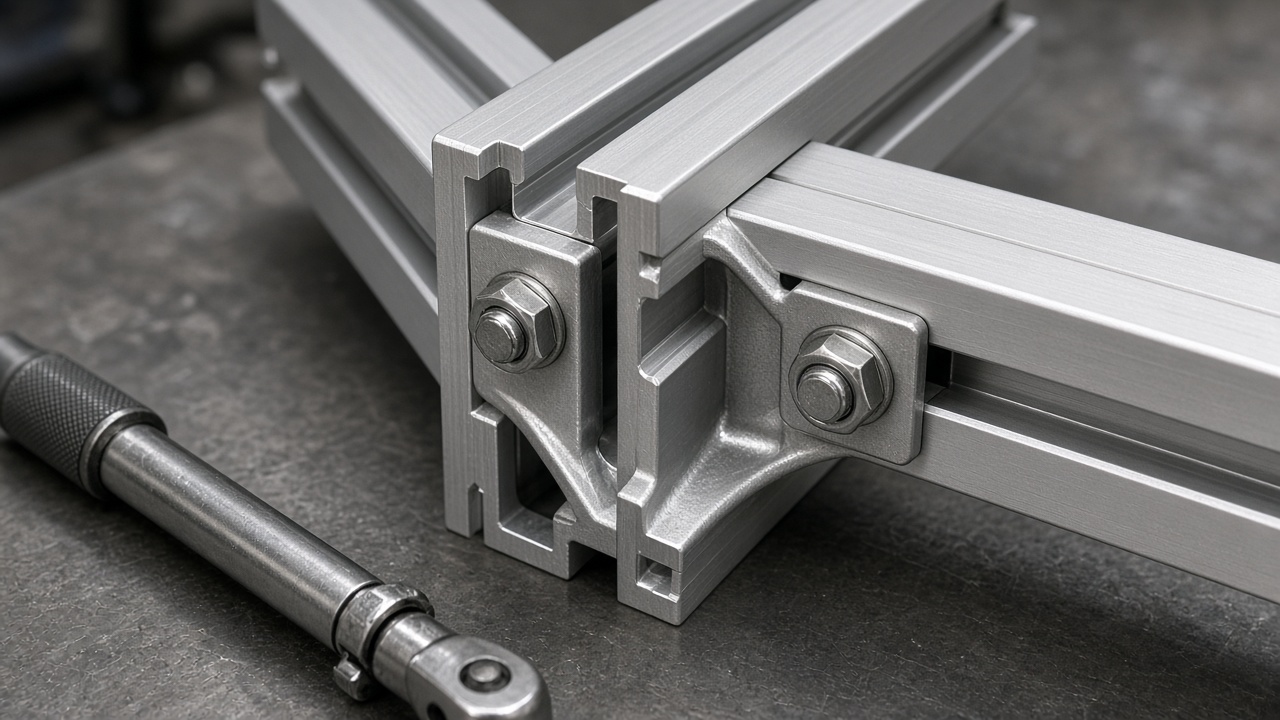
The everyday joint is an external corner bracket with M6 or M8 T-nuts: it squares a bay fast, stays serviceable, and carries bench and guard loads when torqued correctly. Build frames from that joint, then size the section for span — not the other way round.
Short answer
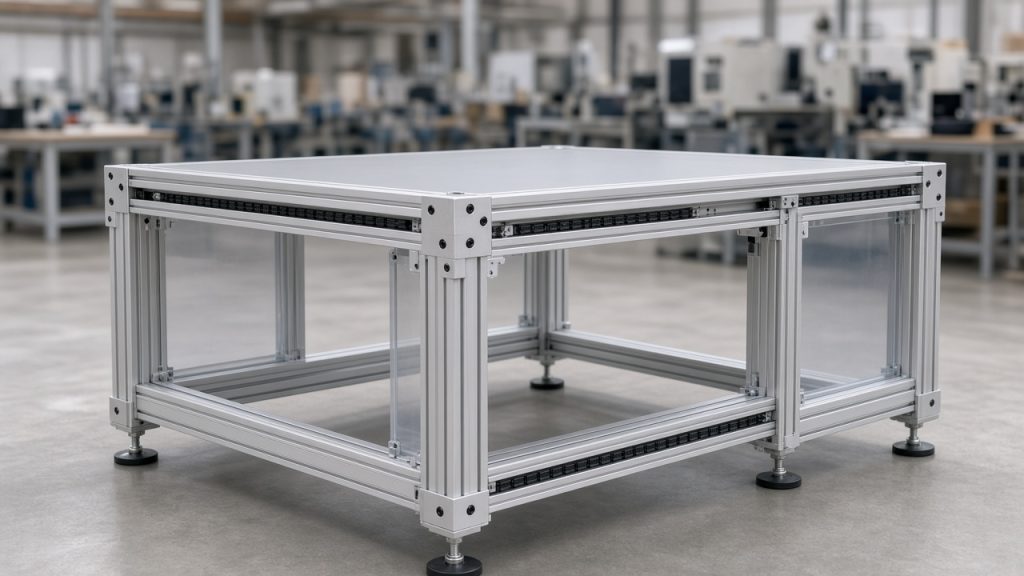
Industrial aluminium-profile applications — workbenches, robot-cell fences, machine guards and light automation bases — succeed when the joint and the cut quality are specified before the catalogue photo. Use external corner brackets (or end taps on high axial posts), dry torque bands of about 5–8 Nm for M6 and 13–20 Nm for M8, and fabrication that keeps bays square: cut length ±0.5 mm, hole position ±0.2 mm, end square within 0.3 mm. A site heavy rail example is a 45 × 90 mm six-slot in 6063-T5 at 4.10 kg/m with I ≈ 68 cm⁰ on the strong axis — useful only if the joints do not slip. Premium benches are finish and detail, not thicker marketing copy: clear anodise, flush panels, cable channels and locked feet. Robot-cell fence height follows the risk assessment and reach rules, commonly landing near 1.8–2.2 m for industrial perimeters once mesh openings and stand-off are fixed.
How do i make a workbench look premium in aluminium
A premium aluminium workbench looks finished because finish, panel fit, cable routing and feet are specified on the BOM — not because a light 2020 perimeter was painted silver.
Lock one metric series (usually 3030 or 4040) so brackets and T-nuts interchange. Specify clear anodise for plant use or a controlled powder colour when branding matters. Seat side and rear panels with retainers matched to thickness so gaps look intentional. Run cable channels in the rear slots instead of zip-tied looms on the outside. Fit M10/M12 leveling feet or locking casters with jam nuts. Keep primary rails on 4040 or a 45 × 90 strong axis when the top must feel solid under 50–150 kg live load. The same checklist answers every “premium look” variant — whether the buyer swaps colour, panel material, foot type or cable cover — because the structure is identical and only one finish variable changes.
| Premium detail | Industrial choice | Cheap look if skipped |
|---|---|---|
| Finish | Clear anodise (plant) / powder (colour) | Raw mill fingerprints and scratch maps |
| Primary series | 4040 or 45 × 90 strong axis | 2020 perimeter that flexes under a vice |
| Panels | PC / laminate + matching retainers | Screws through thin sheet into lip only |
| Cable management | Slot channels / covers | External zip-tie nests |
| Feet / casters | M10/M12 locked feet or locking casters | Bare cut ends rocking on the floor |
| Joints | External brackets + stated torque | Hand-snug corners that rack in week one |
| Cut quality | ±0.5 mm length, 0.3 mm square | Wedge gaps at every corner |
| Top interface | Supported on rails, underside fixings | Top screws pulling the frame out of square |
What height should a robot cell fence be
Robot-cell fence height is set by the risk assessment and the reach distance to the hazard — commonly 1.8–2.2 m for industrial aluminium perimeters once panel openings and stand-off comply with ISO 13857 logic.
Do not pick height from a catalogue photo. Start from the robot envelope, tool length and any ejection risk, then choose mesh or polycarbonate openings that keep the narrowest opening e within the safety distance sr required by ISO 13857. A fence that is tall but coarse-meshed still fails if a hand can reach the hazard. Cobot stations with a documented collaborative mode may use lower or partial guarding when the risk assessment allows it; industrial six-axis cells almost always need a closed perimeter with interlocked doors. Size uprights in 4040 or 4545 for typical 1–1.5 m bay widths, step to heavier sections for tall unsupported mesh, and anchor floor plates so the fence cannot tip into the cell. Removable panels need interlocks where the assessment requires them — a modular T-slot fence is structure, not a safeguard by itself.
| Cell type | Typical fence height | Panel note | Series cue |
|---|---|---|---|
| Industrial 6-axis cell | 1.8–2.2 m | Mesh/PC + interlocked doors | 4040 / 4545 uprights |
| Palletising cell | 2.0–2.4 m | Higher if overhead motion | 4040 + floor anchors |
| Welding cell | 1.8–2.2 m + curtains | Solid/PC for arc; mesh for view | 4040 / 4080 spans |
| Machine-tending bay | 1.8–2.0 m | Match machine reach | 3030 / 4040 |
| Cobot station (assessed) | Partial / lower OK if risk OK | Document mode + stop | 3030 / 4040 bench frame |
| Viewer window strip | Eye-line insert | PC thickness for impact | Retainers to thickness |
| Access door | Same as run | Interlock if required | Hinge + latch hardware |
The joint is the weak point
Most aluminium frames fail at the joint, not in the bar: a 45 × 90 mm six-slot at 4.10 kg/m with I ≈ 68 cm⁰ only delivers that inertia if brackets and T-nuts stay preloaded.
External corner brackets and gussets let you square a bay before final torque and remain serviceable. Internal connectors hide hardware but engage mainly the slot walls — treat them as light-duty or cosmetic. End tapping the core (M5 on light 2020, M6/M8 on 30/40 series) is the right path when a post takes axial load into a rail face; a thin L-bracket alone is not. Through-bolts work when both members can be drilled, but they permanently alter the bar. Fabrication that supports square joints: cut length ±0.5 mm, hole position ±0.2 mm, end square within 0.3 mm. Dry-fit one bay, equalise diagonals, then torque — never pull a crooked cut square with the bolts.
What torque to use
Use about 5–8 Nm for dry M6 T-nut joints and 13–20 Nm for dry M8 T-nut joints unless the fastener maker publishes a different chart — hand-snug is not a preload.
Anodised slots have different friction from mill finish, so the same torque produces a different clamp; recheck after the first transport or vibration cycle. Stage torque: snug all screws, confirm square, then bring each fastener into the working band. Over-torque on light 2020 lips crushes the mouth and destroys clamping geometry; under-torque lets the bay rack under live load. Put the torque note on the assembly drawing next to the connector call-out so dealers and plant techs use the same numbers.
RFQ checklist — applications build
- Application — workbench, robot-cell fence, guard or mixed cell.
- Loads and spans — top mass, live load, bay length, deflection limit.
- Series and slot — 3030 / 4040 / 45 × 90 and mouth size for hardware.
- Joints — external brackets, gussets, end taps; which corners are structural.
- Torque — M6 5–8 Nm / M8 13–20 Nm unless maker differs.
- Fabrication — cut ±0.5 mm, holes ±0.2 mm, end square 0.3 mm.
- Fence height / openings — assessed height and e vs hazard distance.
- Heavy rail option — 45 × 90 six-slot, 6063-T5, 4.10 kg/m, I ≈ 68 cm⁰ when joints hold.
Ask one question before cutting: which corners are structural and what torque band they use. If that is missing, the frame is a guess.
Four application mistakes
Related on this site
- how die cost amortises per meter — unit cost once the tool is paid
- minimum order with a new die — when a custom section becomes viable
- die making adds 7–12 days — calendar before the first cut length
- who owns the die — tooling rights before you change supplier
Terms used in this article
- External corner bracket
- Visible L or gusset connector fixed with T-nuts; the default industrial 90° joint.
- End tap
- Thread cut into the profile core so a butt fastener carries axial load into the rail.
- Preload
- Clamping force from correct torque; what holds a bolted T-slot frame.
- ISO 13857
- Safety distances linked to opening size for reaching through guards.
- I (second moment)
- Section property that governs bending stiffness; useless if joints slip.
Questions buyers ask
What torque should I use?
On clean dry aluminium T-slot joints, use about 5–8 Nm for M6 and 13–20 Nm for M8 as a working band unless the fastener maker publishes a different chart. Anodised slots need slightly different torque for the same preload. Recheck after the first transport or vibration cycle.
Can I drill into the slot?
Yes for clearance or tap holes on the slot centreline when the drawing calls for them — keep hole position within ±0.2 mm. Do not elongate the slot mouth with a drill to force an oversized nut. Through-bolts and end taps are planned drills; random lip holes often start cracks under load.
How do I join at 45 degrees?
Cut a true 45° mitre, dry-fit so faces meet without a gap, then bridge the joint with a mitre plate or angle bracket that lands T-nuts in both slots. A mitre alone is not structural. Torque each screw in the same M5/M6/M8 bands as square corners.
What panel thickness fits the slot?
Match the retainer or gasket to the panel thickness and the slot series — common industrial panels sit in the 3–8 mm band with the correct strip. Do not force a thick sheet into a narrow mouth; use a clamping strip or face-mount. State thickness on the BOM so retainers ship with the frame kit.
Send the frame sketch and joint list
Share application (bench / cell / guard), series, which corners are structural, torque preference and cut list. We return a connector BOM with fabrication tolerances before you cut metal.
Request a quoteRelated reading
Twelve more engineering notes from this blog, picked for this article — plus every category below.
 ApplicationsAluminium Workstations: From Fixed Benches to Reconfigurable Cells
 Applications40×40 Aluminium Profile: Where It Works, Where It Fails, and Why
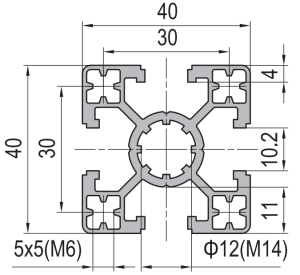 Engineering DesignAluminium Profile Standard Sizes: How the Series Matrix Actually Works
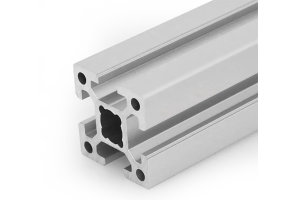 ApplicationsLean Pipe vs T-Slot Profile: Two Interface Philosophies, Not Two Generations
 Engineering DesignWhat Your Extrusion Drawing Must Show (and What Costs You Money)
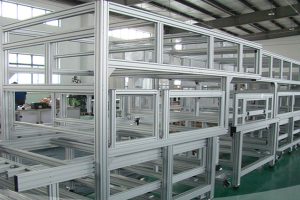 Engineering DesignModular Aluminium Components: Where the System Saves Money and Where It Costs You
 Engineering DesignWho Owns the Extrusion Die After Tooling Is Paid?
 Engineering DesignT-Slot Aluminium: The Slot Mouth Is the Interface Standard, Not the Series Name
 Materials and EngineeringAluminium Extrusion Section Design: What Each Feature on the Drawing Costs You
 Sourcing and ProcurementImporting Aluminum Profiles from China: Nine Failures That Quietly Raise Your Landed Cost
 Quality and InspectionGlobal Sourcing Excellence: Multi-Category OEM and ODM Manufacturing and Supply Chain Integration
 Sourcing and ProcurementDistributor Terms: Territory, Margin and Price Protection
