Industrial Castors for T-Slot and Lean Pipe Trolleys
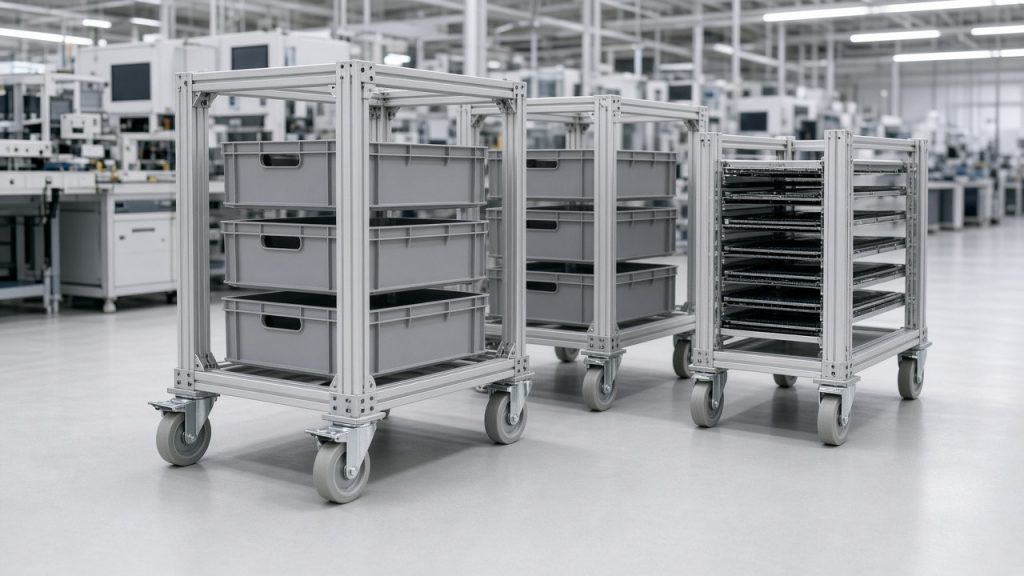
An electronics assembly plant is rolling out 180 material-kitting carts and SMT PCB magazine trolleys onto a light-grey epoxy floor. Standard black rubber wheels are leaving skid marks, and an ungrounded trolley in the SMT zone raises a triboelectric-charge concern for surface-mount parts. The enquiry asked for 3-inch, 4-inch and 5-inch (75 / 100 / 125 mm) castors, a comparison of polyurethane, nylon, TPR and ESD treads, a total-lock brake, and a mount that fits both 40×40 T-slot legs and 28 mm lean pipe. Loaded kitting carts sit at 200–400 kg. The factory reply is written from the published GP-FE-CAS-01 catalogue and the matching foot mounting plate, not from unpublished Shore, ohm or kilogram-per-wheel figures.
Short answer
The listed trolley castor is GP-FE-CAS-01 (CAS-P50-P200): seven configurations on one shared footprint, 60–300 kg per castor, plates 60×60 and 100×100 mm, or an M12 / M16 stem into a tapped block. Wheel diameters 50–200 mm already cover 75 / 100 / 125 mm; overall height is 72–245 mm depending on the wheel, not a published 130 mm or 155 mm pair. Listed treads are polyurethane, nylon, elastic rubber and cast iron. Polyurethane on an aluminium core is the listed non-marking default on epoxy; nylon can mark softer finishes. TPR and ESD-PU are not listed and are quoted to drawing. Braked plate and stem swivels are listed; a total-lock brake is not a catalogue SKU and is quoted to drawing. A 40×40 leg takes a GP-FE-FMP-01 foot mounting plate (6063-T5 or S235) into the 4× M8 end taps, or a stem into a tapped block or the plate’s M12 / M16 boss — not a wide plate hanging off one 40 mm face, and not into the Ø12 mm centre bore, which is tapped M14. A 28 mm pipe interface is also to drawing; the pipe we supply is aluminium 28×1.0 mm, published inner diameter 26 mm. Size a 200–400 kg cart on three castors (about 67 kg and 133 kg each), not four.
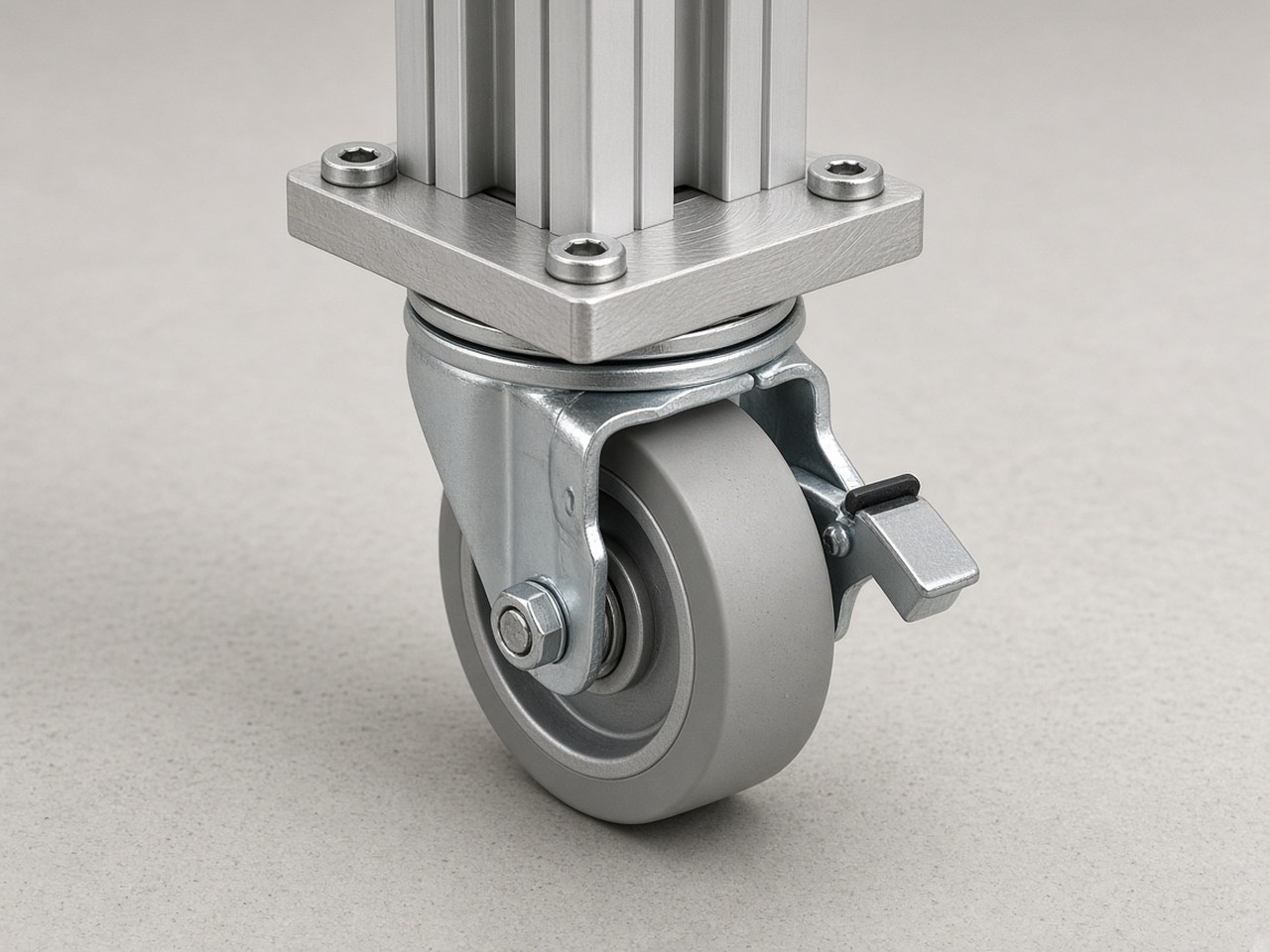
Listed treads on epoxy: polyurethane, nylon, elastic rubber and cast iron
Polyurethane on an aluminium core is the listed non-marking default on epoxy; nylon, elastic rubber and cast iron complete the catalogue, and TPR or an ESD-PU tread is quoted to drawing.
GP-FE-CAS-01 lists polyurethane, nylon, rubber and cast iron. The soft option on that page is elastic rubber, not a listed TPR compound. Wheel hardness is specified per application, with a batch Shore A certificate; we do not publish 90A–95A or 75A–85A bands, or a kilogram rating for a 4-inch or 5-inch wheel by compound.
| Tread | Catalogue status | On light epoxy | Published role |
|---|---|---|---|
| Polyurethane on aluminium core | Listed on GP-FE-CAS-01 | Does not mark epoxy or painted flooring | Default for workshop and assembly floors |
| Nylon (PA6) | Listed | Can mark softer finishes | Highest load for its diameter; normally concrete or steel track |
| Elastic rubber | Listed (the quiet/soft option) | Safe on epoxy, vinyl and painted floors | Quiet running and vibration absorption; lower load rating |
| Cast iron / steel | Listed | Hard on finished floors | Very high loads and hot environments; normally a steel track |
| TPR (thermoplastic rubber) | Not listed — quoted to drawing | Not a published GP tread | No catalogue Shore, ohm or kg-per-wheel figure |
| ESD conductive or dissipative PU / carbon rubber | Not listed — quoted to the site ESD plan | No published ohm band for a wheel | Continuity to the top plate is specified with the enquiry |
75, 100 and 125 mm wheels sit inside the listed 50–200 mm diameter range. The bracket is zinc-plated pressed steel or stainless steel; the swivel is a double ball race, greased for life; the bearing is a roller bearing or a plain bush. A named sealed ball bearing such as a 6001-2RS or 6201-2RS is not a listed SKU and can be quoted to the drawing if required.
Size a 200–400 kg cart on three castors, then read the published bands
A 200 kg cart shares about 67 kg onto each of three castors, and a 400 kg cart about 133 kg; those shares are then read against the published configuration bands, not against an invented 4-inch or 5-inch load table.
The printed rating is a static laboratory figure. Floors are never perfectly flat, so one wheel on a four-castor frame often carries little or no load while the diagonal carries double — hence the published rule of sizing on three. A walking-pace rating falls by roughly a third if the trolley is pushed at speed over a joint, so the catalogue figure then has to cover about 100 kg and about 200 kg on the two carts in this enquiry. A 67 kg share still sits inside the plate-swivel 60–150 kg band; a 133 kg share sits near the top of that band at walking pace, and at speed the 150–300 kg heavy plate-swivel band (wheel Ø 125–200 mm) is the safer check. The 1.5× static load test is an inspection check, not a selection formula.
The seven listed configurations share one mounting footprint and are plain-castor units, not ESD or total-lock SKUs. Two swivel and two fixed track straight; four swivel manoeuvre in any direction.
| Configuration | Wheel Ø | Load per castor | Where it is used |
|---|---|---|---|
| Plate fixed | 50–100 mm | 80–120 kg | Two wheels on one end of a trolley, tracking straight |
| Plate fixed, heavy | 100–150 mm | 150–300 kg | Heavy gantries and tool cabinets, pushed not steered |
| Plate swivel | 50–125 mm | 60–150 kg | Default steering end of a mobile workstation |
| Plate swivel, braked | 50–125 mm | 60–150 kg | Frame that must lock in position while work is carried out |
| Plate swivel, heavy | 125–200 mm | 150–300 kg | Mobile machine bases, weld tables, heavy fixtures |
| Thread stem swivel | 50–100 mm | 60–120 kg | Legs ending in a tapped block or threaded insert |
| Thread stem swivel, braked | 50–100 mm | 60–120 kg | Adjustable-height mobile frames with a locking requirement |
The published earth path is on the frame; a conductive wheel is quoted to the site plan
The published earth path is on the frame and the worksurface; a conductive or dissipative wheel is not a listed GP-FE-CAS-01 option and is quoted to the site ESD plan.
On the ESD aluminium profile workbench (GP-WB-ESD-40) the mill-finish frame is the standard conductive option; an anodised frame is supplied only with masked earth pads, and powder coating is not recommended. There is no coating thickness that makes anodising conductive. Published targets — the site plan still governs — are worksurface point-to-point 1×10⁴ to under 1×10⁹ ohm, worksurface to ground under 1×10⁹ ohm, frame to common point ground under 1 ohm, and a wrist strap of about 1×10⁶ ohm on a separate path, in programmes built around IEC 61340-5-1 and ANSI/ESD S20.20. Castors appear on that bench only as a configuration option, with no ohm rating for a wheel. Conductive anodising at 104–106 Ω on a 45×180 ESD profile is a profile coating, not a wheel tread.
Carbon-black conductive rubber can drain charge and can also streak a light-grey ESD epoxy floor — a known industry problem, and the reason this buyer is already seeing marks from black rubber. GrownParts does not list an ESD-PU, carbon-black or “non-marking conductive polymer-alloy” tread, and we do not publish a 104–106 or 106–109 Ω band for a GP-FE-CAS-01 wheel. A conductive or dissipative tread, and continuity through the bearings to the top plate, is quoted to the site ESD plan. Resistance reports can be requested once that tread is specified to drawing; they are not a stock deliverable for a SKU we do not list. An earth path through a wheel only exists while that wheel is on the floor, and how many wheels must be conductive is a decision for the site plan, not a factory shop-floor rule.
Braked swivels are listed; a total-lock brake is quoted to drawing
A 2 fixed + 2 swivel layout with at least two braked swivel castors is the listed arrangement for a cart that must lock while work is carried out; a total-lock brake, which also locks yaw, is quoted to drawing.
If work is carried out on the frame, at least two braked castors are required — normally the two swivel units, which carry the load when the cart is stationary. At height, brake all four and add a floor lock for the final hold. The listed braked options are plate swivel, braked (50–125 mm, 60–150 kg) and thread stem swivel, braked (50–100 mm, 60–120 kg). There is no listed total-lock SKU. A wheel-only brake stops rolling but leaves the swivel race free; a push on a “braked” trolley can still yaw the heads and shift the parked position, which matters at an SMT loader. A total-lock also locks that yaw. We will quote a total-lock or a directional lock to the drawing. We do not publish a swivel-offset figure in millimetres, a cart-shift figure, or a pedal, tooth and notched-ring geometry. Fixed and swivel housings in one set must share the same overall height, confirmed on the drawing inside the listed 72–245 mm range — not a published 130 mm or 155 mm pair for 4-inch and 5-inch series.
Mount a 40×40 leg through a foot mounting plate; a 28 mm pipe interface is to drawing
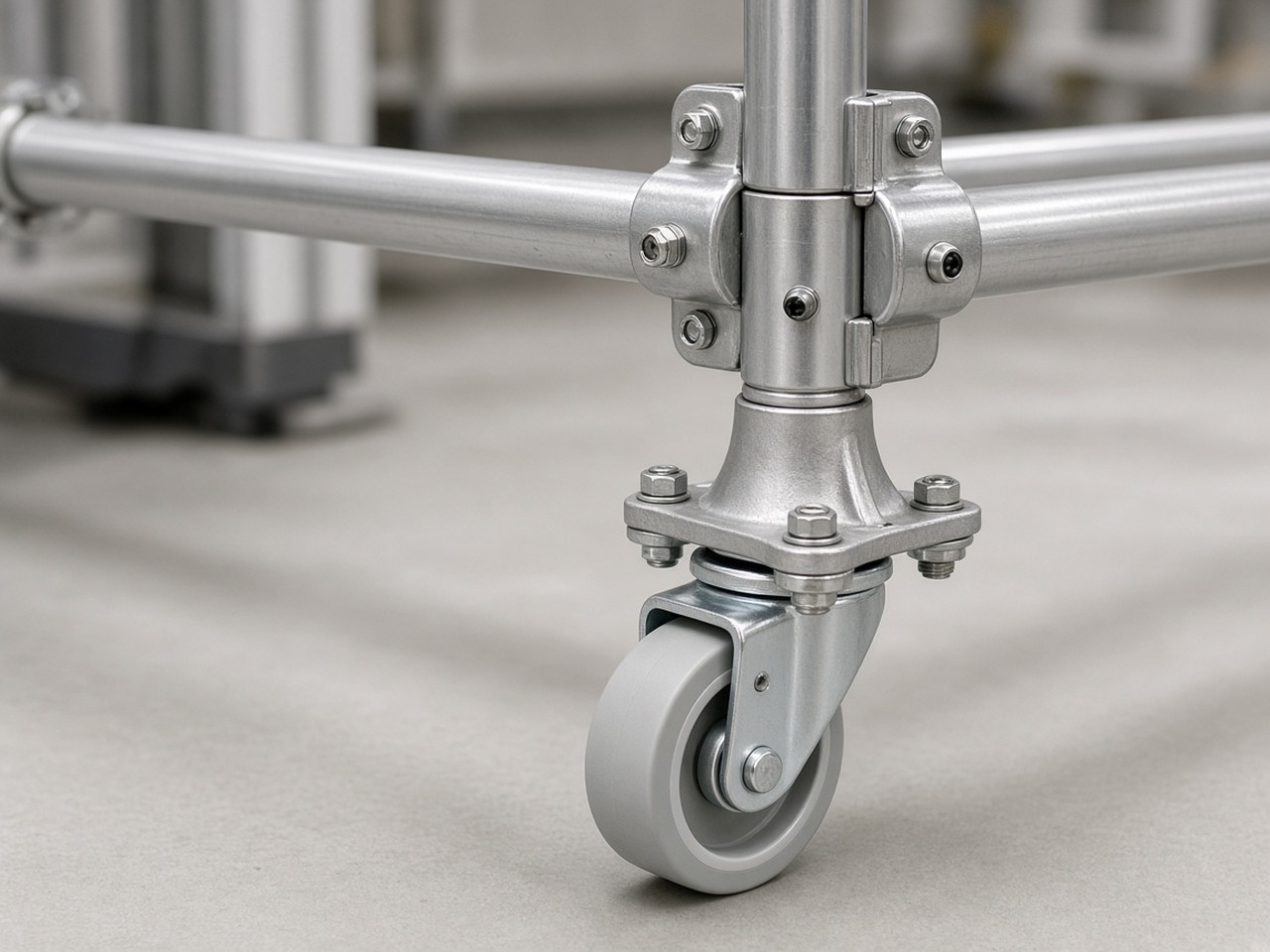
A 40×40 leg takes a plate-mounted castor through a foot mounting plate into the 4× M8 end taps, or a stem into a tapped block or the plate’s boss; a 28 mm pipe interface is quoted to drawing, not issued as a listed expanding-stem or socket SKU.
The castor never bolts to the extrusion directly; it bolts to a foot mounting plate that spreads the load into the end face. GP-FE-FMP-01 is aluminium 6063-T5 or S235 steel — not a listed 6061-T6 “40×40 castor adaptor plate”. Listed underside patterns are 60×60 and 100×100 mm. A 100×100 mm plate is already wider than a single 40 mm face; third-party patterns such as 70×50 or 95×65 mm would be machined as a custom pattern. Thickness is 6, 8, 10 or 12 mm, set by the load: a thin plate flexes, so a heavy castor uses 10 or 12 mm rather than 6 mm, adding 6–12 mm under the leg. Bolt the plate to the leg first, then the castor, and confirm swivel clearance. If the castor plate already matches the end taps, the mounting plate is redundant. On 40 series the published mapping is 4× M8 end taps, an 80×80 mm plate, and a 60×60 mm underside pattern with 4× Ø9 holes. An optional M12 or M16 boss lets one cut list accept a plate castor, a stem or a levelling foot. The 40-series slot mouth is 8 mm (the heavy page also states a 10.2 mm groove) — not a choice between 8 mm and 10 mm T-slots on a standard 40×40. The centre bore on the 40×40 four-slot profile and the heavy-wall variant is Ø12 mm, tapped M14 — not an M8 or M12 stem into the bore.
GP-AP-2810 and the 28 mm lean-pipe joint system (GP-LP-28) describe an aluminium 6063-T5 tube, 28 mm OD, 1.0 mm wall as standard, about 0.23 kg/m, inner diameter 26 mm (28 − 2×1.0). A 0.8 mm light wall and a 1.2 mm heavy wall are available; 1.5 mm is also mentioned for structural applications. We do not publish a 2.0 mm wall, or 23.6–25.6 mm as an inner-diameter range. Joints clamp on the outside diameter with M6 set screws. Against a market steel-core 28×1.2 mm tube, aluminium 28×1.0 mm is about 71 percent lighter and the steel tube is about 3.5 times as stiff in bending. There is no listed expanding stem adaptor or flanged pipe socket, and no 3-inch / 4-inch / 5-inch mounting table with kilogram cut-offs. A taller wheel raises the lateral moment at a 1.0 mm wall, so a clamp or flange that spreads load is preferable to a friction stem that can oval the bore — that is how the interface is drawn, not a published 180 kg or 250 kg cut-off.
Four checks before a 180-cart order is released
A 180-cart programme is released once the loaded mass, the tread, the leg or pipe end, and the kit scope are written down, and it is priced per listed 2026 band, not as one lump sum.
- Loaded mass, layout, and whether work is done on the parked cart. Give the total loaded weight, including the frame, and the layout (2 fixed + 2 swivel or four swivel). If work is done on the parked cart, specify at least two braked swivels; at height, brake all four and add a floor lock. A total-lock, if required, is a to-drawing line.
- Tread versus floor, and the site ESD plan if required. Polyurethane is the listed non-marking default on epoxy. If a conductive or dissipative wheel is required, send the site ESD plan (IEC 61340-5-1 / ANSI/ESD S20.20 as the buyer’s programme).
- Leg or pipe end, and overall height. For 40×40, say whether the end is open (FMP into the 4× M8 taps) or a tapped block or boss (M12 / M16 stem) — not an M8 or M12 stem into the Ø12 / M14 centre bore. For 28 mm pipe, state the wall and whether a to-drawing socket is required. Confirm the same overall height for fixed and swivel units on the drawing, inside 72–245 mm, not an unpublished 130 / 155 mm pair.
- Kit scope and drawings. Cut, machined and marked members with plates, castors and fasteners, bagged by assembly, plus DWG / DXF / STEP / IGES / PDF. Listed CAS orders ship with plate bolts, the wheel material data sheet, and a per-castor load calculation.
We will not issue a lump-sum price for 180 carts or for 720–800 pieces as a mixed fleet. Listed GP-FE-CAS-01 configurations are quoted in the 2026 bands (MOQ 100): 100–499 pcs at $12.50, 500–1,999 at $9.80, 2,000–4,999 at $7.40, and 5,000+ at $5.60 per piece ($1.80–$12.50 range). A run of 720 listed castors therefore falls in the $9.80 band, which does not apply to unlisted ESD or total-lock variants. Foot mounting plates, if used, are a separate GP-FE-FMP-01 line (MOQ 200): 200–999 at $9.80, 1,000–4,999 at $6.10, 5,000–19,999 at $3.70, and 20,000+ at $2.40 per piece in 2026. Lead time on both listed lines is 15–25 days after deposit. Kit packing and samples are available.
Related on this site
- Aluminium profile castors — GP-FE-CAS-01, listed treads and configurations
- Foot mounting plate — GP-FE-FMP-01, 6063-T5 or S235
- Foot and castor components — spare wheels, stems and bolt kits
- 40×40 four-slot profile — 8 mm mouth, Ø12 / M14 centre bore
- 28 mm lean-pipe joint system — aluminium 28×1.0 mm, joints clamp on the OD
- Aluminium pipe 28 mm — published inner diameter 26 mm
- ESD aluminium profile workbench — frame earthing, not a wheel ohm rating
- How is an ESD workbench grounded at the four joints?
- How do you design an aluminium profile workbench frame?
- Building with T-slot aluminium
Questions buyers ask
What wheel treads are listed, and do you catalogue TPR or ESD-PU?
Listed treads on GP-FE-CAS-01 are polyurethane, nylon, elastic rubber and cast iron. Polyurethane is the non-marking default on epoxy; nylon can mark softer finishes. TPR and ESD-PU are not listed and are quoted to drawing.
How should I size four castors for a 200–400 kg cart, and how is a 180-cart fleet quoted?
Use three castors in the calculation: about 67 kg on a 200 kg cart and about 133 kg on a 400 kg cart. A walking-pace rating falls by roughly a third at speed. Listed GP-FE-CAS-01 configurations at 720 pieces fall in the 500–1,999 band at $9.80 / pc (2026), MOQ 100, not as a lump sum; unlisted ESD or total-lock variants are quoted to drawing.
Do you have a total-lock brake, and are overall heights 130 mm and 155 mm?
No listed total-lock SKU. Listed options are plate or stem swivel, braked, plus a floor lock for the final hold at height. A total-lock is quoted to drawing. Overall height is 72–245 mm depending on wheel diameter; 130 mm and 155 mm are not published.
How do I mount a castor to a 40×40 leg or to 28 mm lean pipe?
On 40×40, bolt a GP-FE-FMP-01 plate (6063-T5 or S235, 6–12 mm) to the 4× M8 end taps, then bolt the castor to the plate. A stem is M12 or M16 into a tapped block or the plate’s boss, not into the Ø12 mm centre bore, which is tapped M14. There is no listed expanding stem for 28 mm pipe (aluminium 28×1.0 mm, published ID 26 mm); that interface is quoted to drawing.
Also searched as: industrial castors for aluminium profile trolleys, lean pipe trolley wheels, 4-inch PU castors on epoxy floors, ESD conductive SMT trolley castors, total-lock brake, 28 mm lean-pipe stem adaptor, 40×40 castor mounting plate.
Send the loaded mass, the floor and the leg or pipe end
Give us the loaded weight and layout, whether work is done on the parked cart, the floor and any site ESD plan, and the 40×40 end condition or the 28 mm pipe wall. You will get a 2026 offer on the listed GP-FE-CAS-01 and FMP bands, a three-castor load calculation, and a to-drawing line for an ESD tread, a total-lock or a pipe socket.
Request a trolley-castor quoteRelated reading
Twelve more engineering notes from this blog, picked for this article — plus every category below.
 ApplicationsAluminium Profile for LED Strips: A Heat Sink First, a Housing Second
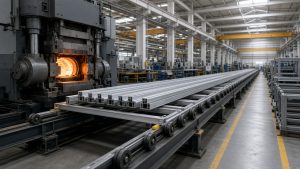 Engineering DesignAluminium Extrusion Price per Meter: How the Number Is Built
 Engineering DesignCut-to-Length, Drilling and Tapping: What Fabrication Adds
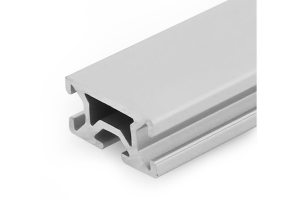 Engineering DesignMetric vs Imperial T-Slot Profiles: How to Test Compatibility Before You Order
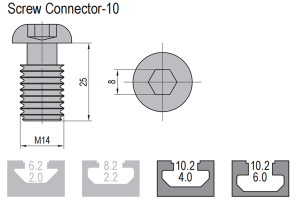 Engineering DesignAluminium Profile Anchor Pins: A Preloaded Joint, Not a Pin
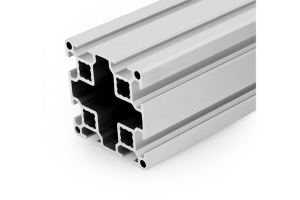 Engineering Design30 Series T-Slot Profiles: The Middle That Has to Justify Itself
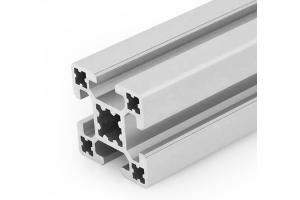 Engineering Design4040 vs 4080 Aluminium Profile: Which for Your Frame
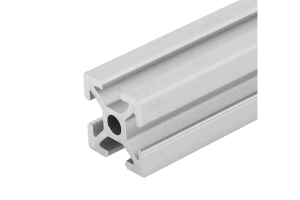 Engineering DesignWhat Is a 2020 Aluminium Profile? (Weight, Slot and Load)
 Materials and Engineering6063-T5 Aluminium Profile: What the Designation Actually Guarantees
 Sourcing and ProcurementAluminium Profile Price Breaks: How Volume Changes the Unit Price
 Materials and EngineeringAluminium Corrosion: Why a Salt Spray Number Is a Ranking, Not a Life
 Sourcing and ProcurementAuditing an Aluminium Profile Supplier: Factory, Trader, or Something in Between