2020 vs 3030 Aluminium Profile
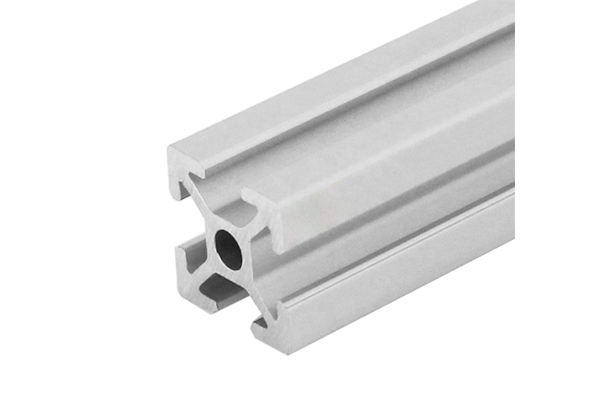
Choose 2020 when the frame is light and short; move to 3030 the moment span or load starts to govern. The switch is driven by deflection, not strength — 2020 runs 0.38–0.62 kg/m, 3030 runs 0.62–1.15 kg/m.
Short answer
Stay on 2020 for compact fixtures, light guards and members under about 0.5–0.6 m at modest loads. Step to 3030 once a rail must carry ~50 kg over ~0.8–1.0 m, or when a workbench, conveyor pitch or tall fence starts to feel soft. Mid-wall Ix sits near 0.7 cm⁴ for 2020 and 2.8–3.3 cm⁴ for 3030 — about a 4× stiffness jump for a 50–80% mass rise. Slot families differ (often 6 mm mouth on 2020 vs 8.2 mm groove class on 3030), so hardware is not drop-in. 2026 USD bands: $0.42–$1.20/m vs $1.60–$2.55/m; made to order with trial lengths. Size to L/500 using mill I — see max-span tables.
The numbers side by side
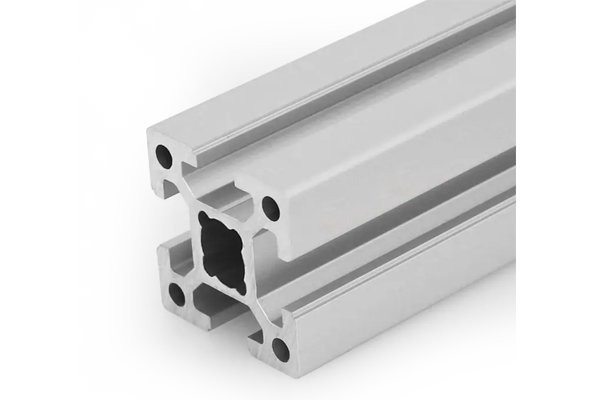
3030 wins on bending stiffness by a larger factor than the mass or metre-price gap suggests.
Ix and span at a stated load decide the frame; envelope photos do not. Mid-wall I and a simply-supported 100 kg mid-span screen to L/500 (E ≈ 69 GPa) set the order-of-magnitude spans below. Wall class moves mass and I inside the brief ranges — quote drawing kg/m.
| Criterion | 2020 | 3030 | Verdict |
|---|---|---|---|
| Envelope | 20 × 20 mm | 30 × 30 mm | 3030: larger joint face |
| Weight | 0.38–0.62 kg/m | 0.62–1.15 kg/m | Stiffness rises faster than mass |
| Slot | Varies — often 6 mm mouth, ~6.2 mm groove, 20 mm pitch, 1 slot class | Varies — often 8.2 mm groove, 6 mm mouth class, 30 mm pitch, 1 slot | Hardware not interchangeable by default |
| Ix (typical mid-wall) | ≈ 0.7 cm⁴ | ≈ 2.8–3.3 cm⁴ | 3030 ~4× stiffer |
| Max span @100 kg (L/500 mid) | ≈ 0.2 m | ≈ 0.45 m | Shorten bay or upsize again for long heavy rails |
| Price band (2026) | $0.42 – $1.20 / m | $1.60 – $2.55 / m | Rework usually costs more than the delta |
| MOQ | Made to order; small trial lengths available | Made to order; trial lengths available | Both trial-friendly on existing dies |
When 2020 is enough
2020 is enough when unsupported lengths stay short, payloads stay light, and the hardware set is already 20-series.
Typical passes: jig rails under 0.5 m; sensor stands; light fixed guards with bays under ~0.6 m and no door; internal braces inside a larger carcass; desktop-scale frames where envelope matters more than granite flatness. Keep working mid-span loads in the low tens of newtons at 0.5 m if you need L/500. The moment a ~0.8 m top must hold a plate, vise reaction or lean-load, stop arguing for 2020.
When you must move to 3030
Move to 3030 when span crosses about 0.8 m under useful load, when vibration appears, or when you need the larger joint face.
Triggers: rail ≥ 0.8–1.0 m with ≥ 30–50 kg working load; workbench perimeter under hand tools; conveyor pitch above ~0.6 m; tall fence with doors; machined faces for guides or cylinders where 1–2 mm sag ruins alignment. Mid-wall 3030 I (~2.8–3.3 cm⁴) cuts deflection by roughly the I ratio versus 2020. If 3030 still fails L/500, the next call is 4040 or a mid-post — that is a different page.
The cost of choosing wrong
Over-sizing wastes aluminium you can price; under-sizing wastes a rebuild.
Mid-band mass is about 0.50 kg/m (2020) vs 0.90 kg/m (3030). On a 40 m cut list that is ~20 kg extra if you jump size everywhere. Metre-price bands ($0.42–$1.20 vs $1.60–$2.55) often put the premium near $1/m or more — see price per metre. One soft-frame rebuild with re-cut rails and lost FAT days usually exceeds that delta on the whole BOM. Hybrid is fine: 3030 on load paths, 2020 on short covers.
RFQ checklist — 2020 vs 3030
- Section and wall — 2020 or 3030 with target kg/m.
- Span and load — length, kg, L/500 or mm limit.
- Slot / hardware — mouth and nuts to reuse.
- Finish — mill or anodised; EN 755-9 / GB/T 6892.
- Hybrid OK? — may light members stay 2020?
Send the governing span and payload first. Size follows from I.
Four ways this pair goes wrong
Related on this site
- What is a 2020 aluminium profile — 2020 on its own
- What is a 3030 aluminium profile — 3030 on its own
- Maximum span and load — deflection tables behind this decision
- Price per metre — how weight differences price out
Terms used in this article
- Second moment of area (Ix)
- Bending stiffness of the section; rises faster than mass from 20 to 30 mm.
- L/500
- Deflection limit span/500 (2 mm at 1 m).
- Slot mouth
- Face opening that admits the T-nut; often ~6 mm on 2020-class profiles.
- Wall class
- Light / standard / heavy inside the same envelope name.
Questions buyers ask
Should I use 2020 or a deeper section for a workbench?
Use 2020 only for light assembly tops with bays under about 0.6–0.8 m and no vise. Step to 3030 for industrial benches once spans approach 1 m or the top must stay flatter under tool loads. Check L/500 before freezing 2020 rails.
Should I use 2020 or a deeper section for a machine frame?
Keep 2020 for covers, trays and short braces; put perimeter load paths on 3030 or larger. Vibration makes deflection the limit long before 6063-T5 yield on a 20×20 envelope.
Should I use 2020 or a deeper section for a robot cell fence?
2020 suits light mesh on short posts under about 0.8 m bay width. Move to 3030 (or 4040 for tall posts and doors) when the fence takes a hinged panel or lean-load without sway.
Should I use 2020 or a deeper section for a conveyor frame?
Prefer deeper rails for conveyors. Continuous load softens 2020 above ~0.5 m pitch. 3030 is the usual first step for light belts; upsize again if pitch exceeds about 1 m.
Should I use 2020 or a deeper section for a cleanroom equipment frame?
2020 rarely suits primary cleanroom rails. Use 3030 only for short instrument stands; use 4040 for metre-class skeletons. Spec sealed anodising with the section.
Should I use 2020 or a deeper section for a machine guard?
2020 works for small fixed guards on short frames. Upsize when a hinged door, long top rail or lean/impact check appears. Do not assume 6 mm-slot nuts fit a 3030 mouth.
Should I use 2020 or a deeper section for a CNC router gantry?
Do not use 2020 as the sole gantry beam. Desktop machines may start at 3030; production routers need 4040/4080 or twin rails with guides on a stiff face.
Should I use 2020 or a deeper section for a test rig?
2020 suits short sensor brackets. For force application or alignment under load, step to 3030 or deeper so the frame is not the compliance error. State load and span on the RFQ.
Send the span and payload for 2020 vs 3030
Give unsupported length, working load, deflection limit and whether 20-series hardware must be reused. We return a size call with kg/m and I against EN 755-9.
Request a quoteRelated reading
Twelve more engineering notes from this blog, picked for this article — plus every category below.
 Applications20 Series T-Slot Profiles: Where the Limits Actually Are
 Engineering DesignCut-to-Length, Drilling and Tapping: What Fabrication Adds
- Engineering DesignWhat Is a 2020 Aluminium Profile? (Weight, Slot and Load)
 Engineering Design4040 vs 4080 Aluminium Profile: Which for Your Frame
 Engineering DesignAluminum vs Steel Machine Frames: Choose by Deflection, Not by Strength
 Engineering Design6061-T5 vs 6063-T5: What the Temper Label Really Decides
 Engineering DesignT-Slot Cross-Brand Compatibility: Bosch, Item and Generic
 Engineering DesignHow to Request a Quote for Custom Aluminium Extrusion (RFQ Checklist)
 Quality and InspectionGood vs Bad Aluminium Profiles: What Your Receiving Dock Can and Cannot Check
 Quality and InspectionAluminium Profile Finishes: Choose by Failure Mode, Not by Process Name
 Sourcing and ProcurementAluminium Profile MOQ: 150 m Existing Die, 500 m New
 Quality and InspectionEuropean Anodised Aluminium Specification: What Should a Purchase Order Contain?
