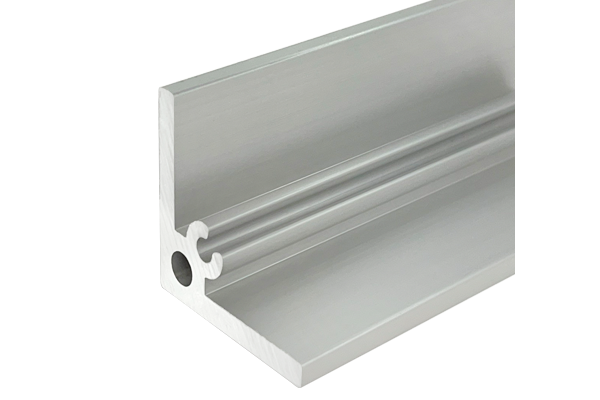
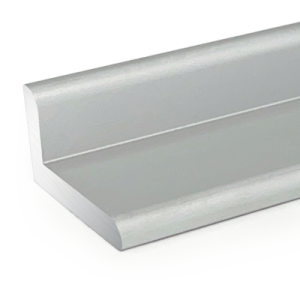
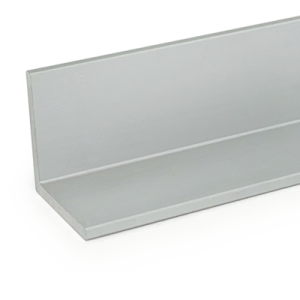
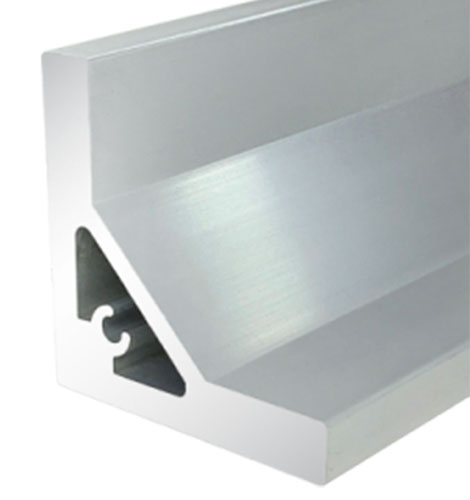
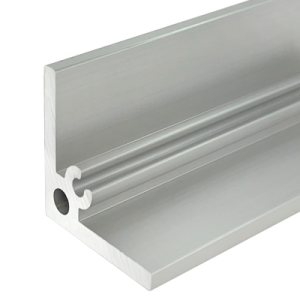
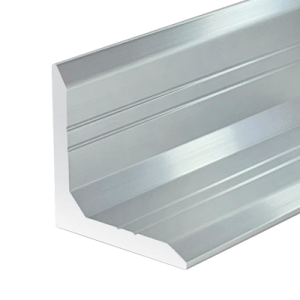
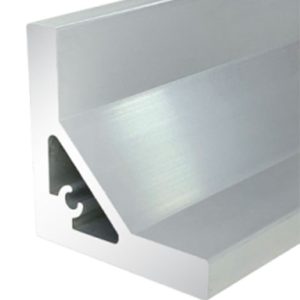
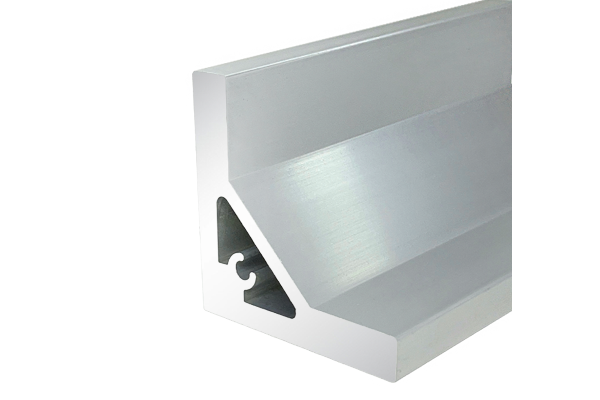
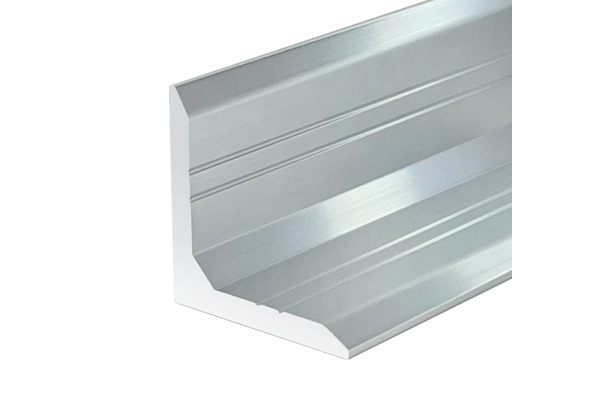
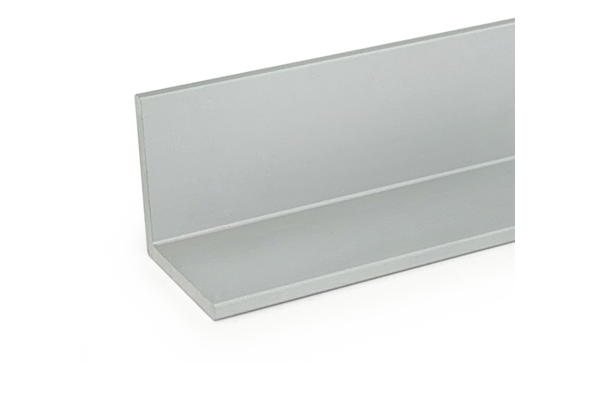
Aluminium angle profiles are L-shaped extrusions with two legs meeting at 90° and a radiused internal fillet. They come in equal-leg and unequal-leg forms, in a range of thicknesses, and they are the cheapest way to add stiffness along an edge or to finish a corner. Standard sections need no tooling, which is why they are usually the first thing to try before commissioning a bespoke die.
Below: how to read an angle specification, why the internal fillet is not a detail, and the tolerances that decide whether an angle will sit flat against a panel.
How an angle is specified
Four numbers describe an angle completely, and leaving any of them out causes a mismatch.
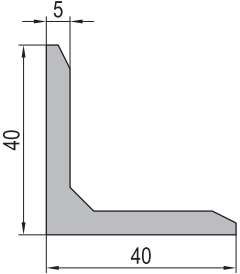
- Leg lengths — quoted as A×B, for example 40×40 for an equal angle or 50×30 for an unequal one.
- Leg thickness — the wall thickness of the legs, usually 1.2 mm to 10 mm. This is the number that governs how much load the section can take at a fixing.
- Internal fillet radius — the radius where the two legs meet. Not a cosmetic feature; see below.
- Alloy, temper and finish — 6063-T6 mill finish as standard, or anodised where the part will be seen or cleaned.
Unequal angles are worth considering more often than they are used. A 60×30 angle does the work of a 40×40 angle in one direction while using less material, provided the orientation is fixed by the design. Where a part could be installed either way round, an unequal angle is a risk rather than a saving.
The internal fillet is not a detail
An extruded angle never has a sharp internal corner. The die has to allow metal to flow through it, so the inside radius is formed by the die itself and is typically comparable to the leg thickness. Three consequences follow, and each of them causes a real problem if ignored.
It will not sit tight into a square corner
An angle placed inside a machined right-angle corner rests on the fillet, not on both legs. The gap is small but it is not zero, and on a part that has to be flush it shows. Where that matters, either relieve the mating corner or specify a smaller fillet and accept a heavier section.
It concentrates stress
A radius reduces stress concentration compared with a sharp corner, so an extruded angle is actually better in that respect than a machined one. Where an angle carries a bending load, the outside of the corner is the critical location, and the fillet is what stops a crack starting there.
It changes the section properties
The fillet adds material exactly where a beam section needs it most — at the extreme fibre — so an extruded angle is slightly stiffer than a sharp-cornered angle of the same nominal legs. This is a benefit, but it means that section property tables calculated for a sharp corner are slightly conservative rather than exact.
Equal, unequal and lipped angles
| Type | Shape | Best for | Watch out for |
|---|
| Equal leg | A = B | Frame corners, edge trim, general reinforcement | Most material for the stiffness; heavier than an unequal angle doing the same job |
| Unequal leg | A ≠ B | Edge reinforcement where one leg carries the load and the other fixes | Can be installed the wrong way round, halving the stiffness |
| Lipped angle | Leg with a turned edge | Panel edges, glazing beads, snap-fit trim | Usually a bespoke die; the lip is what holds the panel |
| Radiused outer corner | Rounded outside | Handrails, trim, anything touched | Bespoke; standard angles have a square outer corner |
Angle or bracket?
Angles and brackets overlap, and the choice is usually about whether the part is structural or a fitting.
- Use an angle when the part runs along a length — an edge, a rail, a frame side. The angle works as a beam and its stiffness comes from its length and orientation.
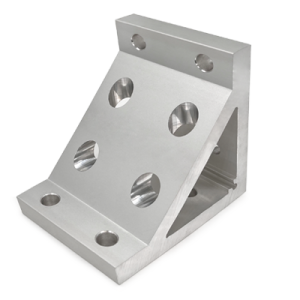
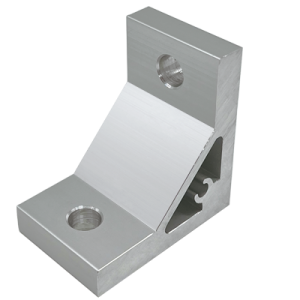
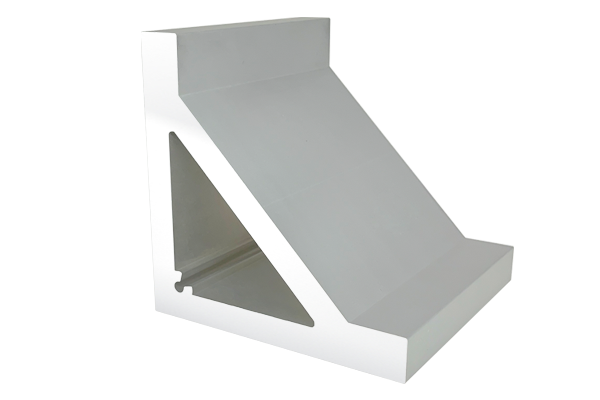
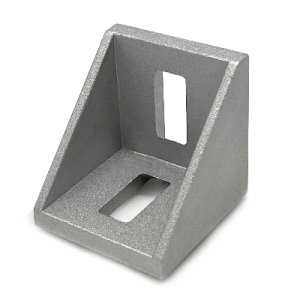
- Use a bracket when the part joins two members at a point. A die-cast bracket or an angle profile bracket is shaped for the slot and spreads the load into the profile.
- Use an angle plus a bracket where a corner has to be both aligned and stiff. The angle sets the alignment along the edge and the bracket carries the joint load.
Tolerances that decide whether an angle fits
Four dimensions on an angle matter in practice, and they are separate items on a drawing.
| Dimension | Why it matters | Note |
|---|
| Leg length | Decides whether the angle covers the edge it is protecting | Tolerance scales with leg size under the nominated standard |
| Leg thickness | Decides the depth of any thread and the strength at a fixing | The tightest of the three section dimensions |
| Angle between legs | A leg that is not at 90° will not sit flat | Usually expressed as a deviation over the leg length |
| Straightness | Accumulates over length, so it shows on long parts | Expressed as millimetres per metre |
An angle is also asymmetric, and that affects how it behaves in service. It bends about neither principal axis when loaded along a leg, so an angle loaded that way twists as well as bends. Where an angle carries a significant load, either orient it so the load passes through the corner, or accept that a channel or a tube would have been the better section.
Cutting, machining and finishing
Angles are supplied in 6,000 mm lengths or cut to a cut list. Because the section is asymmetric, cutting to length is straightforward but mitring is not: a mitred corner on an angle has to be cut on the correct face, and the two legs meet differently. Where an angle forms a visible corner, agree the joint detail before cutting.
Drilling and tapping an angle is common because it is often used as a fixing rail. Tapping into a leg thinner than about 2 mm is unreliable, so specify a thickness that will take the thread or plan on a nut and bolt instead. See CNC machining for the drilling, tapping and milling we can add.
Satin anodised is the usual finish where the part is seen or cleaned, in clear, black or bronze; mill finish is standard where it will be painted or concealed. Film grades are described under anodised aluminium profiles.
Where angles are used
Frame edges and cornersReinforcing a corner or an edge on a bolted structure without adding a full member.
Panel edge protectionCovering the cut edge of a sheet or a composite panel, and giving it something to be fixed to.
Fixings railsA drilled and tapped angle is a cheap way to provide an adjustable fixing line.
General fabricationWherever a part needs a right angle, a flat face and a hole, and a bespoke die would be disproportionate.
Specifying an angle order
Give us the leg sizes, the thickness, the alloy and temper, the finish, the cut list and the quantity, and say which leg is the load-carrying one if the section is unequal. If you need a lip, a rounded outer corner or a specific fillet, that is a bespoke section and the lead time reflects it — see aluminium sections for how a new die is quoted. Standard angles are quoted within one working day. Related ranges: aluminium sections, angle profile brackets, anodised aluminium profiles and CNC machining.