How We Quote Aluminium Profiles by Quantity and Destination
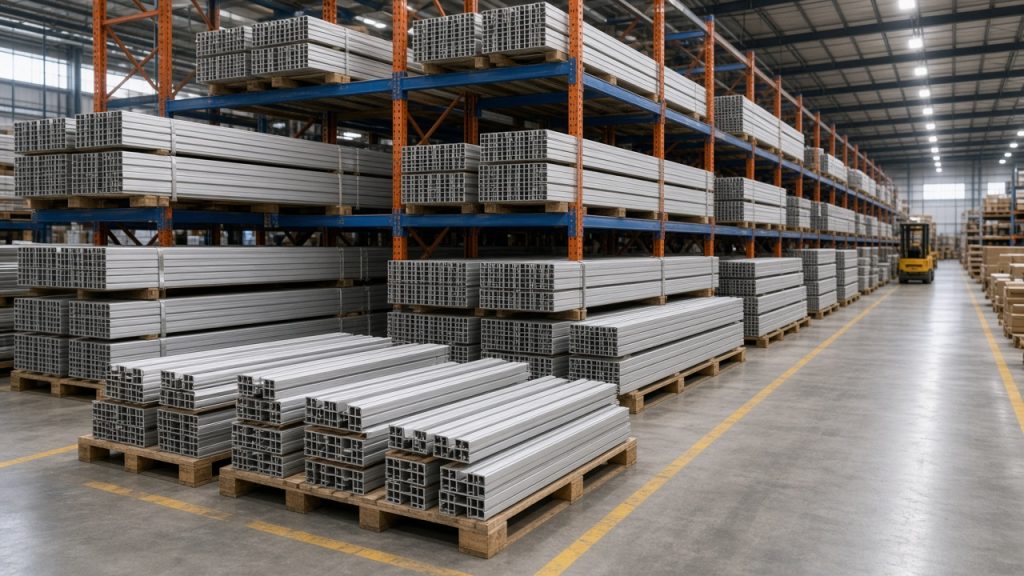
In 2026 a factory FOB Shanghai metre for common T-slot runs about USD 1.50–6.50/m on 20×20 to 40×40, and higher on heavy sections, because extrusion setup, die amortisation and freight are fixed costs spread over the order. The same profile therefore costs different amounts at 100 m and at 5 tonnes.
Short answer
We quote aluminium profiles from the section, the alloy and finish, the die status, the length and quantity, and the Incoterm and destination. Metal and press time scale with kilograms; die setup, trial scrap, anodising bath change and packing are largely fixed per order, so the unit price falls as metres rise. Destination changes the number through ocean freight, insurance and whether the quote stops at FOB Shanghai or Ningbo, or continues as CIF, DAP or DDP. Payment is T/T 30% deposit and 70% before shipment, or L/C at sight. The table below gives 2026 reference bands per metre for the sections buyers ask about most; a firm quote needs the drawing, quantity, finish and port.
How We Quote Aluminium Profiles by Quantity and Destination (by the variables below)
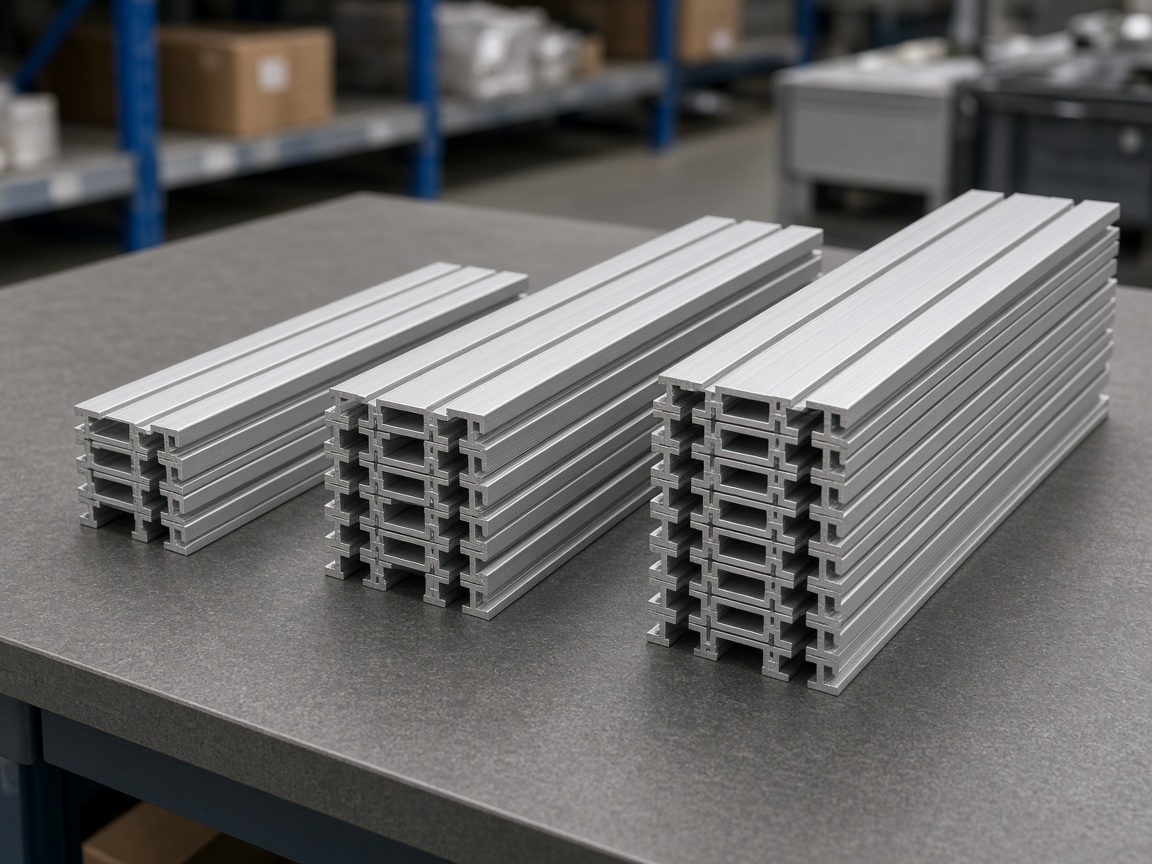
The reference bands below are 2026 China-factory FOB figures for 6063-T5 silver-anodised T-slot off an existing die at roughly 500–2 000 m, expressed in USD per metre so a buyer can compare sections without converting kilograms first.
They are not firm quotes. Mill finish sits toward the low end of each band; black anodising, tight length tolerance, special packing and rush press slots sit toward the high end. A new die adds a one-line tooling charge that is amortised across the order — see how die cost amortises per meter. Heavy CCD sections need a larger press and carry a small premium inside the same kilogram logic. European catalogue prices for the same envelopes are often several times these FOB bands because they include distributor stock, cut-to-size labour and local VAT treatment; an importer comparing a Motodis-style retail list with a Dalian factory sheet is comparing two different products.
When a buyer asks “what is your price for 100 m of 2020 delivered to the US” versus “500 m of 2020 delivered to the US”, the section row stays the same and three variables move: the quantity step, the share of fixed setup, and whether the shipment is LCL or can fill a better ocean rate. The table collapses those 500-odd ask-variants into one reference grid; the destination adder is calculated on top once the Incoterm is named.
| Section | Circumscribed circle | Type | Reference price (USD) | Notes |
|---|---|---|---|---|
| 100×100 (100100) | 141 mm | 6063-T5 T-slot | USD 30.87–40.82/m | Heavy section; larger press / CCD; ~10.50 kg/m |
| 160×80 (16080) | 179 mm | 6063-T5 T-slot | USD 28.81–38.10/m | Heavy section; larger press / CCD; ~9.80 kg/m |
| 20×20 (2020) | 28 mm | 6063-T5 T-slot | USD 1.40–2.20/m | 6 mm or 8 mm slot series; existing die common; ~0.50 kg/m |
| 30×30 (3030) | 42 mm | 6063-T5 T-slot | USD 2.80–3.60/m | 6 mm or 8 mm slot series; existing die common; ~1.00 kg/m |
| 40×40 (4040) | 57 mm | 6063-T5 T-slot | USD 4.34–5.58/m | 8 mm / 10 mm slot; machine-frame staple; ~1.55 kg/m |
| 40×80 (4080) | 89 mm | 6063-T5 T-slot | USD 8.40–10.80/m | 8 mm / 10 mm slot; machine-frame staple; ~3.00 kg/m |
| 45×45 (4545) | 64 mm | 6063-T5 T-slot | USD 5.60–7.20/m | 10 mm slot; Bosch-class envelopes; ~2.00 kg/m |
| 45×90 (4590) | 101 mm | 6063-T5 T-slot | USD 11.48–14.76/m | 10 mm slot; Bosch-class envelopes; ~4.10 kg/m |
| 50×50 (5050) | 71 mm | 6063-T5 T-slot | USD 7.28–9.36/m | 8 mm / 10 mm slot; machine-frame staple; ~2.60 kg/m |
| 80×80 (8080) | 113 mm | 6063-T5 T-slot | USD 16.80–21.60/m | Heavy section; larger press / CCD; ~6.00 kg/m |
| 90×90 (9090) | 127 mm | 6063-T5 T-slot | USD 22.40–28.80/m | 10 mm slot; Bosch-class envelopes; ~8.00 kg/m |
Reading the grid: a 20×20 row near USD 1.40–2.20/m at mid volume is light metal and a small press; a 100×100 row near the high twenties to forties per metre is mostly kilograms and CCD. Use the band to shortlist, then lock alloy, finish and port before you treat any figure as a purchase price.
What the price is actually made of
A metre price is billet metal plus press time, finish, packing and a share of fixed order costs — not a single catalogue line.
Billet follows the LME/SHFE band and is usually 60–75% of a China FOB extrusion number on commodity 6063. Extrusion recovery, scrap and ageing sit next. Anodising is priced by surface area and colour batch; a silver clear coat is cheaper than a dense black that needs tighter rack discipline. Packing for export is an ISPM 15 timber cradle with IPPC mark, or a plywood case for cut lengths under 3 m. Fixed items — die change, first-bar trial, document set, container loading — do not shrink when the order is short, so they dominate the unit cost below a few hundred metres.
Destination and Incoterm decide whether ocean freight and clearance enter the same number or stay with the buyer. FOB Shanghai or Ningbo stops at the ship’s rail. CIF adds freight and insurance to a named port. DAP carries the goods to the named place ready for unloading. DDP adds import duty and clearance on the seller. Two quotes that differ by 8% on the profile line can reverse ranking once DAP Chicago is compared with FOB Ningbo plus the buyer’s own forwarder.
How quantity changes the unit price
Unit price falls at 500 m, 2 000 m, 5 000 m and 10 000 m because fixed costs are spread thinner and the press run is more efficient.
Worked ladder for 40×40 (~1.55 kg/m) around a mid 2026 FOB band of about USD 4.96/m at 500–2 000 m:
| Quantity | What changes | Indicative unit effect (2026) |
|---|---|---|
| 150 m (existing-die MOQ) | Full setup and packing on a short run | +8% to +15% vs mid band |
| 500 m | First formal price step; setup diluted | Reference band |
| 2 000 m | Better recovery; fewer colour-batch orphans | −3% to −6% |
| 5 000 m | Near full-press economics; freight often FCL | −6% to −10% |
| 10 000 m | Contract metal formula becomes useful | −8% to −12% plus metal hedge |
A new die needs 500 m minimum and carries tooling on top until it is amortised — details under minimum order with a new die. Destination then multiplies the effect: the same percentage freight saving on a full 40HQ is larger in absolute dollars than on a LCL pallet to the US Gulf or Hamburg. That is why “quantity × unit price” must be read with the Incoterm in the same cell, not on a separate email.
Importers who call off 400 m every month often pay more than a distributor who books 5 000 m twice a year, even when the annual metres are similar. Consolidating call-offs into the published steps is usually worth more than negotiating adjectives on a 150 m spot buy.
What to send us for a firm quote
Send the section or DXF, alloy and temper, finish, cut length, quantity in metres or tonnes, die status, Incoterm and destination port — that set produces a firm 2026 number.
If the die is new, say so; die making adds 7–12 days before the press, covered on die making adds 7–12 days, and ownership is documented under who owns the die. State whether lengths are stock 6.02 m bars or cut-to-size. Name FOB Shanghai, FOB Ningbo, CIF, DAP or DDP and the discharge port. With that package we return metal, process, finish, packing and freight as separate lines so the buyer can see what quantity and destination actually move.
Payment terms on the firm sheet are T/T 30% deposit and 70% before shipment, or L/C at sight. Capacity context for large call-offs is about 600 t per month of extrusion with in-house anodising, which matters when several heavy sections share the same sailing.
RFQ checklist — quantity and destination quote
- Section / drawing — standard code (2020, 4040…) or DXF with tolerances.
- Alloy and temper — usually 6063-T5 for T-slot; state 6061-T6 if required.
- Finish — mill, silver anodised, black anodised, or powder coat with RAL.
- Length and quantity — metres or tonnes; stock bar or cut list.
- Die status — existing or new; who pays and who owns the tool.
- Incoterm and port — FOB Shanghai / Ningbo, or CIF / DAP / DDP with named place.
- Target window — so press and anodising slots can be held.
Ask one question before comparing quotes: whether the other offer is FOB China or landed. A lower FOB number can lose to a clearer CIF once freight is honest.
Four ways a quantity quote misleads
Related on this site
- how die cost amortises per meter — build the metre number from kg and tooling
- minimum order with a new die — 150 m existing vs 500 m new
- die making adds 7–12 days — calendar behind the quote
- who owns the die — tooling title and reuse
Terms used in this article
- FOB
- Free on board at the named Chinese port; buyer takes ocean freight and risk after loading.
- CIF / DAP / DDP
- Seller adds freight and insurance (CIF) or delivers to place (DAP) or delivers duty paid (DDP).
- Die amortisation
- Spreading the one-time tooling charge across the metres in the order or contract.
- CCD
- Circumscribed circle diameter — the smallest circle around the section, which sets press size.
- Price step
- A quantity band (500 / 2 000 / 5 000 / 10 000 m) where the unit price is recalculated.
- LCL / FCL
- Less-than-container vs full-container load; freight economics change sharply between them.
Questions buyers ask
What is included in the quoted price?
Unless the quote states otherwise, the 2026 FOB Shanghai or Ningbo figure covers billet, extrusion, cut to stock length, silver anodising where listed, packing on an ISPM 15 cradle, and loading. Die cost for a new tool is shown as a separate line. CIF, DAP and DDP add ocean freight, insurance and, for DAP/DDP, destination charges.
Do you charge for samples?
Cut samples off an existing die are usually charged at the small-lot metre rate plus express freight. New-die samples carry the die charge and the first-press trial length. Sample fees are credited against the production order when the same die and alloy are confirmed.
How long is the quotation valid?
Quotes are typically valid for 14 days against the LME/SHFE billet band stated on the sheet. After that the metal component is re-indexed; fabrication, anodising and freight lines stay unless those markets move.
Can the price be fixed for a contract?
Yes for a call-off contract with defined monthly volumes and an agreed metal formula or a fixed metal adder for a set window. Payment stays T/T 30% deposit and 70% before shipment, or L/C at sight. Price steps still apply at 500 m, 2 000 m, 5 000 m and 10 000 m.
Send quantity, finish and destination for a firm sheet
List the sections, metres, finish and named port (FOB Shanghai / Ningbo, CIF, DAP or DDP). We return 2026 USD lines for metal, process, finish, packing and freight so you can see what quantity actually changes.
Request a quoteRelated reading
Twelve more engineering notes from this blog, picked for this article — plus every category below.
 Engineering DesignStandard vs Custom Aluminium Extrusion: The Break-Even Calculation
 Engineering DesignHow to Request a Quote for Custom Aluminium Extrusion (RFQ Checklist)
 Quality and InspectionT-Slot Aluminium Profiles for Industrial Frames and Automation: A Specification Playbook
 Materials and EngineeringIndustrial Aluminium Extrusion: Five Advantages and the Conditions Attached to Each
 Engineering DesignCustom Aluminium Extrusion: From Drawing to Production
 Quality and InspectionSampling and First Article Approval for Aluminium Extrusion
 Engineering DesignCut-to-Length, Drilling and Tapping: What Fabrication Adds
 Engineering DesignAluminium Extrusion Lead Time: New Die vs Existing Die
 ApplicationsHow to Fix Panels, Guards and Accessories to Aluminium Profiles
 Materials and EngineeringAluminium Corrosion: Why a Salt Spray Number Is a Ranking, Not a Life
 ApplicationsAluminium Pergola Profiles: A Beam Problem With a Water Problem
 Engineering DesignAluminum Corner Brackets for T-Slot Frames: How to Choose by Load Path, Not by Looks
