How to Choose T-Slot Nuts for Slot 8 and 10
A buyer standardising T-slot nuts for Slot 8 and Slot 10 frames has asked us to compare roll-in nuts with a spring ball, roll-in nuts with a spring leaf, hammer T-nuts and ordinary slide-in nuts, at a volume around 100,000 pieces. They also want to know whether serrated wings will bite through anodising to give an ESD earth path, and they have asked for 20,000 pieces per thread, M4 to M8, in zinc-plated steel and in 304 stainless. The useful answer is which GrownParts nut enters the groove when, which retainer we actually publish, and which numbers are on the page you are buying from.
Short answer
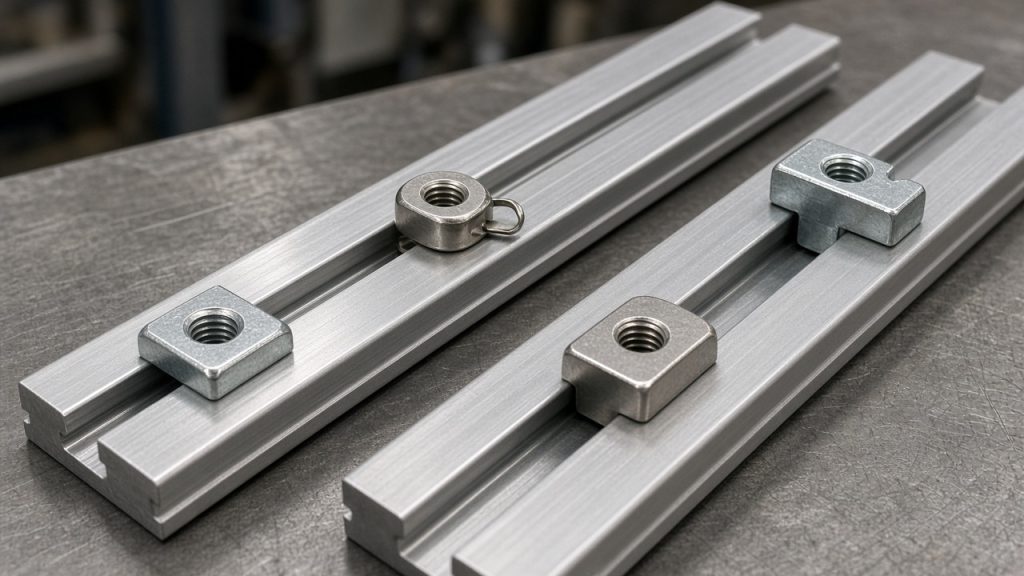
We do not catalogue a “spring-ball roll-in nut” or a “spring-leaf roll-in nut”. The published pre-set nut (GP-NT-PS) uses a 65Mn anti-drop spring tab, is placed before assembly, and is listed in M5, M6 and M8, with tab engagement of 2–5 N and pull-out of approx. 1.5 kN (M6) and 2.5 kN (M8). The subsequent nut (GP-NT-SUB) slides in from the end face after assembly. Hammer nuts on the series pages are slide-in and post-install quarter-turn: the 40-series M8 (GP-TN-40-M8) is for the 8 mm groove, the 45-series M8 (GP-TN-45-M8) is for the 10 mm slot, and those two are not interchangeable. The anti-torsion subsequent nut (GP-NT-AT) has 0.2 mm serrated wings, 95 per cent vibration torque retention, and max torque of 10 Nm (M6) or 25 Nm (M8) — a mechanical interlock, not an ESD earth path. Do not assume the teeth bite through anodising; electrical continuity is a measured, to-drawing requirement. A 20,000-piece-per-thread enquiry is quoted per type, thread, groove and material. The NT-* lines have breaks at 100, 500 and 1,000 pieces but no unit USD; that quantity sits past the 1,000-piece break. The T-nut and bolt set (GP-NT-SET) has a published 2026 band of $0.125 per set at 20,000–99,999 sets. We will not invent a lump sum for 100,000 pieces.
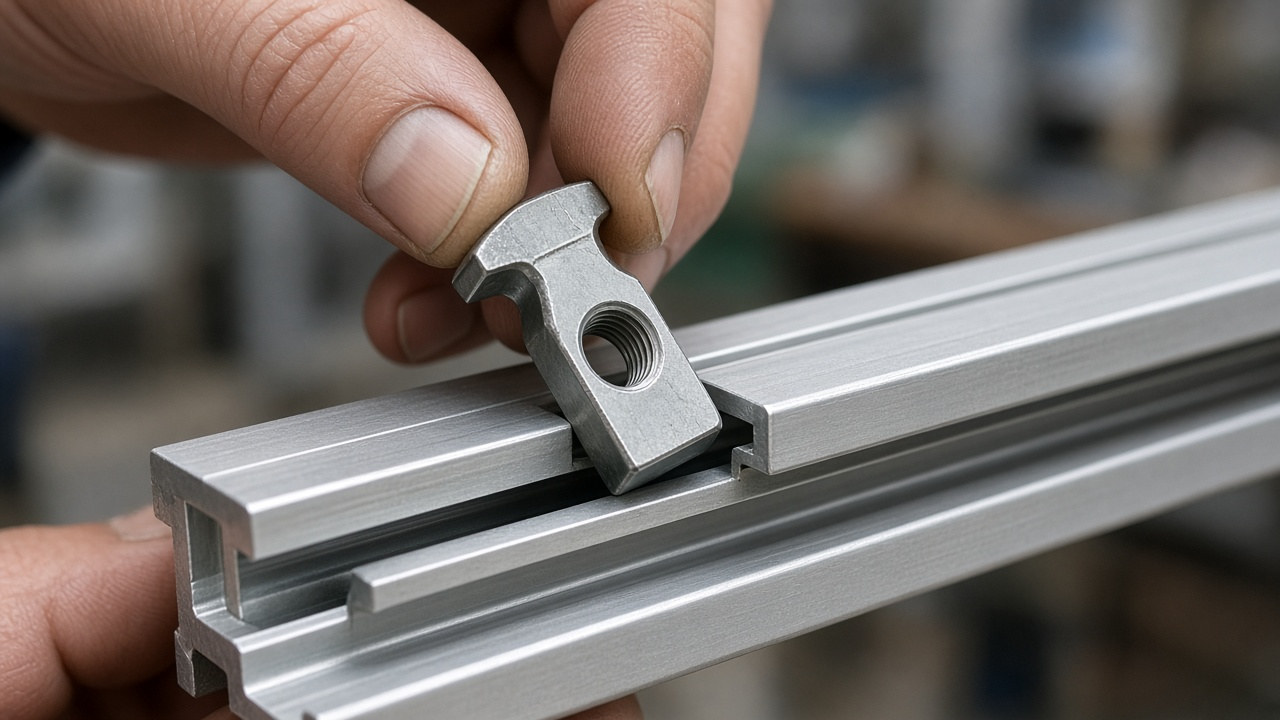
How to choose T-slot nuts: pre-set, subsequent, hammer / quarter-turn and anti-torsion
Choose the nut by when it has to enter the groove and whether it must resist rotation — not by an imported roll-in trade name such as spring-ball or spring-leaf.
Some imported roll-in T-nuts use a spring-loaded ball, and others a leaf spring, as a retainer so the nut can be dropped into a finished frame and will not slide down the slot. We do not publish a catalogue SKU under either of those names, and we will not invent ball or leaf dimensions. The published map is the spring-tab pre-set nut, the subsequent slide-in nut (round or square), the series-specific hammer / quarter-turn nut, and the serrated anti-torsion subsequent nut. A T-bolt is the alternative when you do not want a separate nut.
The pre-set nut (GP-NT-PS / NT-PS) goes into the groove before the frame is closed and is bolted from outside. A 65Mn anti-drop spring tab holds it (2–5 N). We stamp the body, tap a 6H thread, form the spring tab, then zinc-plate carbon steel C1035 or machine and passivate stainless A2 or A4. Stock sizes have no MOQ and ship in 2–3 days; custom sizes, including reducers, start at 500 pieces and take about two weeks. That page groups grooves as 20 series (6 mm), 30 series (8 mm) and 40 series (10 mm) — a 40-series width I come back to below.
The subsequent nut (GP-NT-SUB) slides in from the end face after assembly, round or square, with a sliding force of 0.5–1.5 N or 1.5–3.0 N respectively. The square nut (GP-NT-SQ) uses four flats for positioning of ±0.2 mm and a body width of 7.5 / 9.5 mm. Both share the pre-set pull-out figures and the M5 / M6 / M8 range, and neither is recommended for 20 series (6 mm): the subsequent body catches on the narrow slot mouth, and the square body is too narrow for effective wall contact.
Hammer nuts on the series pages are listed as slide-in and post-install quarter-turn: you offer the head through the slot mouth and turn it so it sits under the lips. The 20-series nut is M5 at about 3 N·m, the 30-series M6 at about 6 N·m, the 40-series M8 (8 mm groove of 40×40) and 45-series M8 (10 mm slot of 45×45, 33 mm pitch) at about 15 N·m, and the 50-series M10 at about 30 N·m. The 40- and 45-series nuts are not interchangeable. M4 belongs on the master T-nut range (GP-TN-RANGE): M4 to M10, 15 to 60 series, four types, pull-out from 0.5 kN (M4) to 3.5 kN (M10), weight 0.9–18.0 g. Do not assign M4 to a hammer page that only lists M5, M6, M8 or M10.
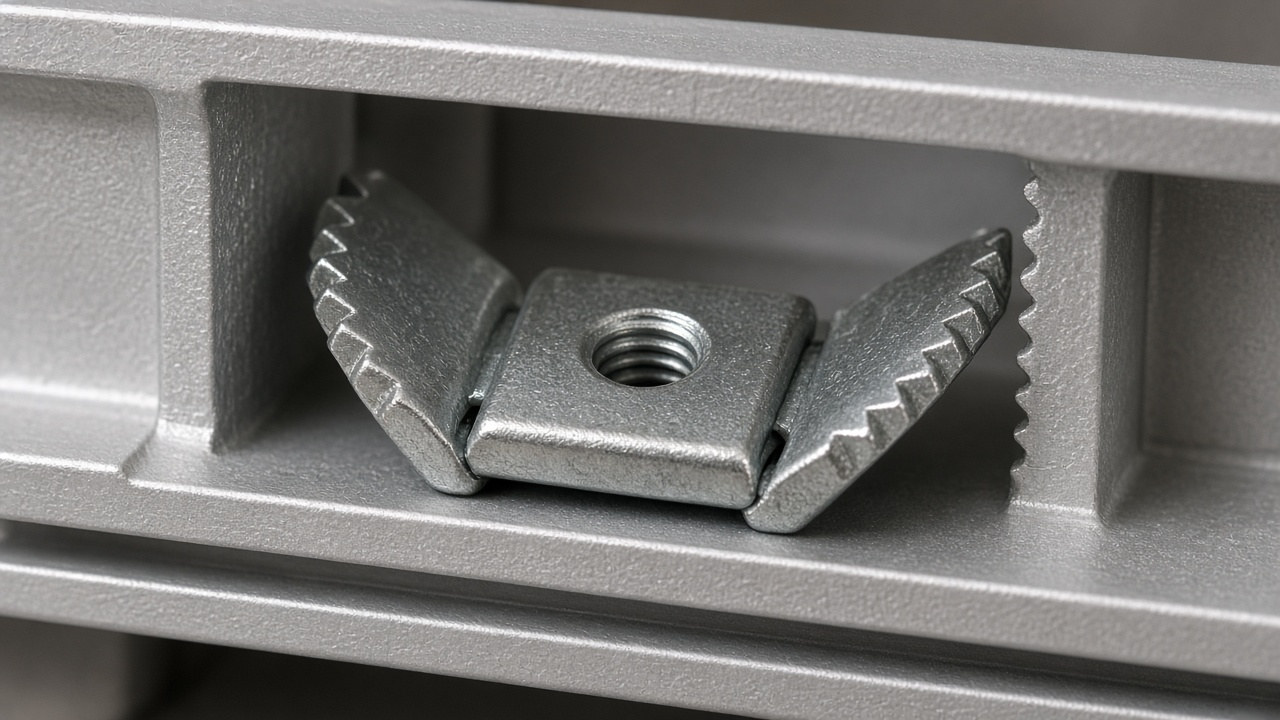
The anti-torsion subsequent nut (GP-NT-AT) is the vibration fastener: serrated twin wings (0.2 mm), 95 per cent torque retention, reusable, M6 and M8 only, max torque 10 or 25 Nm, wing span 7.2 / 9.2 mm. It is not available for 20 series; use thread locker there. A vibration test report is available on request. If you would rather not handle a separate nut, the T-bolt (GP-BT-T) has an integral T-head in M5 to M10, grades 8.8 and 10.9, with groove-limited torque of 5 / 10 / 25 / 35 Nm. M10 T-bolts for 40 series are available on request but are not stocked. See also how to join aluminium profiles and building with T-slot aluminium.
The selection rule
If the frame is still open, use a pre-set spring-tab nut. If you can reach an end face after assembly, use a subsequent slide-in nut — square if you need positioning. If you must add a fixing through the slot mouth, use a hammer / quarter-turn nut in the matching series and measured groove. For vibration, use the anti-torsion subsequent nut in M6 or M8, or thread locker on 20 series.
Slot 8 vs Slot 10: why 40-series and 45-series nuts are not interchangeable
A 40-series hammer nut and a 45-series hammer nut are not interchangeable; on the RFQ, state both the profile series and the measured groove width, because our NT-* range pages and our series-specific hammer pages do not use the same 40-series slot width.
This is a genuine catalogue conflict, not a typing slip we should quietly “correct”. The pre-set page groups 20 series as 6 mm, 30 series as 8 mm and 40 series as 10 mm; the square, subsequent and anti-torsion pages group 30 and 40 series as 8 and 10 mm grooves. The series-specific hammer pages — and most 40-series profile pages on this site — treat 40 series as an 8 mm slot and 45 series as a 10 mm slot, and they state that those hammer nuts do not interchange. We will not rewrite either family of pages here. For 40 versus 45, treat the hammer pages as the guide and measure the groove.
On that guide, GP-TN-40-M8 fits the 8 mm slot mouth and 12 mm cavity of 40 series. GP-TN-45-M8 fits the 10 mm mouth, 14.0 mm cavity and 33 mm slot pitch of 45×45 (head width 14.2 mm, neck 9.7 mm into a 10.0 mm mouth). A 10 mm slot also appears on 50 and 60 series with the M10 hammer nut (GP-TN-50-M10) and a 14 mm cavity — that is not a reason to mix 40, 45 and 50 series nuts without checking the section. If you are unsure, measure the mouth, cavity and pitch, or send the section drawing, and write both the series and the actual groove width on every RFQ line. Profile conventions are in the metric T-slot 15–60 series guide.
| Series | Hammer-page slot (use this for 40 vs 45) | NT-* range-page grouping |
|---|---|---|
| 20 series | 6 mm (GP-TN-20-M5, M5, about 3 N·m) | 6 mm on the pre-set page; square, subsequent and AT not recommended |
| 30 series | 8 mm (GP-TN-30-M6, M6, about 6 N·m) | 8 mm |
| 40 series | 8 mm mouth, 12 mm cavity (GP-TN-40-M8, M8, about 15 N·m) | 10 mm on NT-PS, NT-SQ, NT-SUB and NT-AT |
| 45 series | 10 mm mouth, 14.0 mm cavity, 33 mm pitch (GP-TN-45-M8, M8, about 15 N·m) | Not interchangeable with the 40-series grouping |
| 50 / 60 series | 10 mm mouth, 14 mm cavity (GP-TN-50-M10, M10, about 30 N·m) | Covered on the master range |
Serrations, vibration torque retention, and why that is not an ESD earth
The 0.2 mm serrations on the anti-torsion subsequent nut are published for mechanical interlock and 95 per cent vibration torque retention — not as an ESD grounding method, and not as a claim that the teeth will bite through anodising.
A vibration test report is available on request. The published figures — 0.2 mm serration depth, 95 per cent torque retention, a reusable wing, and 10 Nm (M6) or 25 Nm (M8) maximum torque — are fastening claims, not an electrical specification.
Anodising is an insulating film, and powder coat is an insulator as well. We do not claim that these serrations reliably cut through either film to earth a frame. Bright witness marks on the aluminium after a nut is torqued are not a measured earth path. Electrical continuity is a to-drawing requirement: state the maximum resistance, the test method, and which faces must be conductive — a machined earth boss, a local film window, a dedicated earth block, or a bond strap. We will quote a method that can be verified. Do not write “serrated T-nut = ESD ground” on the bill of materials.
Zinc-plated steel vs 304 / A2 / A4, and how a 20,000-piece-per-size enquiry is quoted
Zinc-plated carbon steel is the standard commercial finish; stainless is quoted with the wording on the page you are buying from, and a 20,000-piece-per-thread enquiry is priced per type, thread, groove and material — not as one lump sum for 100,000 pieces.
On the NT-* pages the base material is carbon steel C1035, zinc plated, or stainless A2 or A4. On the hammer pages the standard is carbon steel with clear trivalent zinc at 8–12 micron, or passivated 304 stainless; the 40-series hammer page also lists 316 (A4-80). A2 is the usual 304 equivalent and A4 the usual 316 equivalent. We will use the wording of the page we are quoting, and we will not invent a “304” stock code on a page that only says A2 or A4. The shop route is stamping or cold forming the body, thread tapping or rolling to 6H (ISO 965-2 on the hammer lines), spring-tab forming where specified, serration cutting on the anti-torsion wings, zinc plating, and stainless passivation.
Treat 20,000 pieces per thread, in zinc-plated steel and in 304 stainless, as line items — type, thread, groove width and material — not as a single 100,000-piece price. M4 is quoted from the master range (pull-out 0.5 kN), not from a series-specific hammer nut. The NT-* pages publish price breaks at 100, 500 and 1,000 pieces and do not publish a unit USD; a 20,000-piece line sits past the 1,000-piece break. Stock sizes ship in 2–3 days; custom and stainless about two weeks; no MOQ on stock, custom from 500 pieces. Hammer pages carry their own 2026 USD bands and higher MOQs, applied only to the hammer line you order. The matched T-nut and bolt set (GP-NT-SET) is a different product: a nut, bolt and washer kit, MOQ 5,000 sets, published 2026 range $0.06–$0.19 per set, with a $0.125 band at 20,000–99,999 and a lead time of 12–20 days. That $0.125 figure is a kit band, not a loose-nut unit price, and not a lump sum for 100,000 loose pieces.
Send this and the first quote will be usable
- Profile series and measured slot mouth (8 or 10 mm); add cavity and pitch if 40 versus 45 is in doubt, or attach the section drawing.
- Nut type, thread and quantity on each line. M4 is a master-range line, not a hammer-page line.
- Material in the catalogue wording you want: zinc-plated steel, A2 or A4, or 304 or 316 where that page lists them.
- If an earth path is required, the resistance limit and test method — not a note to rely on serrations. STEP and PDF are on request; downloads is a range overview, not a self-serve library.
Related on this site
- Pre-set T-slot nut (GP-NT-PS) — 65Mn spring tab, placed before assembly
- Anti-torsion subsequent nut (GP-NT-AT) — serrated wings, 95 per cent vibration torque retention
- T-nut master range (GP-TN-RANGE) — M4 to M10, including the published M4 pull-out of 0.5 kN
- 40-series hammer nut — M8 for the 8 mm groove; not a 45-series part
- 45-series hammer nut — M8 for the 10 mm slot on a 33 mm pitch
- T-nut and bolt set — kit pricing, including the 2026 $0.125 band at 20,000–99,999 sets
- Which series is Slot 8 and which is Slot 10? — 15 to 60 series profile guide
- Downloads — range PDFs; STEP and section drawings on request
Terms used
- Pre-set nut
- Placed before the frame is closed. Our published design (GP-NT-PS) uses a 65Mn anti-drop spring tab, not a spring ball or leaf spring.
- Subsequent / slide-in nut
- Enters from the profile end face after assembly (GP-NT-SUB), in a round or square body.
- Hammer / quarter-turn nut
- A series-specific nut listed as slide-in or post-install quarter-turn, offered through the slot mouth and turned under the lips.
- Anti-torsion subsequent nut
- GP-NT-AT: serrated twin wings, 0.2 mm depth, 95 per cent vibration torque retention, M6 and M8 only.
- Slot mouth / groove width
- The opening you measure on the profile, typically 6, 8 or 10 mm. The series name does not always imply it, especially on 40 versus 45 series.
- A2 / A4 and 304 / 316
- A2 is the usual 304 equivalent and A4 the usual 316 equivalent. Use the wording on the page you are quoting from.
Questions buyers ask
How do I choose T-slot nuts: pre-set vs subsequent/slide-in vs hammer / quarter-turn vs anti-torsion?
Choose by when the nut must enter the groove and whether it must resist rotation: pre-set spring-tab if the frame is still open; subsequent slide-in or square from the end face after assembly; hammer / quarter-turn through the slot mouth; anti-torsion subsequent (M6/M8 only) on vibrating joints. We do not catalogue a spring-ball or spring-leaf roll-in SKU.
Are Slot 8 and Slot 10 T-nuts interchangeable between 40-series and 45-series profiles?
No. The hammer pages treat 40 series as an 8 mm slot (GP-TN-40-M8) and 45 series as a 10 mm slot on a 33 mm pitch (GP-TN-45-M8); those nuts are not interchangeable. The NT-* range pages group some 40-series grooves as 10 mm. Specify both series and measured groove width, and treat the hammer pages as the guide for 40 versus 45.
Do the serrations on anti-torsion nuts bite through anodising to provide an ESD earth path?
No. The 0.2 mm serrations on GP-NT-AT are published for mechanical interlock and 95 per cent vibration torque retention, not as an ESD grounding method. We do not claim that the teeth reliably bite through anodising. Electrical continuity is a measured, to-drawing requirement.
Do you supply a spring-ball or spring-leaf roll-in T-nut?
Not under those catalogue names, and we will not invent ball or leaf dimensions. Some imported roll-in nuts use a spring ball or a leaf spring as the retainer. Our published map is the 65Mn spring tab on the pre-set nut, the subsequent slide-in nut, and the quarter-turn hammer nuts on the series pages.
What is the difference between zinc-plated carbon steel and 304 / A2 / A4 stainless?
Zinc-plated carbon steel is the standard commercial finish (C1035 on the NT-* pages; clear trivalent zinc, 8–12 micron, on the hammer pages). Stainless follows the wording of the page you are buying from: A2 or A4 on the NT-* range, 304 on the hammer pages, and 316 as well on the 40-series hammer. A2 is the usual 304 equivalent and A4 the usual 316 equivalent.
How is a 20,000-piece-per-thread enquiry, M4 to M8, quoted — and is there a lump-sum price for 100,000 pieces?
It is quoted per type, thread, groove width and material, not as one invented lump sum for 100,000 pieces. The NT-* lines have breaks at 100, 500 and 1,000 pieces but no unit USD; 20,000 pieces sits past the 1,000-piece break. M4 is quoted from the master range (pull-out 0.5 kN), not as a hammer nut. The kit line (GP-NT-SET) has a published 2026 band of $0.125 per set at 20,000–99,999 sets — a kit price, not a loose-nut price.
Also searched as: roll-in T-nut with spring ball, spring-leaf roll-in T-nut, hammer T-nut, pre-set T-slot nut, subsequent slide-in T-nut, anti-torsion serrated T-nut, Slot 8 vs Slot 10 T-nuts, 40 series vs 45 series T-nuts, ESD grounding T-slot nut.
Send the series, the measured groove and the line quantities
Give us the profile series and the measured slot mouth (8 or 10 mm), the nut type, thread and quantity on each line, and zinc-plated steel or the stainless wording of the target page. If you need an earth path, add the resistance limit and test method. You will get a written offer per line, with a clear no where a spring-ball SKU, a 40/45 interchange, or an ESD claim from serrations is not something we publish.
Request a T-slot nut quoteRelated reading
Twelve more engineering notes from this blog, picked for this article — plus every category below.
 Engineering DesignAluminium, Zinc and Nylon Hinges for Machine Doors
 ApplicationsHow to Anchor Aluminium Profile Frames
 Engineering Design3030 vs 4040 Aluminium Profile: A Decision With Numbers
 Engineering DesignMetric Industrial Aluminium Profiles: 15 to 60 Series
 Engineering DesignMetric vs Imperial T-Slot Profiles: How to Test Compatibility Before You Order
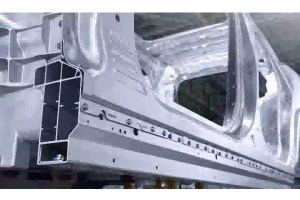 Engineering DesignHow to Choose an Aluminium Extrusion Profile: The Three Decisions That Bind
 Engineering DesignExtruded vs Die-Cast Aluminium Corner Brackets
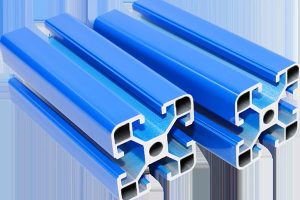 Engineering DesignPrecision Cutting and Tapping of Aluminium Profiles: The Tolerance That Actually Matters
 Materials and EngineeringIndustrial Aluminum Profiles: Alloys, Tempers and How to Select Them
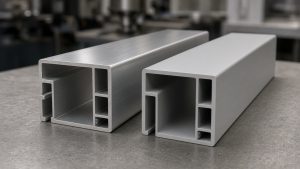 Quality and InspectionAnodising vs Powder Coating: Thickness, Colour, Salt Spray
 Materials and EngineeringAnodised vs Powder Coated Aluminium Profiles: A Specification Guide for European Buyers
 Materials and EngineeringAluminum Extrusion Tolerances: How to Write a Specification Your QC Team Can Actually Inspect