How to Anchor Aluminium Profile Frames
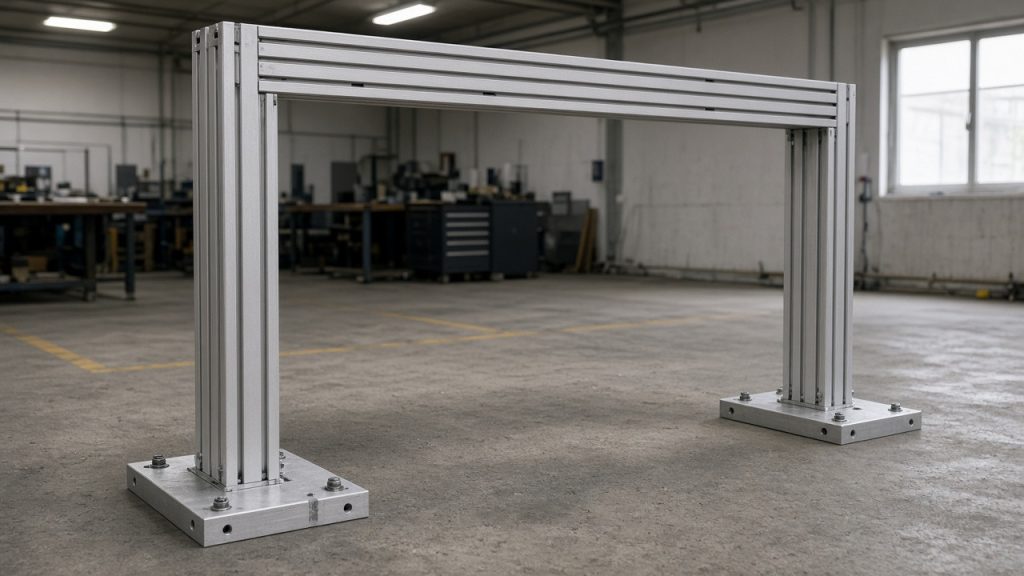
An OEM building overhead Cartesian gantry frames from 80×80 and 45×90 aluminium profiles has a side-load problem that a screw-in nylon foot will not solve. During rapid X-Y deceleration the legs see a high overturning moment, and the enquiry is clear: the legs must be bolted to the concrete slab, not left standing on friction. The request is for about 600 base plates, 12 mm to 16 mm thick, with external Ø13 mm ears for M12 anchors, and a version with a central M16 or M20 thread that still spreads the load under 40×80, 80×80, 90×90 and 45×90 legs. Those are buyer terms; the catalogue answers them with a drilled end plate, listed thickness that stops at 15 mm, and a custom outline wherever the ear, the boss or the section sits outside a published SKU.
Short answer
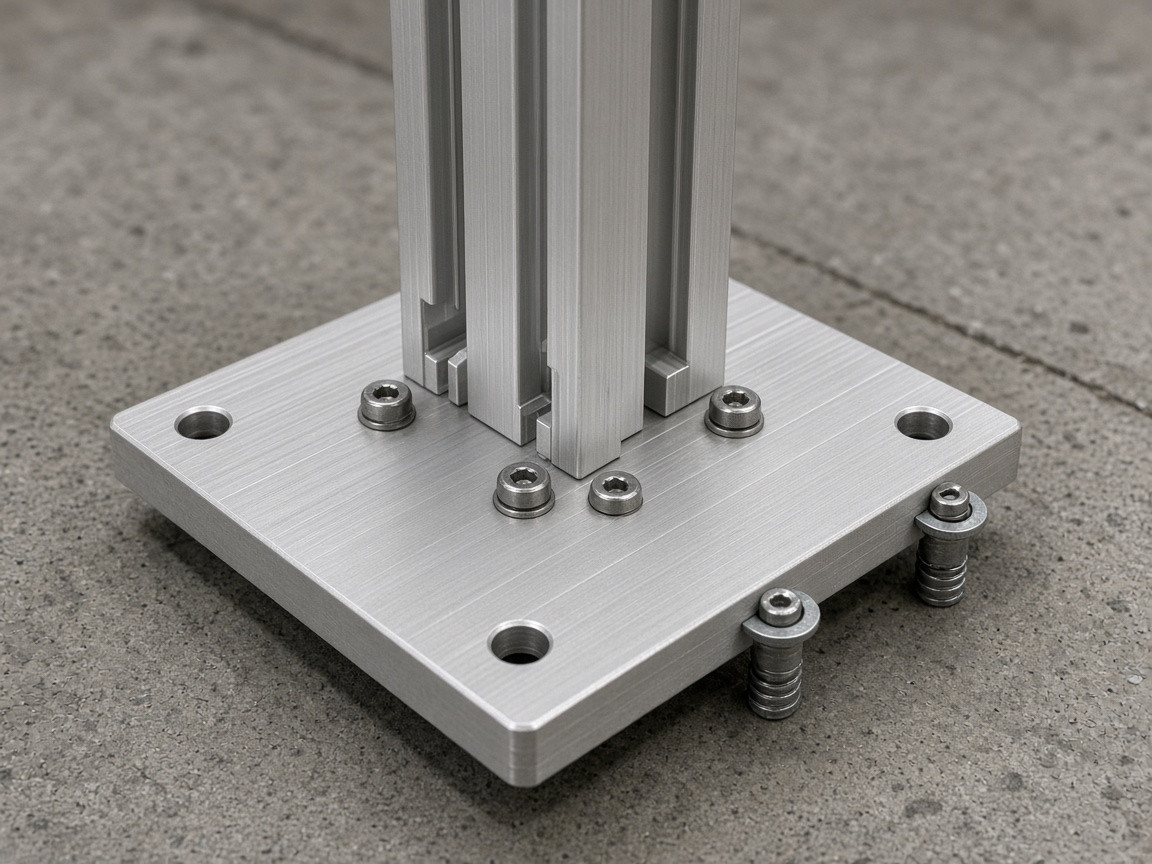
A plain levelling foot levels the frame; it does not give the floor a bolt path against overturning or walking. The listed floor plate is GP-FE-BPL-01 (BPL-40-200): a drilled 6063-T5 aluminium or S235 steel plate, 40×40 to 200×200 mm, in 6 / 8 / 10 / 12 / 15 mm, with a hole pattern matched to the end taps (M6–M12) and two or four holes for M8–M16 floor anchors. Size the plate from the floor, not the leg. On the published 1,200 kg worked example, three of four legs carry the load, so each leg is 400 kg; a screed at 0.5 N/mm² needs about 8,000 mm² — a 90×90 mm plate — while a structural slab at 5.0 N/mm² needs only 800 mm². Published thickness stops at 15 mm (12–15 mm for heavy or anchored legs); 16 mm is to drawing. Protruding Ø13 mm ears for M12 anchors are not a named BPL geometry — Ø13 mm appears on the holed swivel foot and on the 60-series L-base — so an ear-flange plate for 80×80, 45×90 or 90×90 is a custom outline. A central M16 or M20 boss is a listed option, thread cut to the drawing; it lives in the plate, not in the published Ø12 mm M14 centre bore of a square 80×80 profile. 90×90 is a custom plate (outside the published 30×30 to 80×80 fit, still within 40–200 mm); 45×90 needs a custom hole pattern. Quote 600 plates per type, not as one mixed line. We do not publish a seismic certificate, a pull-out rating in kN, or a Eurocode figure.
Size the plate from the floor, not the leg
The plate size is set by the floor bearing pressure after the three-leg rule, not by the section of the leg.
A slim 80×80 or 40×80 leg concentrates the frame load into the profile end. On a heavy gantry that pressure can exceed what a screed, a raised access floor or a coated finish will take without deforming. A drilled plate bolted to the end taps turns that point load into a distributed one and doubles as the surface the frame is anchored to. Floors are never perfectly flat, so one leg on a four-leg frame usually carries little or nothing: the published rule is to size on three of the four legs carrying the whole load.
The worked example published is a 1,200 kg frame: 1,200 kg ÷ 3 = 400 kg per leg. Divide that load by the bearing pressure the floor will accept, and you have the minimum plate area. The figures below are that published example, not this enquiry’s mass.
| Floor type | Safe bearing pressure | Plate for a 400 kg leg |
|---|---|---|
| Structural concrete slab | 5.0 N/mm² | 40×40 mm — any plate works |
| Screed over slab | 0.5 N/mm² | 90×90 mm (about 8,000 mm²) |
| Raised access floor | 0.3 N/mm² | 115×115 mm or a spreader beam |
| Timber deck | 0.15 N/mm² | 165×165 mm or a load-spreading beam |
| Coated / epoxy finish | Check the coating | Plate plus a bonded rubber or nylon pad |
Thickness is about stiffness, not only strength: a thin plate flexes and lets the leg settle. The published BPL steps are 6 mm for light frames, 8–10 mm for general machine frames, and 12–15 mm for heavy or anchored installations. The listed table stops at 15 mm; a 16 mm plate, which the enquiry asked for alongside 12 mm, is quoted from the drawing. Hole positions are held to ±0.2 mm; thickness to ±0.15 mm. Undrilled plates can be supplied for an unusual site-drilled layout, with the drilling faces left uncoated.
Five landings for a T-slot leg: plate, boss, holed foot, L-base and gusset
Flange or ear holes exist so a tall or side-loaded frame can be anchored against overturning and walking; a plain levelling foot cannot do that job on its own, and a plate with an integral threaded boss is what converts a slim profile into a large-stem foot while a plain plate stays at fixed height.
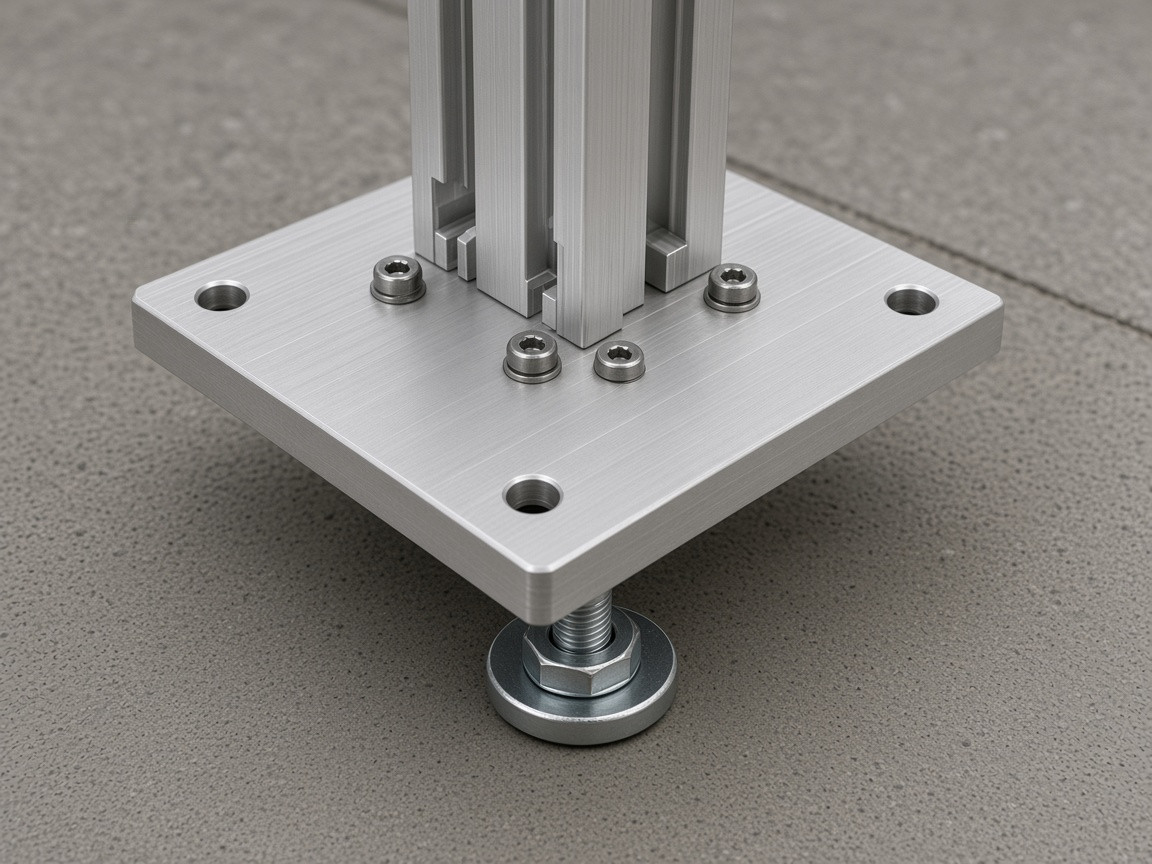
A plain BPL plate is fixed height and can be drilled for floor bolts. The same family has an integral threaded-boss option, so the frame gets load spreading and levelling in one part; the thread is quoted from the drawing, and there is no published M16 / M20 boss chart. Where the buyer wants to level and then bolt through the pad, the part is a swivel foot with mounting holes (GP-FE-SFH-01), not a plate. The SFH page mentions frames in seismic locations as a use case; that is not a tested seismic rating, and we will not invent a pull-out figure in kN.
| Landing | Listed part | What it does | What it is not |
|---|---|---|---|
| Plain drilled plate | GP-FE-BPL-01 | Spreads load; 2 or 4 holes for M8–M16 anchors | Fixed height; 16 mm and ear flanges are to drawing |
| Plate with threaded boss | BPL-01 option | Spreads load and takes a levelling-foot stem | Thread from the drawing, not a stock M16 / M20 SKU |
| 40×80 gasket plate | GP-FE-BP48-01 | 80×120 mm, 4×Ø11 mm for M10, EPDM seal | Not for 40×40; holes are Ø11, not Ø13 for M12 |
| Holed swivel foot | GP-FE-SFH-01 | Levels, then bolts through the pad | Not a base plate; no seismic certificate |
| L-base bracket | GP-FE-LBB-01 | Fixes to the side of the leg; retrofit or raking | Fixed height; does not replace a levelling foot |
| Gusseted base angle | GP-FE-BAB-01 | Stiffens the base corner | Does not replace a floor plate |
| Foot mounting plate | GP-FE-FMP-01 | Castor interface; M12 / M16 boss option | Not a floor plate |
The L-base earns its place when the end face is already used, the leg is raking, or the frame has to be anchored without being dismantled. It is 6063-T5 or S235, with a stainless option; published floor holes include Ø13 mm on the 60 series. Pull-out can be calculated from the tipping moment as a custom note; we will not invent a kN figure here. A gusseted base angle raises corner stiffness and does not replace a floor plate. A fixed foot (GP-FE-FFB-01) is the no-thread alternative, with a drilled-base variant for a set height.
Do not confuse the floor plate with GP-FE-FMP-01. That part is a castor and levelling-castor interface — a 60×60 or 100×100 mm underside pattern, or an M12 / M16 boss, in 6–12 mm — used when a frame must accept a levelling castor or a later change of foot. It is not the part that anchors a gantry leg to a slab.
What is listed for 40×80 and 80×80, and what 45×90 and 90×90 require
A 40×80 leg has a listed gasketed plate; an 80×80 leg sits inside the published BPL fit; 45×90 and 90×90 are quoted from the drawing.
GP-FE-BP48-01 is the 40×80 plate, and only that section: 80×120 mm, 8 mm standard or 10 mm heavy, 4×M8 end taps and 4×Ø11 mm holes for M10 anchors, in 6063-T5, anodised 10–15 µm or powder coated, with a 2 mm closed-cell EPDM gasket. The gasket seals the open core against water, coolant and swarf from the floor. A drain-path variant is used on a wash-down frame, because a full seal traps water that enters from above. The plate does not fit 40×40, and its holes are Ø11 mm for M10, not Ø13 mm for M12. If the 40×80 lines in the mix need M12 anchors or protruding ears, that outline is to drawing, not a hidden BP48 option.
An 80×80 square leg is inside the published BPL fit of 30×30 to 80×80 mm and rectangular sections, with a hole pattern matched to the end taps (M6–M12) and two or four holes for M8–M16 anchors. A protruding-ear flange with Ø13 mm holes is not a named BPL geometry. Ø13 mm does appear on the SFH M16 × 80 mm pad (4×Ø13 mm for M12) and on the 60-series L-base (3×Ø13), so an ear-flange plate for 80×80 is a custom outline from the drawing, still within the 40×40 to 200×200 mm plate-size range.
A 90×90 square leg sits outside that published 30×30 to 80×80 fit, but still within the 40–200 mm plate-size range, so we will cut a custom plate rather than list a stock 90×90 SKU. A 45×90 rectangular section can use the same family — BPL is described as fitting rectangular sections — but the hole pattern must come from the drawing. Do not send an M16 or M20 stem into the published Ø12 mm M14 centre bore of a square 80×80 profile: the boss lives in the plate. BPL is 6063-T5 aluminium plate or S235 steel, anodised 10–15 µm, powder coated, or zinc-plated. It is not advertised as die-cast — that is the ADC12 base angle or the fixed foot — and it is not listed as 6061 or as CNC-only, even though the outline and holes are CNC machined.
Level and square first, then anchor — and how 600 plates are quoted
Confirm the end taps, bed the plate, tighten diagonally and set the anchors last, after the frame is level and square; then quote the 600-piece mix per type, not as one line.
The published installation sequence is the one that fails when it is reversed. Confirm the end taps — M6, M8 or M10, and the spacing — before the plate is drawn. Fit the plate to the leg and set the frame down; on an uneven floor, bed it on a thin grout or a shim pack so it does not bridge a hollow. Tighten the leg bolts diagonally in two passes, then drill and set the anchors only after the frame is level and square. Anchor last. The same order applies to an L-base: set the anchors, then tighten the slot bolts last so the bracket does not pre-load the leg out of square.
Buyers type “seismic load spreading” when they mean a tall frame that must not walk or tip under side load. Load spreading is the bearing-pressure arithmetic above; anchoring is the bolt path through the plate, the L-base or the holed foot. We do not publish, and will not invent, a seismic certificate, a pull-out rating in kN, or a Eurocode figure. A calculated pull-out from the tipping moment is a custom note, not a catalogue rating.
Send this and the first quote is usable
- Floor build-up (slab, screed, raised access, timber or a coated finish) and the loaded frame mass, so the three-leg calculation can be run on the actual floor.
- The 600-piece mix by leg — how many 40×80, 80×80, 90×90 and 45×90 — with the end-tap size and spacing for each, as separate lines.
- Whether each type needs anchor holes, a protruding-ear outline, an integral threaded boss (and the matching M16 or M20 stem), or both; and whether 12–15 mm listed thickness is enough, or 16 mm is required from the drawing.
- Drawings in DWG, DXF, STEP, IGES or PDF. Custom size, thickness, hole pattern and boss are quoted from the drawing. A floor-bearing calculation is free of charge.
We do not publish a lump-sum price for 600 mixed plates. Each listed type is quoted per piece in the matching 2026 USD band. For a listed GP-FE-BPL-01 size, MOQ 200, lead 15–25 days after deposit, the 200–999 band is $14.50 at the list top (1,000–4,999 $9.20; 5,000–19,999 $5.60; 20,000+ $3.70; range $0.85–$14.50 / pc). Six hundred pieces of one listed BPL size sit in that band; the actual piece price still depends on size and thickness, so a 40×80 line, an 80×80 line and a custom 90×90 or 45×90 line are not one number. GP-FE-BP48-01, also MOQ 200, lead 15–25 days, is 200–999 $6.20; 1,000–4,999 $3.90; 5,000–19,999 $2.45; 20,000+ $1.60 (range $1.60–$6.20 / pc). L-base and base-angle brackets, if they share the order, have a MOQ of 500. Custom ear-flange outlines, 16 mm plates and M16 / M20 bosses are to drawing.
Related on this site
- Aluminium profile base plate GP-FE-BPL-01 — 40×40 to 200×200 mm, 6–15 mm
- Base plate 40×80 with gasket GP-FE-BP48-01 — 80×120 mm, Ø11 mm for M10
- L-base corner bracket GP-FE-LBB-01 — side-of-leg anchoring, including retrofit
- Base angle bracket GP-FE-BAB-01 — stiffens the corner; not a floor plate
- Swivel foot with mounting holes GP-FE-SFH-01 — level, then bolt through the pad
- Foot mounting plate GP-FE-FMP-01 — a castor interface, not a floor plate
- How do you mount levelling castors on T-slot legs? — when the frame must also roll
- How do you brace a tall T-slot frame? — for the rest of the overturning path
Terms used
- Three-leg rule
- Size a four-leg frame as if three legs share the total load, because an uneven floor unloads one leg.
- Floor bearing pressure
- The pressure the floor will take without deforming; it sets the plate area.
- Integral threaded boss
- A listed BPL option that takes a levelling-foot stem in the plate, thread from the drawing.
- Ear or flange hole
- A hole, sometimes on a protruding outline, for a floor anchor. Ø13 mm ears are not a named BPL geometry.
- Foot mounting plate
- GP-FE-FMP-01, a castor interface, not a floor plate.
- Holed swivel foot
- GP-FE-SFH-01. A pad that can be bolted down; not a base plate, and not a seismic rating.
Questions buyers ask
Do you supply 12–16 mm CNC or die-cast plates with Ø13 mm ears for M12 anchors?
Published BPL thickness is 6 / 8 / 10 / 12 / 15 mm (12–15 mm for heavy or anchored legs). 16 mm is to drawing. BPL is 6063-T5 plate or S235 steel, not die-cast. Protruding Ø13 mm ears are not a named BPL geometry; an ear-flange outline is quoted from the drawing.
Do you have a version with a central M16 or M20 threaded hole that still spreads the load?
Yes, as a listed option, not as a published boss-size SKU table. The thread on the GP-FE-BPL-01 boss is cut to the drawing so it can match an M16 or M20 stem, and the boss lives in the plate, not in the Ø12 mm M14 centre bore of a square 80×80 profile.
How do I size a base plate for a 1,200 kg gantry on four legs?
Use the published three-leg rule: 1,200 kg ÷ 3 = 400 kg per leg, then divide by the floor’s bearing pressure. The product-page example is 90×90 mm on a 0.5 N/mm² screed and 800 mm² on a 5.0 N/mm² slab. Send the actual floor build-up and frame mass; 1,200 kg is the published worked example, not this enquiry’s mass.
Can a plain levelling foot be bolted to the slab on its own?
Not if it has no holes and no plate: it levels the frame and then relies on friction. To bolt through the pad, use GP-FE-SFH-01. To spread load and anchor the frame, use a drilled BPL plate, a plate with a boss plus anchors, or an L-base.
Does a base angle bracket or an L-base replace a floor plate?
A gusseted base angle does not: it only stiffens the corner. An L-base can stand in for a separate end plate when the end face is unavailable, the leg is raking, or the frame is retrofitted, but it is fixed height and does not replace a levelling foot.
Is a 90×90 or 45×90 base plate a stock item?
No. 90×90 is a custom plate, still within the 40–200 mm plate-size range. 45×90 needs a custom hole pattern. The listed 40×80 plate is GP-FE-BP48-01, 80×120 mm.
What does 600 base plates cost?
We do not publish a lump-sum for a mixed 600-piece order. Quote each type in its 2026 USD band: a listed BPL size, MOQ 200, sits at $14.50 list-top in the 200–999 band; BP48 is $6.20 in that band. Custom 90×90, 45×90, 16 mm, ear-flange and M16 / M20 boss plates are to drawing.
Also searched as: aluminium profile base plates, floor mounts, flange mounts, seismic load spreading, ear-flange M12 expansion bolts, M16 M20 threaded boss levelling foot, 40×80 80×80 90×90 45×90 gantry legs, T-slot machine legs bolted to concrete
Send the floor build-up, the leg mix and the drawings
Give us the floor construction, the loaded frame mass, the 600-piece mix by 40×80, 80×80, 90×90 and 45×90, and whether each type needs anchor holes, an ear-flange outline, a threaded boss, or 16 mm from the drawing. We will size the plates for the floor and return FOB pricing against the 2026 bands or the drawing.
Request a base-plate quoteRelated reading
Twelve more engineering notes from this blog, picked for this article — plus every category below.
 ApplicationsAluminium Workstations: From Fixed Benches to Reconfigurable Cells
 Engineering DesignT-Slot Cross-Brand Compatibility: Bosch, Item and Generic
 Engineering DesignHow to Choose an Aluminium Extrusion Profile: The Three Decisions That Bind
 Engineering DesignModular Safety Fencing for Robot Cells
 Engineering DesignWall Thickness Is Not a Strength Decision. It Is an Extrudability Decision.
 ApplicationsAluminium Profiles Across Industries: What Actually Changes From One Sector to the Next
 ApplicationsAluminium Conveyor Frames: Why Belt Tracking Is a Geometry Problem
 ApplicationsT-Slot End Caps, Slot Covers and Panel Edging
 Materials and EngineeringAluminum Extrusion Tolerances: How to Write a Specification Your QC Team Can Actually Inspect
 Quality and InspectionGood vs Bad Aluminium Profiles: What Your Receiving Dock Can and Cannot Check
 Materials and EngineeringRecycled Aluminium Profiles: A Number You Have to Be Able to Evidence
 Materials and EngineeringDie-Cast Aluminium Corner Brackets Guide