How to Mount Levelling Castors on T-Slot Legs
A European or North American OEM is uncrating a 600 kg precision station — a laser marking cell, an automated test bench or a CNC enclosure — built on a metric T-slot aluminium frame. The legs are 40×40, 40×80 and 80×80. The job is to roll the frame out of the crate, position it on the line, then wind the pads down so the wheels are clear of the floor and the parked load is not sitting on rubber. The enquiry asked for four Footmaster-style levelling castors, named GD-60, GD-80 and GD-100, and wanted ratchet-lever versus thumbwheel adjustment, stem versus adapter-plate mounting, and a dynamic-versus-static selection on the three-point support rule. Those brand and model names are not listed SKUs on this site; the arithmetic and the mounting routes below use only the published GrownParts catalogue.
Short answer
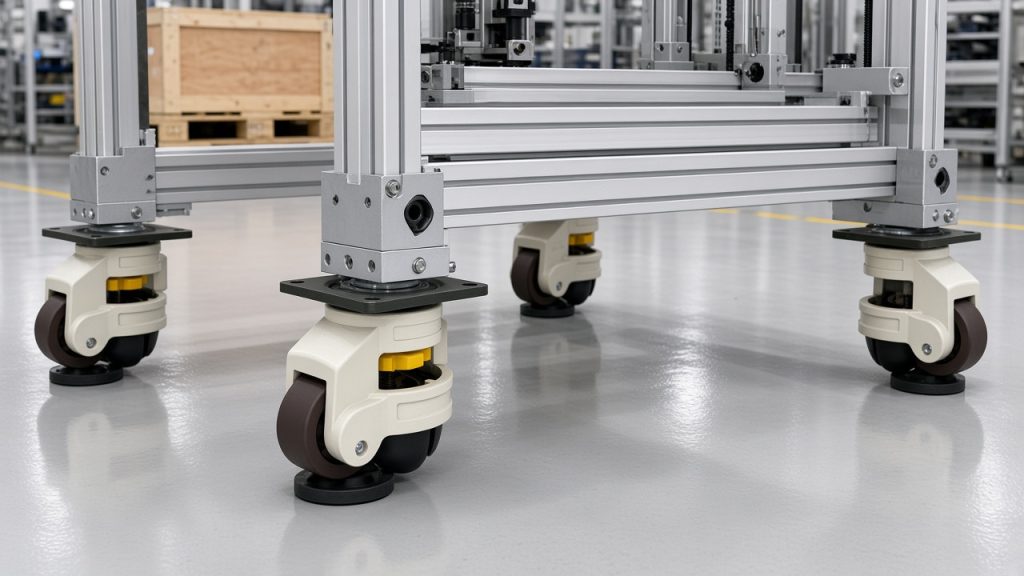
We do not catalogue a Footmaster brand or a GD-60, GD-80 or GD-100 SKU. Those names are the buyer’s shorthand for a combined wheel-and-pad levelling castor. The listed unit is GP-FE-LVC-01 (LVC-P50, LVC-P75, LVC-P100 and LVC-P125). For a 600 kg loaded frame on four units, design as if three share the load: 600 kg ÷ 3 = 200 kg per unit with the pads down. The smallest listed pad-down rating is 300 kg on the 50 mm unit, which covers that parked figure; the wheel rating that applies while the frame is moving is not published per LVC size and has to come back with the quote. The published adjustment is the adjustment nut; a ratchet lever or a thumbwheel is quoted to drawing, not as a stock code. An M12 or M16 stem does not go into the published Ø12 mm M14 centre bore on 40×40 or 80×80; the listed stem routes are a tapped block in the leg, or the M12 / M16 threaded boss on GP-FE-FMP-01. The plate route through that foot mounting plate is the usual one on a standard 40-series or 45-series leg. FMP’s standard mapping covers 40, 45 and 60 series and 40×80; a square 80×80 adapter plate is to drawing.
Sizing four levelling castors for a 600 kg frame
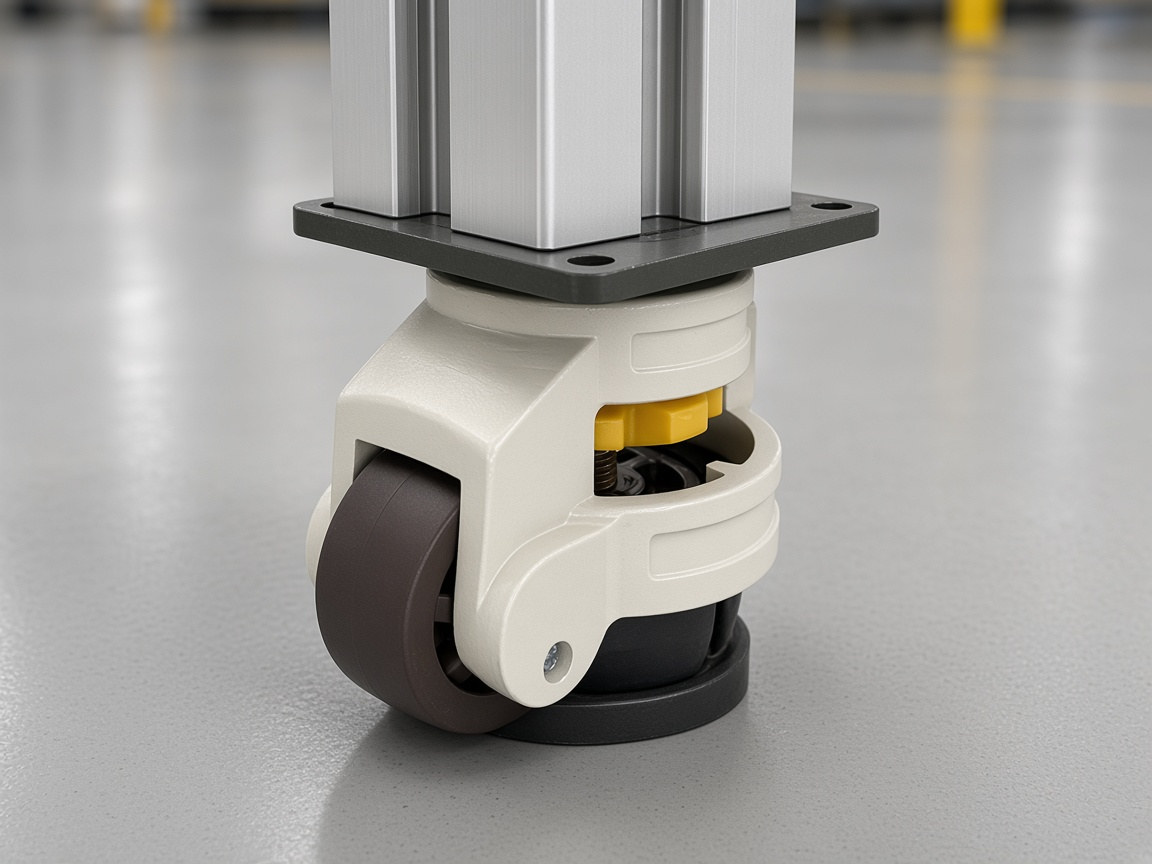
On a 600 kg frame with four levelling castors, the published three-castor rule sets the parked design load at 200 kg per unit; every listed LVC pad-down rating covers that figure, and the moving case has to be confirmed against the wheel rating, which is not listed per size.
The number on a castor is a static laboratory rating. Floors are never perfectly flat, so one unit on a four-castor frame usually carries little or no load while the diagonally opposite one carries double. The standard safe rule, published on the aluminium profile castors page, is to design as if three units share the total weight: 600 kg ÷ 3 = 200 kg per unit, compared with the GP-FE-LVC-01 pad-down ratings, which apply static and with the pad wound down. They are not rolling ratings, and they are not GD-60, GD-80 or GD-100 equivalents.
| Wheel Ø | Pad travel | Load per unit (pad down) | Overall height | Typical use (as published) |
|---|---|---|---|---|
| 50 mm | 12 mm | 300 kg | 85 mm | Light workstations and benches |
| 75 mm | 15 mm | 500 kg | 110 mm | Assembly benches and kit carts |
| 100 mm | 18 mm | 700 kg | 135 mm | Machine frames and heavy benches |
| 125 mm | 20 mm | 1,000 kg | 160 mm | Heavy machinery and gantries |
The 50 mm unit’s published pad-down rating is 300 kg, which covers the 200 kg parked figure. That is the parked case only. While the frame is being moved, the load is on the wheel, and the wheel rating applies instead. Per-size wheel ratings are not published for LVC-P50 to LVC-P125, and the 60–300 kg configuration loads on the plain-castor page must not be assigned to LVC sizes. Confirm the moving-case wheel rating with the quote. If the station is pushed at speed, a walking-pace rating falls by roughly a third over an expansion joint, so the catalogue rating must sit above the 200 kg three-castor figure after that approximate reduction. That is published CAS guidance, not a tested LVC dynamic table.
What 1.5× is not
The static inspection at 1.5× rated load, pad down, is a factory test, not a selection formula. The arithmetic for this frame is 600 kg ÷ 3 = 200 kg parked, then a separate check of the unpublished wheel rating for the moving case.
GP-FE-LVC-01 stands 85–160 mm overall and adds about 35 mm compared with a plain castor of the same wheel size. A foot mounting plate adds typically 6–12 mm. Take both off the leg length at the design stage. We do not publish a residual wheel-to-floor clearance, a wheel-flex millimetre, or an isolation natural frequency. Floor clearance is the published pad travel — 12, 15, 18 or 20 mm by size — and the statement that the wheel is lifted clear.
The adjustment nut, the pad and the wheel — and what is only to drawing
The listed changeover is done with the adjustment nut, corner by corner, until the pad takes the load and the wheel lifts clear; a ratchet lever or a thumbwheel is a to-drawing actuator, not a catalogue SKU, and it does not change the published pad-down ratings.
Wind the pad up and the frame runs on the swivel wheels. Push the station into place, then turn the adjustment nut on each unit until the pad contacts the floor and the wheel lifts clear, working corner by corner and checking the level as you go. Fine-tune once all four pads are down. Wind the pads up before moving again. No tools are needed, and the pads stay with the frame. Do not drag the frame with the pads down.
In industry language, a ratchet lever speeds pad travel on a heavy unit, and a thumbwheel is finer and slower. GrownParts does not list a lever or thumbwheel levelling-castor SKU, and we will not invent lever ratios, handle lengths or thumbwheel diameters. Either actuator is quoted to drawing. It does not create a GD-series equivalent or a new published pad-down capacity. Brakes are not needed for parking once the pads are down; they are still useful while the frame is being moved and positioned.
A polyurethane wheel is the default: quiet, non-marking, resistant to oil and swarf, and suited to epoxy, vinyl and painted floors. A nylon wheel takes a higher load for its diameter and has the lowest rolling resistance, at the cost of more noise and less tolerance of an uneven floor. A nylon pad is the standard pad and does not mark a coating; on a very smooth floor it can slide under a heavy side load, in which case a rubber pad is used. A rubber pad has higher friction and damps vibration slightly better than nylon. The listed pad materials are nylon or rubber; we do not publish an NBR compound on the LVC or CAS pages, and we will not claim one here. If the station will spend most of its life parked, and vibration matters more than rolling, a swivel ball foot (GP-FE-SBF-01) has no wheel: the PA6 nylon base does not mark floors and damps vibration, with a 10–15° ball joint to keep the pad flat.
Stem versus adapter plate on 40×40, 40×80 and 80×80
The listed ways to put an LVC under a T-slot leg are a plate mount — directly if the bolt patterns already match, or through GP-FE-FMP-01 — or a thread stem into a tapped block or into the FMP M12 / M16 boss; the published Ø12 mm M14 centre bore on 40×40 and 80×80 is not a listed stem seat.
GP-FE-LVC-01 mounts on a 60×60 or 100×100 mm plate, or on an M12 or M16 thread stem. A 40×40 leg and a square 80×80 column (and the heavy 80×80) have a 12 mm centre bore tapped M14, so an M16 stem will not enter and an M12 stem is not the M14 tap. The listed stem routes are a machined or tapped block in the leg, or the M12 / M16 threaded boss on the foot mounting plate. On a standard 40-series or 45-series leg, the plate route through FMP is almost always the simpler one.
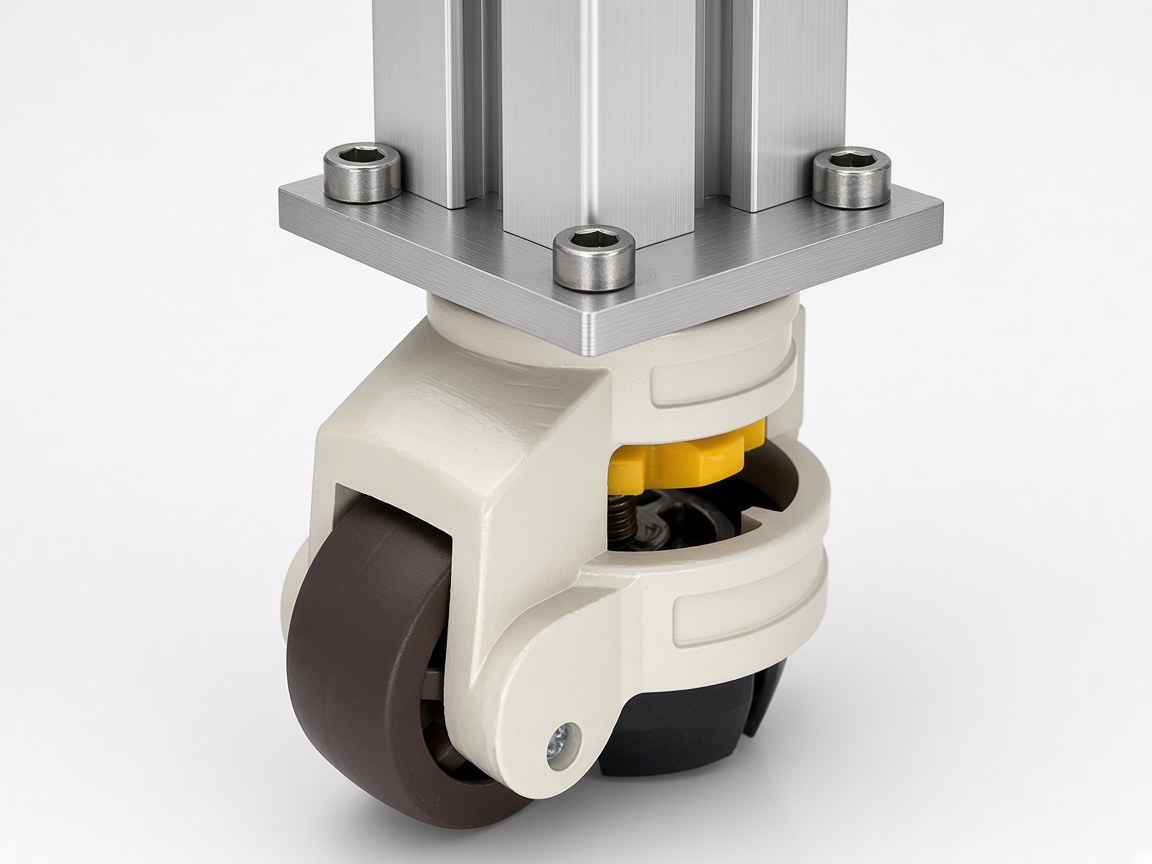
On 40×40, the published FMP plate is 80×80 mm on four M8 end taps, with a 60×60 mm pattern (four Ø9) underneath — the 40-series plate shown above. On 40×80, it is an 80×120 mm plate with a 60×60 mm pattern centred. The heavy 40×80 six-slot section lists a typically 14 mm centre bore for through-bolts or location, not a published M12 or M16 tap. A square 80×80 column has no row in the FMP mapping; that adapter is to drawing. We will not invent a four-M8 spacing for 80×80 as a stock plate, and the square column is not the R90 L-section 80×80 corner profile.
If the LVC plate pattern already matches the profile end taps, the mounting plate is redundant. Otherwise bolt the plate to the leg first, then fit the castor, and confirm that the swivel head clears the plate edge through a full rotation. Thickness is set by the castor load, not by the profile: 6 mm light, 8 mm general, 10–12 mm heavy. A thin plate flexes between the four bolts and lets the castor tilt and bind. We publish no shear stress in MPa and no eccentric moment in N·m. A larger swivel offset steers more easily but raises the frame slightly and increases the overturning moment on the plate.
| Mounting route | Listed condition | Height added | What to watch |
|---|---|---|---|
| Plate via GP-FE-FMP-01 | 40, 45 and 60 series and 40×80 | LVC height plus 6–12 mm plate | Four M8 end taps on 40 and 40×80; four M10 on 60. Set thickness so the plate does not flex. Check swivel clearance. |
| Direct plate, no FMP | Only if the LVC pattern already matches the end taps | LVC height only | The mounting plate is then redundant. |
| Stem into a tapped block | Leg ends in a machined or tapped block, M12 or M16 | LVC height (stem) | A listed stem route. The block must be solid enough to take the thread. |
| Stem into the FMP M12 / M16 boss | FMP threaded-insert row: 80–100 mm plate with a boss | LVC height plus plate | A listed stem route. A combined underside accepts a plate-mount or a stem unit. |
| Stem into the profile centre bore | Not a listed method | — | Published bore on 40×40 and 80×80 is Ø12 mm tapped M14. M16 will not enter; M12 is not M14. |
| Square 80×80 adapter plate | To drawing — no row in the standard FMP mapping | LVC height plus the agreed plate | Custom top pattern, thickness and boss from the drawing. Not a listed stock plate. |
FMP plates are aluminium 6063-T5 or S235 steel; LVC brackets are zinc-plated steel, with a stainless option. A custom 80×80 plate is dimensioned on the drawing that accompanies the quote.
Four points to settle before the OEM order
Send the loaded mass and how the frame is moved, the leg ends and the height budget, the wheel and pad materials, and the drawings; we will quote LVC and, where needed, FMP per type in the 2026 bands, and anything outside the list to drawing.
Send this and the first quote is usable
- Total loaded mass, including the frame, and whether the station is only positioned or is pushed at speed — that sets the 200 kg parked figure on this 600 kg enquiry, and whether the unpublished wheel rating must be derated.
- Each leg section (40×40, 40×80 or 80×80) and its end condition: open, end taps, or a tapped block. Include the height budget for the LVC stack (85–160 mm overall, about 35 mm more than a plain castor of the same wheel) plus the plate, typically 6–12 mm.
- Wheel and pad material against the floor — polyurethane or nylon wheel; nylon or rubber pad — and whether a ratchet-lever or thumbwheel actuator is required (to drawing).
- Drawings in DWG, DXF, STEP, IGES or PDF, and whether samples are required. Per-part CAD is supplied on request; downloads are range PDFs, not a public library of an unlisted Footmaster copy. Design the mounting plate in at the start so one cut list can build a fixed, levelling or mobile version of the same frame.
We do not publish a lump-sum price for a four-castor set on a 600 kg machine. LVC is quoted per piece, MOQ 100, in the 2026 USD list: 100–499 pcs $28.00; 500–1,999 $19.50; 2,000–4,999 $13.80; 5,000+ $9.60 (range $6.50–$28.00 / pc), lead 20–30 days after deposit. FMP is a separate line, MOQ 200: 200–999 $9.80; 1,000–4,999 $6.10; 5,000–19,999 $3.70; 20,000+ $2.40, lead 15–25 days. Custom 80×80 plates and lever or thumbwheel actuators are to drawing. Samples and OEM or ODM marking are available.
Related on this site
- Levelling castor GP-FE-LVC-01 — LVC-P50 to P125, pad-down ratings 300 to 1,000 kg
- Foot mounting plate GP-FE-FMP-01 — 40, 45, 60 and 40×80 mapped; 80×80 to drawing
- Aluminium profile castors GP-FE-CAS-01 — the three-castor rule, not LVC wheel ratings
- Swivel ball foot GP-FE-SBF-01 — a parked foot, no wheel
- What is a 40×40 aluminium profile? — Ø12 mm centre bore tapped M14
- What is a 40×80 aluminium profile? — used with the 80×120 mm FMP plate
- How do you design a T-slot workbench frame? — including the height budget at the legs
- From a fixed bench to a reconfigurable workstation — when a frame has to move between jobs
- How do you join aluminium profiles? — end taps and joints above the foot
- Building with T-slot aluminium — frames, fences and workbenches
Terms used
- Pad-down rating
- The published static load per LVC unit with the pad wound down. Not a rolling or wheel rating.
- Three-castor rule
- Size a four-castor frame as if three units share the total load, because an uneven floor unloads one unit.
- Adjustment nut
- The published actuator on GP-FE-LVC-01. A ratchet lever or thumbwheel is to drawing, not a listed SKU.
- Foot mounting plate
- GP-FE-FMP-01. Standard mapping covers 40, 45, 60 and 40×80, not a listed square 80×80 plate.
- Centre bore
- The published Ø12 mm bore tapped M14 on 40×40 and 80×80. Not a listed M12 or M16 stem seat.
Questions buyers ask
Do you supply Footmaster or GD-60, GD-80 and GD-100 levelling castors?
No. Those names are not listed SKUs on grownparts.com. The listed levelling castor is GP-FE-LVC-01 (LVC-P50, LVC-P75, LVC-P100 and LVC-P125). We will not publish a GD-to-LVC cross-reference table as if it were a catalogue equivalent.
Can I screw an M12 or M16 stem into the centre bore of a 40×40 or 80×80 leg?
Not as a listed method. The published centre bore is Ø12 mm tapped M14. The listed stem routes are a tapped block in the leg, or the M12 / M16 threaded boss on GP-FE-FMP-01. On a standard 40-series or 45-series leg, the plate route is usually simpler.
How do I size four levelling castors for a 600 kg aluminium machine frame?
Use the published three-castor rule: 600 kg ÷ 3 = 200 kg per unit parked, pads down. The smallest listed LVC pad-down rating is 300 kg on the 50 mm unit, which covers that figure. While the frame is moving, the unpublished per-size wheel rating must be confirmed with the quote. If the frame is pushed at speed, a walking-pace rating falls by roughly a third; that is published CAS guidance, not a tested LVC dynamic table. The 1.5× static inspection is a factory test, not a selection formula.
Do you have a ratchet-lever or thumbwheel levelling castor, and does it change the load or the floor clearance?
No listed lever or thumbwheel SKU. The published adjustment is the adjustment nut. Either actuator is quoted to drawing and does not create a new pad-down rating. Floor clearance is the published pad travel of 12–20 mm, with the wheel lifted clear.
Is there a standard mounting plate for a square 80×80 column?
No. The published FMP mapping covers 40, 45 and 60 series and 40×80. An 80×80 column adapter is to drawing.
Do I still need brakes on levelling castors?
Not for parking, once the pads are down and the wheels are clear. Brakes are still useful while moving. Wind the pads up before moving again.
What does a set of four levelling castors cost for this 600 kg machine?
We do not publish a lump-sum price for a four-castor set. LVC and FMP are quoted per piece in the 2026 USD bands (LVC MOQ 100; FMP MOQ 200). Custom 80×80 plates and lever or thumbwheel actuators are to drawing.
Also searched as: Footmaster-style levelling castor, GD-60 GD-80 GD-100, T-slot levelling casters, ratchet or thumbwheel levelling castor, stem versus adapter plate on 40×40 40×80 80×80, three-point support rule, pad-down versus rolling load on a 600 kg frame
Send the loaded mass, the leg ends and the height budget
Give us the total loaded mass and whether the frame is pushed at speed or only positioned, each leg section and end condition, the height stack, the wheel and pad materials, and whether a lever or thumbwheel actuator is required. We will confirm GP-FE-LVC-01 and, where needed, the FMP plate, and return FOB pricing against the 2026 bands or the drawing.
Request a levelling-castor quoteRelated reading
Twelve more engineering notes from this blog, picked for this article — plus every category below.
 ApplicationsHow to Choose the Right 4040 T-Slot Aluminium Profile for Industrial Applications
 Engineering DesignWhat Is a 2020 Aluminium Profile? (Weight, Slot and Load)
 Engineering DesignAluminum vs Steel Machine Frames: Choose by Deflection, Not by Strength
 Engineering Design6061-T5 vs 6063-T5: What the Temper Label Really Decides
 Engineering DesignAluminium Profile Sizes 20 × 20 to 100 × 100: What Fails First
 ApplicationsHow Strong Is an Aluminium Profile? It Depends on How You Fix It
 ApplicationsAluminium Profile Shelving: It Buckles and Tips Before It Bends
 ApplicationsAluminium Profiles Across Industries: What Actually Changes From One Sector to the Next
 Sourcing and ProcurementAluminium Profile Quote: What Changes the Number by Quantity
 Sourcing and ProcurementAluminium Profile Shipping: Packing, Container Loading and ISPM 15
- Quality and InspectionGlobal Sourcing Excellence: Multi-Category OEM and ODM Manufacturing and Supply Chain Integration
 Quality and InspectionAluminium Extrusion Certificates and Standards Explained (EN 755, EN 12020, ISPM 15)